7 Tips For Designing Web Forms
Clutch surveyed 502 web users about what they actually want from form design. Here are 7 data-backed UX principles that reduce abandonment and improve...
Updated February 24, 2026

Goodbye marathon browsing sessions and hello agentic commerce. With a few design tweaks, your website can win over both AI shopping agents and human shoppers.
While there's something thrilling about going down the research rabbit hole and finding a fantastic deal on the 20th website, not everyone loves hopping between tabs and jotting down prices on sticky notes. For weary or busy customers, AI shopping agents can be the perfect assistants, and 70% of consumers already use them to shop online.
With agentic commerce, shoppers ask AI to research, compare, and, in some cases, even buy products. Instead of comparing dog harnesses on five different sites, a customer could ask ChatGPT, "What's the best no-pull, escape-proof harness for my greyhound?" The chatbot will curate options and even give tips for measuring the dog to find the right fit.
Looking for a Web Design agency?
Compare our list of top Web Design companies near you
AI agents aren't just changing how people shop. They're also making businesses rethink how they sell. If shoppers no longer need to visit your site — not even to check out — how can you get them to actually convert? Further, how do you ensure your products appear in AI agents' recommendations?
It starts by designing your website for both agentic commerce and traditional shoppers.
Agentic commerce uses AI agents to handle shopping tasks. For example, a customer could describe their dream living room couch ("something plushy and purple for under $800"), and the agent will buy the best match.
It might sound like something out of a sci-fi movie, but it's very real. ChatGPT now offers Instant Checkout, which lets users buy directly from Etsy sellers, with over a million Shopify merchants expected to integrate soon. Klarna and Shopify Shop also have AI-powered shopping assistants that share product recommendations and answer questions like "Do you have any Christmas sweaters with bells?"
Not only are these tools available, but consumers are also using them. In fact, 65% of consumers use AI assistants to research products before purchase, with 32% using them weekly for shopping research.
Agentic shopping begins when a customer tells the AI what they're looking for. A stressed-out mom might say, "I want to buy a cozy new bathrobe." The AI agent quickly gathers a few product options and compares features and prices. At this point, the user might refine their search with something like, "Give me leopard-print bathrobes."
Once the customer has chosen a product, the agent will confirm their selection and may even complete payment within the chat interface. With platforms like ChatGPT, that means shoppers may never visit the retailer's website.
That's very different from traditional checkout, which puts the burden on the buyer. Shoppers have to browse product pages and track price points and features themselves. Once they find what they need, they add the items to their cart and check out on the seller's website.
You might assume that people use AI shopping agents because they don't want to put much thought into their shopping, but that's not the case. These tools help customers research more effectively while saving time.
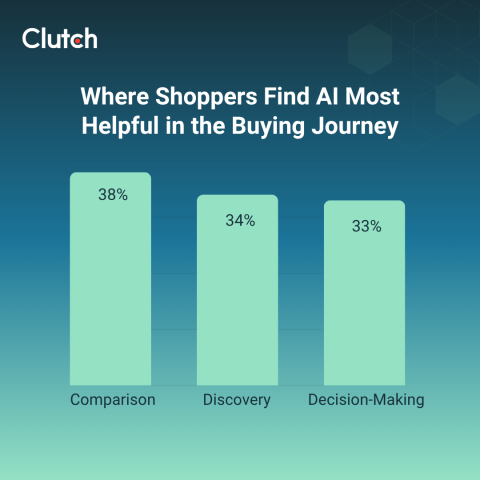
According to a Clutch survey, shoppers find AI tools most helpful during these stages of the buying journey:
Consumers turn to AI shopping assistants for the following reasons:
Commerce agents improve the online shopping journey by easing some of the mental load and helping them make informed decisions faster. Instead of bouncing between a dozen product pages to read about features, shoppers can ask AI to create a comparison chart.
Plus, AI can be a sounding board for decision-making. An Amazon product page probably won't tell you if a vacuum will pick up your golden retriever's hair, but ChatGPT can give advice.
These tools win over users because they address shortcomings in the traditional user experience. Old-school shoppers need to cross-check prices manually, which often leads to a confusing jumble of tabs. Plus, spec tables may have completely different features. AI handles the legwork by searching for and compiling all of that data.
The takeaway: Agentic shopping helps shoppers make smarter and faster decisions. It's about reducing mental effort, not creating a glossier website or smoother checkout process.
There's no right or wrong way to use AI for retail purchases. It depends on the tool and the level of assistance shoppers want.
Some platforms contain the entire customer journey inside the agent. The AI compares products and verifies the user's choice. Then it collects their payment details and checks them out, all within the same chat. The agent relies on product data to help the customer make decisions, and the shopper never actually visits the brand website.
In other cases, the AI agent is more of a recommender. It narrows down the customer's options, then sends them to the retailer's site to complete the purchase. This is a make-or-break moment for businesses. If your website is confusing or has too much friction, the shopper may second-guess the AI's decision and go somewhere else.
You can also embed AI agents directly in your site. Like a friendly hotel concierge, these tools are always available for personalized support. They help customers choose the right size and compare models. They also answer questions, freeing up your support team for other work. The website still hosts the purchase, but the agent leads customer interactions.
Maybe a customer isn't ready to buy right away. Many tools also have AI-powered email and SMS follow-up notifications. For example, a user could ask your AI assistant to email them a product link in a month to ask for a review.
If you've put a lot of effort into your website, the prospect of shoppers using AI agents may seem discouraging. But that doesn't mean your site is suddenly irrelevant.
Sales might happen through a chat interface, but the AI pulls all product information from your site. Your online presence also helps build brand identity and trust.
These elements make it more likely that AI will recommend your business in the first place.
Like humans, AI shopping agents use your website to discover products and gather data. Make sure all your information is accurate and consistent wherever it appears online. This includes product descriptions, specs, pricing, and model variations.
AI doesn't read text as intuitively as a human, so structure your data clearly. For example, schema markup — such as "priceCurrency" and "availability" — helps it understand content. You should also include simple feature lists and descriptive product data.
Agentic commerce is only as good as the product data it pulls from. If your site is messy or has many gaps, the AI agent may recommend the wrong product or misstate its features. That can lead to disappointment if customers order the wrong thing. Or worse, the AI may not mention your brand at all when comparing items.
AI can summarize product features, but it can't tell users what your brand is all about unless you spell it out yourself.
Use your website to shape your own narrative. Clearly explain what your brand stands for, including your core values and how they relate to your audience's lifestyle. On product pages, highlight what makes your products stand out from competitors' offerings.
L.L. Bean's website, for instance, shares its sustainability and inclusivity initiatives. That can motivate AI agents to recommend these products to eco-conscious users.
Customers won't hand over their credit card information to any random business, even if the transaction is handled by AI. They need to trust that they're making the right choice and buying from a real brand.
Use your website to establish this confidence. Share plenty of social proof, such as customer reviews and video testimonials. You should also clearly explain your return policies and any warranties you offer.
When customers trust that your brand is reputable (and not an AI hallucination), they're more likely to convert.
Customers count on AI agents to help them make smart decisions, not push specific products or brands. For example, if a shopping assistant always recommends clothing from the same fashion boutique, users might start to feel suspicious or pressured. Impartiality is key.
Use your website to give AI agents the raw data they need to make accurate, supportive, and — most importantly — unbiased recommendations.
As Charlie Marchant, CEO of Exposure Ninja, explains, “These agents have even less patience than people. They expect a clean, logical website structure they can interpret and act upon. Every page element needs to be easy to read, navigate, and convert.”
Here are five tactics to optimize your website for agentic commerce.
AI agents can't read between the lines to tell who your audience is. Give them a hand by explicitly spelling out who your brand serves.
One way to do this is to add a "Best For" and "Not Ideal For" section to your product pages. Include use cases or notes about how your products are designed for certain lifestyles. Selling pet toys? Point out which treat dispensers and balls are perfect for high-energy working dogs.
Users expect AI agents to help them weigh their options and spend their money wisely. Help the chatbots pitch your products by sharing relevant information, such as:
If a user is shopping for winter jackets, AI can use the info on your site to explain why polar fleece works better in Boston than that cute but thin denim.
Carefully organizing your data allows AI to paint the most accurate picture. Start by listing key product features in bullet points, so agents can quickly summarize them. If you sell multiple models, such as three types of sandals, include comparison tables. Consistent labels and units will also help AI size up your offerings.
When AI agents curate recommendations, they often pull the first sentence or two of the product descriptions. Take advantage of this habit by placing your biggest selling points upfront. Begin every product page by spotlighting the main benefit or differentiator. In the second sentence, include two or three key functions.
AI loves specificity as much as humans, so avoid vague superlatives. Your hiking boots aren't "the best around"; they're "extremely durable and guaranteed to last for at least 150 miles." Calling out specific benefits and features gives both AI agents and shoppers the practical information they need to evaluate your product.
Humans might spend a few leisurely minutes perusing your website, but AI agents don't have nearly as much time to browse. Help them find information quickly by labeling each section with clear headings or subheadings, such as "Features" and "Reviews." Make critical info like ratings and guarantees obvious, too.
Agentic commerce hasn't completely replaced traditional checkout. They're just two of many endpoints that help you connect to your true audience: human shoppers.
As more customers turn to AI shopping agents, brands that communicate their value clearly will come out on top. Your website should consistently show customers why your business and products matter. A well-organized, transparent site also builds confidence and trust, which helps you win over — but not pressure — shoppers.
A big mistake, according to Marchant, is that “Most brands still see AI-driven shopping as something to prepare for in the future, but future-focused and tech-savvy consumers are already using it.” She continues, “This isn’t a ‘someday’ problem. ChatGPT’s Agent Mode and Instant Checkout are already live. Google will follow, and when it does, the impact will be immediate and massive. If you’re still waiting to take this seriously, you’re already behind.”
Need help getting started? Explore Clutch's directory of top-rated web designers with the skills to optimize your website for agentic shopping.