
Why Searching for a Specialized Dev Agency Takes Longer Than It Should — And What to Do About It
Looking for a niche software development agency? Learn how to define your requirements, find specialized providers, and vet their experience.
Updated June 19, 2026

Learn what businesses need to know before launching into a software project.
Software development is a complex process that can also be pretty unpredictable. You may face problems that need a quick fix, and it is next to impossible for programmers to be prepared for every single situation that may arise when building new solutions.
Fortunately, some of these challenges tend to recur in different projects. This means your business just needs a little bit of knowledge and preparation to avoid the most common mistakes and work on new IT projects more effectively.
Looking for a Software Development agency?
Compare our list of top Software Development companies near you
In need of a software development company? Take a look at our software development directory on Clutch.
Today, software development is a key element in business process management, essential for the growth of businesses and organizations of practically any size. Mindful of the scale of the venture, this article aims to outline several of the most frequent challenges that often crop up in IT projects and that nearly every programmer will need to address at some point in their career.
This article will help businesses prepare for these situations to prevent mistakes, avoid unnecessary frustration and always remain productive in their endeavors.
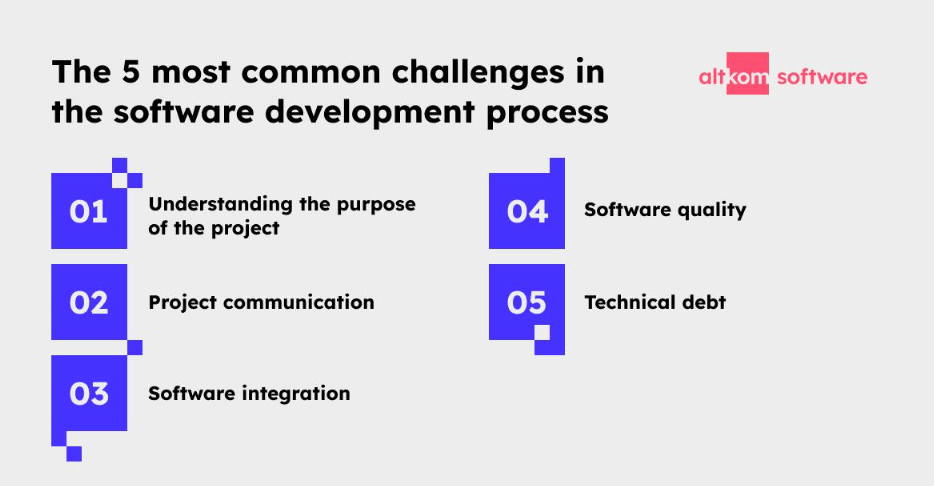
Have a look at this list of the five most typical software development challenges and ways to avoid them.
Software is usually developed with a specific business goal in mind, e.g., to address clearly defined problems or future user needs. Problems may appear if the target group and the product’s market potential are not researched well enough before developers get to work.
Without a thorough analysis, your business runs the risk of setting down inconsistent project requirements, and if you don’t understand your users, your products may fail to hit the target.
Before you start out on any software project, take some time to answer the following questions: What problem do you want to solve? What are you doing? Why are you doing it? How are you doing it?
Otherwise, you will soon stumble on risks caused by your ignorance.
These risks may include:
From the point of view of software development, if such risks materialize, you might have to make unplanned changes to the project, including its budget and schedule.
How to prepare for the challenge:
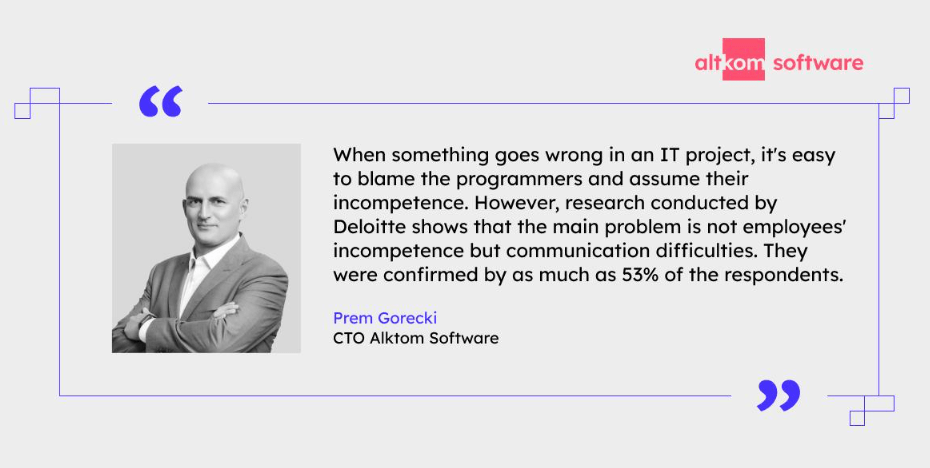
Communication is the most important skill for any manager today. Without communication, you cannot manage people and software development. In projects that involve several dozen people divided into several teams (often distributed across different locations and even time zones), communication is vital for success and should take up to 10-15% of your teams’ working time.
Ineffective communication may generate issues; your teams may not understand the project's goal, repeatedly ask the same questions, duplicate work, or carry out incorrect implementations. All this will increase team frustration and, ultimately, slow down their progress or even bring it to a complete halt. Consequently, your business may fail to meet your commitments, struggle with project delays and redundancy programs. Experienced programmers also rarely want to work on badly managed projects.
How to prepare for the challenge
Integration is one of the most important phases of software development. Most hidden bugs come to light at this stage of the project. Statistics show that as much as 70% of system integrations fail to meet the targets, which is a real challenge for IT teams.
The best way to address software integration is to rely on network services. In order to achieve integration and data flow between platforms, flexible network services must support SOAP (Simple Object Access Protocol) and REST (Representational State Transfer) protocol standards. A correct integration should enable you to move from file-based integration to network services integration.
How to prepare for the challenge
Low software quality involves a number of negative side effects, which directly translate into low customer satisfaction ratings. And, as you know, a dissatisfied customer is a customer who refuses to pay for your services, often breaks the contract, and signs on your competition.
If you frequently release low-quality solutions, customer loyalty will weaken, and they will leave, which spells lower performance and redundancy programs for your business.
In addition, low software quality also affects programmer productivity. IT teams that produce low-quality products are slower, less committed, and more stressed.
How to prepare for the challenge
In the example of one of our projects, we can show how the cost of fixing errors changes depending on the stage of software development at which they can be detected:
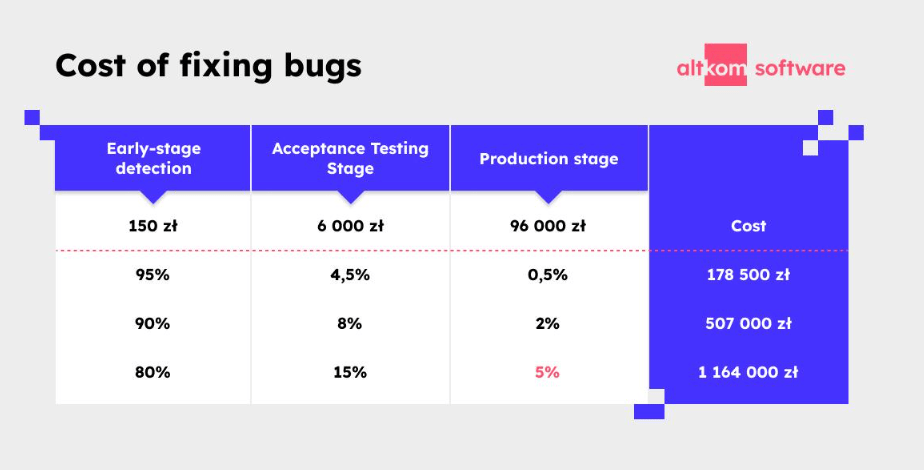
Each stage of bug detection has a different cost estimation.
Technical debt is a shortcut – businesses might feel tempted to take it on when they want to meet their needs quickly and, e.g., release a product before their competition does. To do so, you might reach for non-optimal technical solutions; these will frequently meet your short-term goals (which may make sense in business terms, e.g., if we want to verify a hypothesis quickly) but may stand in the way of your long-term plans or even make them impossible to achieve.
It is important to understand that before you have paid off your technical debt, you will not be able to make any new investments or further streamline your projects.
If you delay or omit to pay off your debt, you risk:
How to prepare for the challenge
Remember those appropriate coding standards, in tandem with refactoring, will allow the risk of technical debt to be minimized. “Small” changes must be introduced continuously, while the larger ones should be recorded and implemented in alignment with your priorities.
We have discussed five examples of recurrent project challenges which are often overlooked by developers but should be mitigated from the beginning of any project. Of course, the list is far from exhaustive; there are many more risks you would do well to eliminate early on or at least address with mitigation measures.
Every team leader and decision-maker should also be mindful of the need to reduce employee turnover, improve team performance, and manage risk (e.g., by drawing up risk response plans or procedures).
Additional Reading: