![How to Create a Budget for BI & Analytics Services [With Template]](https://img.shgstatic.com/clutch-static-prod/image/resize/715x400/s3fs-public/article/f07e9d6bd89e7f70df9c94301acdd847.png)
How to Create a Budget for BI & Analytics Services [With Template]
Use our custom template for your business intelligence and analytics needs.
Updated November 20, 2025

Rarely a day goes by without a data breach or cyberattack making the news. While big attacks against major corporations get lots of media attention, cyberattacks on small businesses may fail to make the cut. That's unfortunate, because small and mid-size businesses are prime targets for attackers.
In fact, 58% of businesses with fewer than 200 employees have been the victim of a cyberattack.
Many small business owners don't realize the risk. They may lack a security background or simply believe they're unlikely to attract a hacker's eye. The reality is different: hackers know that small businesses are less likely to have the strong defenses of major enterprises. They use that knowledge to their advantage and catch small businesses unaware.
Looking for a IT Services agency?
Compare our list of top IT Services companies near you
In this guide, we'll share the facts about cyberattacks and explain why cybersecurity should be a top priority for any organization — including small businesses.
Why do people believe that small businesses are less at risk of a cyberattack? Part of it is size. The vast majority of small businesses (79%) employ fewer than ten people. They earn a tiny sliver of what a major Fortune 500 company does. In fact, the average small business owner takes home a little over $75,000. Such slim resources lead many business owners to believe they're simply not attractive prey to a hacker.
Some small business leaders may not realize how much sensitive data they really need to store. Even the smallest organizations keep record of customer data like names, addresses, payment details, credit card information, and more. Businesses with several employees will also keep records of payroll information, social security numbers, and even health and benefits.
Although small businesses think they can fly under the radar, all of this data can attract hackers.
Here's the real deal: 58% of companies with fewer than 200 employees have experienced a cyber incident.
What are hackers after when they attack small businesses? Nearly all have financial motivations and seek to steal data or hold systems hostage in exchange for a ransom. And while the majority of cyberattacks against major corporations have a human element or error involved, that's not true of small businesses.
Malware and ransomware are the most common cyberattacks for small businesses. Other common tactics include phishing and data breaches, where the hacker steals sensitive business and customer information.
To a hacker, small businesses are easy targets. Unlike large corporations, which usually have dedicated cybersecurity teams to fend against hacking attempts, small businesses lack IT resources. They're simply not prepared to defend themselves against sophisticated attacks.
Small business owners have a lot on their plate. They take on all the responsibilities of running an organization, from marketing to operations to finance. Many employ just a handful of workers — if they have staff at all. Funding may be minimal, with owners relying on their savings or loans to keep the business afloat. Hiring an IT team may be well outside their budget. They may float by with inexpensive or free tools that lack the protections of professional-grade solutions.
Some owners make do with older systems they bought years ago. They may be running outdated software or hardware that's no longer supported by developers or manufacturers. These unpatched systems are like candy for a hacker, since they can quickly maneuver their way in through known vulnerabilities.
Cyber hygiene isn't front of mind for some owners. Basic safeguards like changing passwords frequently may not occur to them. And if the owner doesn't emphasize cyber protection, their staff may lack the know-how to deal (or recognize) an event when it occurs.
Another problem is the lack of backup and recovery solutions. While large enterprises may have huge servers and retain daily backups of their systems, a small company might rely entirely on a handful of computers. If they get infected by malware or a virus, any data stored on them is lost. That's especially true if the business doesn't regularly back up its data on an external hard drive or server.
A cyberattack can have severe financial, reputational, and operational consequences for a small business. In some instances, recovery isn't an option.
Just how much does a data breach cost an organization? Globally, the average cost was $4.44 million, based on a 2025 IBM report. However, U.S. businesses face higher costs because of the regulatory environment. Companies that have been breached in the U.S. pay an average of $10.22 million to resolve an attack, which includes legal fines, detection costs, and containment expenses.
When a cyberattack hits, it can knock out the organization's entire network. That means no order processing, customer service, or inventory management. Internal emails come to a halt, the company's website goes down, and staff can't handle their normal duties (at least those that require system access). This can lead to lost revenue, a problem that continues until the business regains control of its systems.
Legal repercussions can add up, too. If the cyberattack exposed personal information, the organization may be required to notify affected individuals. They must also notify law enforcement, who will take steps to assess the situation. Some states may issue regulatory fines if they find the organization partially at fault for having inadequately protected systems. According to IBM, 32% of breached companies incurred some type of fine. Of those organizations, 48% pay more than $100,000 in penalties.
A cyberattack can harm customer relationships and do lasting damage to the brand's reputation. In a Hiscox Group study, 47% of businesses hit by a cyberattack found it harder to attract new customers. Even worse, 43% lost some of their existing clients, and 21% lost business partners.
That may seem unfair. After all, why should a business suffer if it's the victim of a hacker's illegal actions? It boils down to perception. If customers or business partners believe an organization doesn't have strong cyber protections, they're less likely to trust it with their data. They'd rather purchase or partner with an organization that values security.
A cyberattack can take days, weeks, or months to resolve. During that period, a business may be unable to serve customers. Everything stops until the business gets a handle over its systems. Unfortunately, that's not always possible. Some businesses may be unable to recover their data at all, especially if they don't have any backup copies of it.
If the cyberattack involves ransomware, hackers may promise the return of systems in exchange for money. But even if the company decides to make the payment, there's no guarantee that the hacker will follow through. According to the Hiscox Group, just 18% of businesses surveyed fully recovered their data after making a ransomware payment.
No business wants the hassle or the repercussions of a cyberattack. While they're not always fully preventable, there are actions that you can take to reduce your risk.
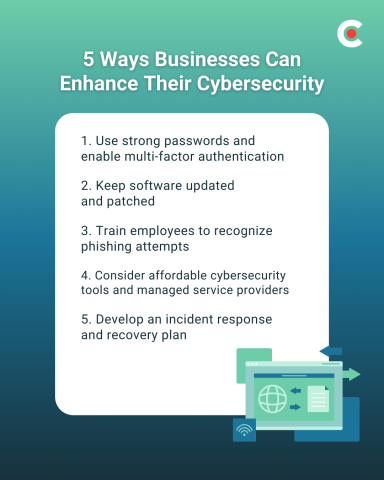
Cyber security professionals recommend a mix of capital and lower case characters, numbers, and symbols for every password you use. And instead of setting the same password for multiple accounts, it's best to use unique ones.
Go one step further with multi-factor authentication (MFA). It requires users to authenticate a log-in using biometrics, a smartphone, or a security token. Even if a hacker discovers your password, it may be next to impossible for them to breach MFA security.
Whenever a developer or manufacturer releases a new update, don't wait to download it. Immediately install it, since it may contain security fixes that prevent hackers from breaching your systems.
Require employees to undergo some basic cybersecurity for small businesses training. There are free online and on-demand courses available through the federal government's Cybersecurity & Infrastructure Security Agency (CISA). It also provides resources you can use to develop your own in-house training course.
Basic protection against malware and viruses is fairly inexpensive. If you accept online payments or store customer data, it's worth investing in tools to safeguard your database and network. Businesses that don't require full-time help can look for a managed cybersecurity solution from a local provider.
What will you do if the worst happens and a hacker breaches your systems? Without an incident response plan, you may be left trying to pick up the pieces and not knowing where to start. Get ahead of the game by writing a plan you can follow if an attack occurs. Outline who you'll contact for help and the steps you'll take to contain the threat. Consider working with a cybersecurity expert to develop a custom plan that makes sense for your business.
Small businesses may not have the resources of a large enterprise, but they can (and do) fall victim to cyberattacks. If you're a small business owner, know the risks of an attack and what can happen if one occurs. Take steps to protect your organization from harm. Simple fixes, such as using MFA and keeping systems updated, can reduce your risk.