
12 Years With Clutch: How Intuz Builds on a Partnership That Delivers
A Relationship That Has Stood the Test of Time Intuz is an AI consulting and development company established in 2008, with operations in Silicon Valley...
Updated January 2, 2025

IT services trends are of particular importance in the coming year. As companies gear up to battle advanced cyber threats, they’ll use new technologies.
The rapid evolution of new and elegant tech products necessitates a more comprehensive and cutting-edge tech infrastructure for small and large businesses.
From artificial intelligence to machine learning, various trends can, have, and will continue to alter the B2B landscape drastically. Small business owners and IT professionals must keep up with these trends to ensure their business processes and operations are efficient and relevant.
This blog post will explore five top IT and cybersecurity trends that will dominate in 2024.
Looking for support getting ahead of these trends? Connect with top IT services firms and cybersecurity companies on Clutch.
With the amount of personal and business information communicated via technology every instant, it’s no surprise that cybercriminals have become increasingly commonplace in the recent past.
The prevalence of malicious actors in the digital world may seem like an abstract threat to business leaders, but they can easily wreak havoc on any enterprise.
IBM’s Cost of a Data Breach Report 2023 highlights that the average cost of unauthorized users infiltrating a company’s network was $4.55M in 2023. This staggering loss has increased by 15% since 2020.
As this statistic demonstrates, the rise in the frequency and sophistication of phishing attacks means that businesses must be proactive in protecting themselves against cyber threats.
To be proactive, IT teams should seek out and implement threat detection measures into their companies’ IT networks.
For instance, adding artificial intelligence (AI) measures can aid in identifying and responding to potential threats before they can cause damage. AI’s instantaneous analysis capabilities allow for real-time threat diagnostics that can trigger any number of appropriate cybersecurity responses.
Zero-trust architecture is becoming increasingly popular as well. This IT and cybersecurity philosophy assumes that all systems are potentially compromised. Every user’s data access request must be appropriately and explicitly verified before even a low level of access is granted.
The newfound accessibility of AI has opened up a wealth of IT growth opportunities for forward-thinking businesses.
Whether handling customer inquiries promptly and accurately via chatbot communication, crafting insightful business presentations in seconds, or instantly generating useful marketing collateral, AI has many perceived use cases by top corporate minds.
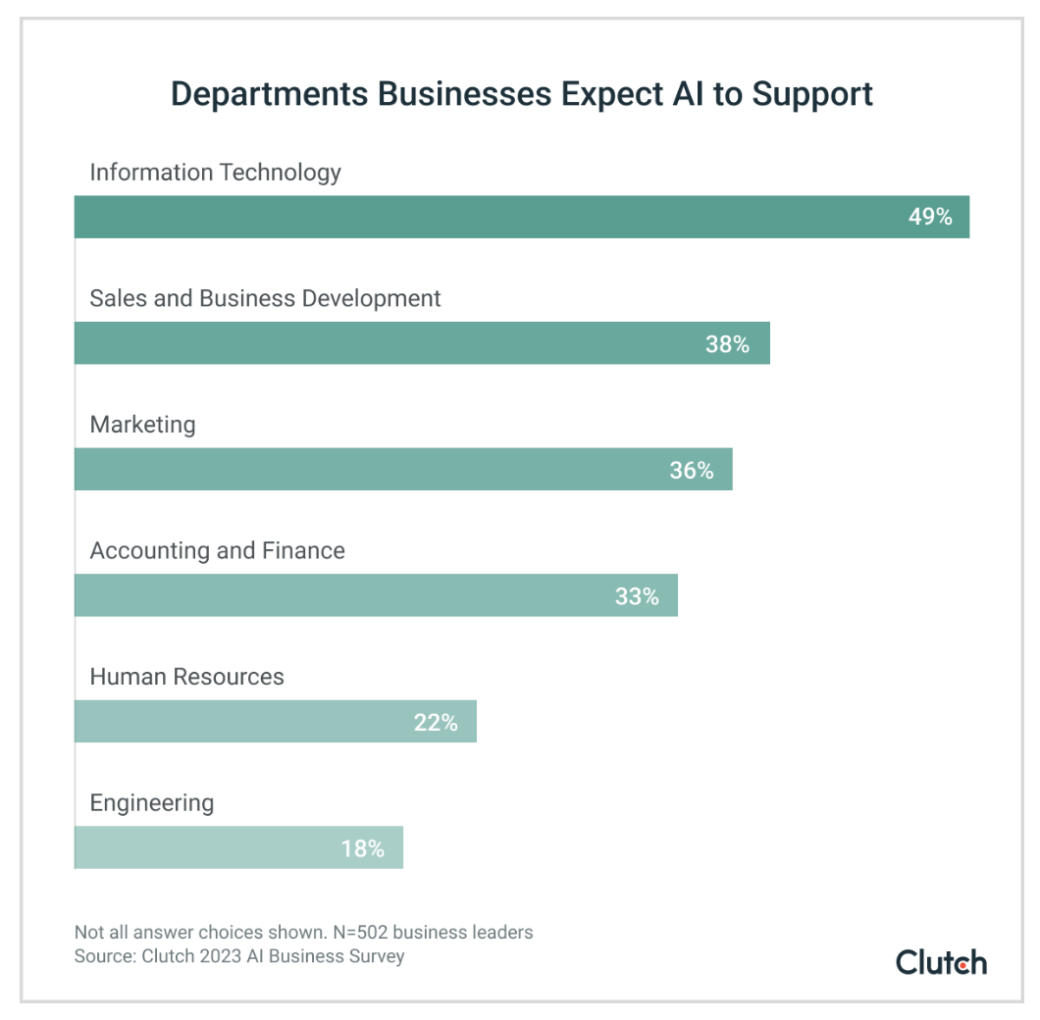
According to a recent Clutch survey, businesses are integrating AI in all parts of their business but expect the most impact in their IT departments. With the evolution of advanced algorithms, businesses can now employ AI to analyze and act on massive amounts of data more accurately than ever before.
This trend can lead to quicker and more accurate decision-making for small business owners, leading to better business outcomes. As such, those who leverage AI are likely to boost the agility and efficiency of their businesses.
As with any conversation about emerging tech, it would be a mistake not to mention the cybersecurity concerns that present themselves by being an early adopter of AI. However, users can expect data reliability and privacy concerns to continue to be addressed as the technology matures.
If a business is flush with new tech ideas but doesn’t wield a development team traditionally necessary to bring these ideas into reality, low-code or no-code technologies may allow them to realize their vision in a way not previously possible.
Low-code and no-code development tools allow users to build IT solutions with little-to-no technical coding required. Businesses that embrace this trend can create custom applications with a greater degree of speed and efficiency.
For companies with no developers employed, low-code and no-code tech unlock the previously unfeasible capability for in-house app creation.
Even for organizations with a robust enterprise solutions team, though, low-code and no-code development can free up the more seasoned IT professionals to handle more intricate projects by allowing more straightforward development jobs to be assigned to less experienced individuals.
Businesses everywhere are told to think of customer experience at every step of their value chain. How, though, might they do this for both human and mechanical customers?
Custobots, nonhuman economic actors that exchange payment for goods and services, have brought this question to the forefront of many business leaders’ minds.
An expert at Gartner predicts that by 2025, there will be 15 billion custobots active in the digital marketplace. As such, retailers preparing to market their offerings to these artificial consumers will set themselves up for short- and long-term gains.
For businesses without a retail arm, custobots can drive increased efficiency for procurement or administrative functions. For example, a custobot could be programmed to detect when an office’s copy paper is running low and order more so that print jobs can proceed uninterrupted.
Custobots represent both a new customer base externally and a means of assistance with various activities such as bookkeeping, chat support, and inventory management internally–paving the way for greater cost savings and sales volume.
Immersive content technology, such as augmented/virtual reality (AR/VR), has been on the technological horizon for quite some time. While AR/VR may feel just out of view for many companies, IT professionals see immersive content as a whole as an area worth discussing in the next year and beyond.
By understanding the immersive internet, businesses can prepare for future AR/VR gains. Social media and other electronic interaction platforms make up the immersive internet by allowing users to share their personalities and have real-life experiences.
AR/VR technology represents the next step in the growth of the immersive internet.
Small and large businesses must prepare for this transformative technological shift in the coming years by adapting their marketing strategies, customer experience, and communication channels. Adaptation will be essential to keep up with the changing times.
The trends discussed above showcase how the rapid evolution of business and consumer technology has influenced operations in every industry.
Threat detection, increased AI access, low-code and no-code technologies, custobots, and immersive content experiences represent IT and cybersecurity trends that should significantly change the business landscape throughout 2024.
By embracing these trends, small business owners and IT professionals can drive significant business growth in the next year and beyond. While change can be daunting, the rewards of embracing these trends can be considerable.
Staying ahead of these top IT and cybersecurity trends can provide small businesses with much-needed confidence as they prepare for the future.