
The Real Cost of Your MVP in 2027
AI made code cheap, but not software that holds up. See how MVP cost drivers have shifted and why human validation and taste are now what you’re really...
Updated September 22, 2026

Both in-house and outsourced software development can work well, but the right choice depends on what your business needs right now. In-house development offers greater control and product knowledge, while outsourcing provides speed, cost savings, and access to specialized talent. The best approach depends on factors like your project, budget, timeline, and stage of growth.
Both in-house and outsourced software development work. The question is which works for your business right now.
In-house development gives you control, cultural alignment, and a team that deeply understands your product. Outsourcing gives you speed, cost savings, and access to specialized talent you can't easily hire locally.
Looking for a Software Development agency?
Compare our list of top Software Development companies near you
Most companies don't choose one forever. They choose based on project type, budget, timeline, and where they are in their growth cycle.
Here's how to make that decision clearly.
| Factor | In-House | Outsourcing |
| Cost | Higher — salary, benefits, overhead | Lower — pay for what you need, no overhead |
| Talent access | Limited to local/regional market | Global talent pool |
| Control | Full control over team and process | Shared control; requires strong documentation |
| Speed to start | 1–3 months (hiring + onboarding) | 2–4 weeks (vendor selection) |
| Scalability | Slow — tied to hiring cycles | Fast — scale up or down by contract |
| Communication | Easy — same office, same timezone | Requires active management; time zones a factor |
Having an in-house team come with perks, and there are many businesses that have successfully managed digital products with in-house teams.
Benefits of in-house development include:
By hiring an in-house team, businesses can feel secure knowing their development team in nearby if they need to discuss progress or needed changes.
In-house teams, however, also come with challenges, especially cost. These challenges include:
In-house teams can be expensive for businesses, especially small business, to build and maintain. Businesses need to consider the cost of hiring and ongoing trainings as technology evolves.
While the reasons for outsourcing may vary, the common thread is about extracting value.
Benefits of outsourcing:
Outsourcing services allow businesses to build entire teams or supplement their in-house teams with experts to “fill in” knowledge gaps.
Although it offers many benefits, outsourcing also comes with potential challenges, and it’s not always the best option for everyone.
Challenges of outsourcing:
Most of these challenges revolve around communication and can be resolved with expectation setting and regular check-ins.
If you opt for outsourcing, make sure you:
By preparing for the potential challenges of outsourcing, your business will be better equipped to handle and overcome communication barriers so that they don’t get in the way of progress.
Determine If Your Business Can Benefit From Outsourcing
Digital experiences are at the heart of almost every enterprise and are powered by customer insights and digital strategy.
For example, a battery-powered car is not built by traditional manufacturing and engineering skills – It takes design strategists, UI/UX experts, and a team of software developers to make it work. Additionally, it has a digital dashboard that stores crucial information and has millions of lines of code behind it.
Similarly, great customer service of an airline, hotel or any other service brand needs a digital strategy, user experience, and software engineering team to put it all together.
Traditional business models are being disrupted across domains. For example, there was a time when a bank competed with other bank brands only. Now, however, a traditional bank may compete with new-age Fintech players.
Additionally, new technologies and possibilities are always on the horizon. A few years ago, hailing a cab through a voice command in the living room would have been merely a sci-fi fantasy, and app developers would not have imagined how augmented reality could shape the customer experience.
We cannot predict which new technology or platform will emerge in the next few years.
To make sure they’re not left behind, businesses can either:
It’s not possible for every small business to factor in technological trends and create internal teams – To do this, the business would have to have an enormous budget.
Conversely, outsourcing also comes with its pros and cons, but the key concerns CXOs have regarding outsourcing have checks and balances.
Many companies have a different process for green-lighting and funding an internal project vs. an outsourced project.
When a company funds an external project there are often several layers or project approval from several groups with varying perspectives:
• IT
• Project management office (PMO)
• Finance
• Executives
Having the project pass through so many people allow you to find issues before the project kick-off such as insufficient budget, unrealistic timelines, and adoption and support issues.
This can help improve the chances of success.
For software development companies, finding the best most experienced resources is a requirement of the business. For in-house teams, the requirements are often lower.
Internal resources are often spread across multiple projects and responsibilities giving them less time to focus on a deliverable.
Outsourced projects often leverage dedicated resources.
So what parameters should CXOs consider in order to make a decision?
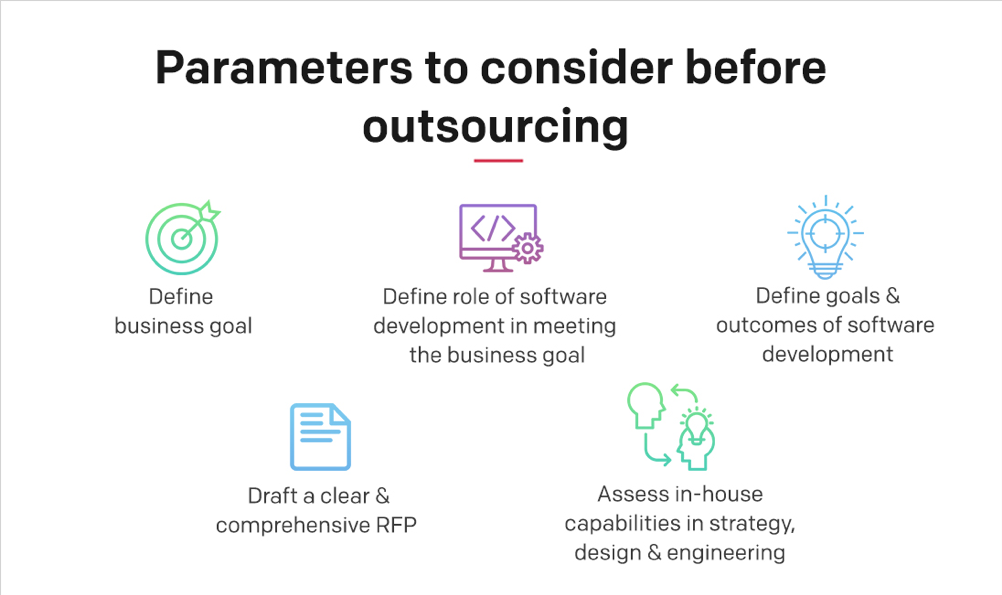
Before outsourcing, CXOs should:
By keeping these parameters in mind, business decision-makers can more confidently decide whether to outsource software development needs.
No formula makes this decision for you. But five factors consistently separate companies that make the right call from those that don't.
Outsourcing fits naturally into formal approval processes — vendors require defined contracts, scopes, and budgets that map directly to PMO and Finance reviews. In some organizations, outsourcing actually moves faster through approvals than an in-house headcount request.
If speed of delivery is the constraint, outsourcing typically gets you to launch faster — dedicated vendor resources vs. in-house developers splitting focus across multiple priorities. The caveat: your requirements need to be documented clearly. Ambiguous requirements kill outsourced timelines faster than in-house ones.
If your product is the software — if it's what differentiates you in the market — in-house gives you control that's difficult to replicate externally. If the software is a support function (internal tools, automations, a one-time build), outsourcing is almost always the better economic choice.
Outsourcing doesn't eliminate management overhead — it shifts it. Senior leadership needs to be involved in setting requirements, reviewing milestones, and communicating expectations. Companies that treat outsourcing as "hand it off and forget it" consistently underperform. If you don't have the internal capacity to manage a vendor actively, build in-house first.
One-time builds, market experiments, and time-boxed projects are ideal for outsourcing. Ongoing product development that requires deep institutional knowledge benefits from in-house ownership — or at minimum, a long-term outsourced partnership treated like an internal team.
If outsourcing is the right call, partner selection determines whether it works. Evaluate vendors on:
Look for vendors who ask hard questions about your goals and push back where requirements are unclear. That's a stronger signal than vendors who say yes to everything.
The new competitive battleground is customer experience. Delivering it requires specialized talent — AI engineers, UX researchers, mobile developers, data architects — that almost no business can maintain entirely in-house. That's not a failure of ambition. It's a reality of how fast technology moves.
Partial outsourcing is underused as a strategy. Many companies maintain a small in-house team for product direction and IP-sensitive work while outsourcing execution to vendor partners. This hybrid model captures the benefits of both: institutional knowledge inside, execution capacity and cost efficiency outside.
The key is treating outsourced partners as long-term relationships, not transactional engagements. Vendors embedded in your process over 12+ months consistently outperform new vendors on speed, quality, and alignment — and they require less management overhead as the relationship matures.
Outsourcing is almost always cheaper on a project basis. In-house development has higher fixed costs — salary, benefits, recruiting, training — but can be more cost-effective long-term if your development needs are continuous and large in scope.
Communication gaps, unclear IP ownership, and cultural misalignment are the most common issues. Most are solvable with clear contracts, detailed RFPs, and active project management from senior stakeholders.
Yes — and many companies do. The hybrid model keeps product strategy and core IP in-house while outsourcing specific execution phases or technical functions. It's increasingly the standard approach for growing companies.
Look for verified client reviews on third-party platforms like Clutch, check portfolios for work relevant to your industry, and ask for references you can contact directly. A rigorous RFP process filters out vendors who aren't serious about your requirements.
Brad is business development director for the central and mountain regions of the U.S. for Robosoft Technologies. He is based out of Dallas, Texas. In a career spanning 20+ years, Brad has crafted services and SaaS solutions with a focus on large account sales, account management, and enterprise software development. With experience across retail, CPG, financial services, and technology, Brad believes there is a vast ocean of opportunities for enterprises in design thinking, UX/UI, analytics and emerging technologies.
See full profile