
Micro SaaS: How Solo Developers Build Profitable Products
Solo developers now make up 35% of startups. Discover how micro SaaS lets individuals build and launch profitable products without a big team.
Updated July 15, 2026

AI-assisted software development has already become the everyday practice for the majority of development agencies. We know for sure that artificial intelligence tools are now an integral part of the modern engineering workflow. They help developers with various tasks, including generating code, writing tests, debugging applications, and accelerating routine tasks from hours to seconds.
For engineering leaders, the results are often impressive and very beneficial. Teams deliver features faster, and developers spend less time on repetitive coding. At the same time, the overall productivity appears to increase almost immediately.
For example, the impact of generative artificial intelligence (AI) time savings in IT reached 30% in 2025.
Looking for a Software Development agency?
Compare our list of top Software Development companies near you
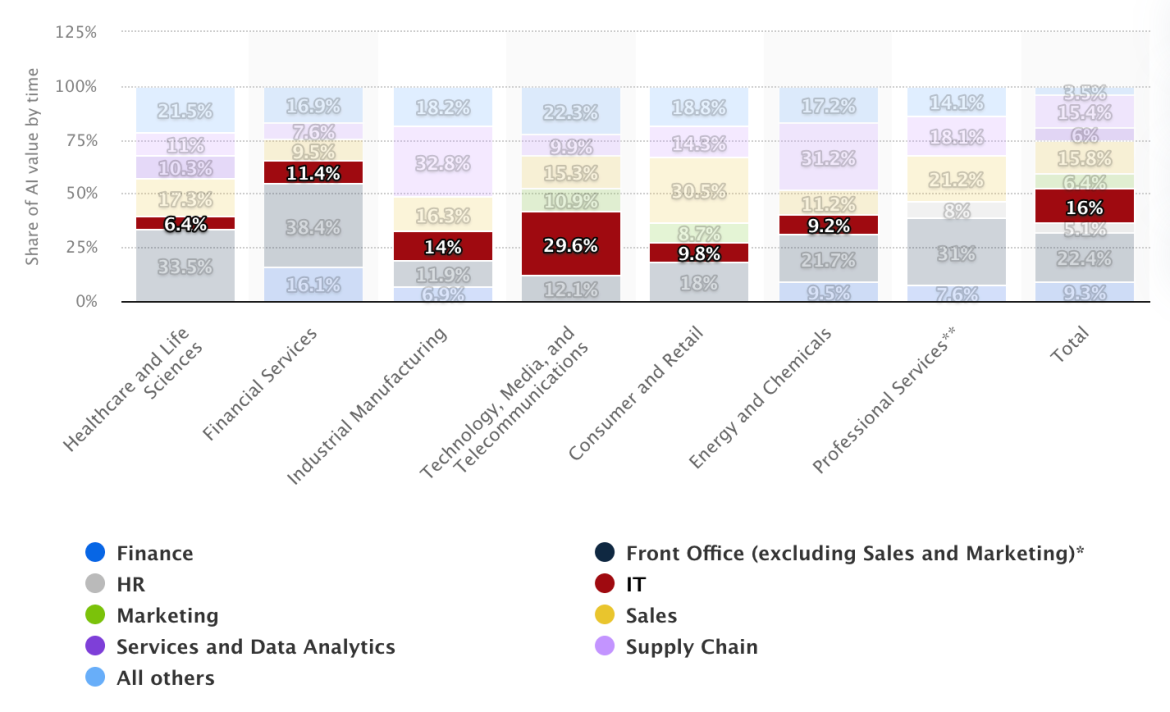
The impact of generative artificial intelligence (AI) time savings in key sectors worldwide in 2025, by function. Source: Statista
On the contrary, many organizations begin noticing a different pattern. Code reviews become more demanding, and technical debt accumulates more quickly. The same tools that improve development speed can also create additional quality risks that only become visible months later.
In this article, we'll examine what the latest research says about AI coding productivity, where quality risks actually emerge, and how engineering teams can capture the benefits of AI without risking software quality. Our goal is to understand how to use artificial intelligence responsibly as part of a modern software development process.
The highest productivity gains from AI occur when software developers use it for tasks that are repetitive, well-defined, and follow established patterns.
For example, AI is highly effective at tasks such as generating boilerplate code, setting up new projects, creating CRUD endpoints, writing configuration files, and producing database migration scripts. These tasks rarely require deep architectural thinking. However, they consume a huge amount of developer time.
Testing is another area where you can use AI to increase productivity. It can quickly generate unit tests for existing functions, suggest edge cases, and help improve code coverage. Keep in mind that developers still need to verify that the tests actually validate the intended behavior. However, AI significantly reduces the time needed to write the initial test suite.
The same applies when developers need to translate existing implementations into different formats. For example, you may use AI to convert a REST API to GraphQL, migrate a component between frameworks, or rewrite code from one programming language to another.
Documentation is a case where AI provides huge benefits. Writing README files, API documentation, code comments, and docstrings is important. However, these processes are often postponed because they compete with feature work. AI can produce a solid first draft in seconds. And developers can just refine something rather than write the whole document.
Even debugging becomes more efficient with AI. However, only when the problem is clearly defined. Stack traces, failing unit tests, compiler errors, and reproducible bugs provide AI with concrete context. As a result, it allows developers to identify likely causes and suggest fixes much faster than manually searching documentation or community forums. The common characteristic across all these tasks is that they have clear boundaries. You can delegate them to AI when the problem is well understood, and the solution follows patterns it has seen many times before.
The reported 30–55% productivity gains are real. But… Most studies measure things that are easy to quantify.
For example, how quickly developers write code, how many pull requests they merge, how many tickets they close, or how fast they produce a first draft.
These are very useful metrics; however, they measure only how quickly developers create the code. On the contrary, they do not demonstrate how effective the code is in the long run and how well it performs over time.
The real challenges often appear after deployment.
AI performs best when solving familiar, well-defined problems. However, at Empat, we know for sure that the production software is full of exceptions that no benchmark can easily capture. There are legacy systems, undocumented business rules, one-off customer requirements, and architectural decisions made years ago for reasons that may no longer be obvious. These are things an AI model doesn't know unless they're explicitly provided in the context.
As a result, AI-generated code can look complete while still missing important details. It compiles, passes the available tests, and even gets approved during code review. The problem may become visible only after some time has passed. Usually, it occurs when an unexpected edge case arises in production or when the system is under heavy load.
Another challenge is that AI-generated code often looks more trustworthy than it really is.
The AI code is usually very good-looking, with clean formatting, descriptive variable names, and logical structure. On the contrary, that polished appearance can make reviewers less critical. They may not check whether this is the right solution for a certain system. It's easy to assume the generated code is correct simply because it looks professional.
However, the main objective of software engineering is to write code that fits a particular product, architecture, and team.
AI doesn't understand why your team chose a certain design or why a certain service has strict performance constraints. Artificial intelligence generates solutions based on patterns learned from millions of public repositories. However, it doesn’t know the unique history of your application.
That's why the most successful AI-assisted software development companies don't see AI as a replacement for engineering expertise. They use it to speed up repetitive tasks and produce strong first drafts. At the same time, they rely on experienced developers to review the code, validate the logic, and ensure it aligns with the architecture and business requirements.
For organizations now adopting AI-assisted development, success depends less on the choice of tool and more on how engineering practices are organized around it.
You should not focus on measuring the speed of development. It’s better to monitor what happens after the code is implemented. Metrics such as production defects, incident frequency, mean time to resolution, and customer-reported issues provide a much clearer picture of whether AI is creating long-term value or simply shifting work from development to maintenance.
At the same time, the code review standards should remain as rigorous as before the adoption of AI. Clean formatting and well-written comments don't guarantee correct logic or good architectural decisions. In many cases, AI-generated code warrants closer inspection because it often appears more polished than it is.
Engineering leaders should also pay attention to developer growth. AI can help junior developers become productive more quickly. However, relying on generated solutions without understanding them slows the development of critical problem-solving and debugging skills. Mentorship, pair programming, and thoughtful code reviews are essential parts of building strong engineering teams.
Finally, organizations should establish coding conventions and architectural guidelines before AI usage becomes widespread. When developers generate code faster, consistency becomes even more valuable. Shared patterns, reusable components, and clear engineering standards help ensure that increased development speed doesn't come at the cost of long-term maintainability.