
Micro SaaS: How Solo Developers Build Profitable Products
Solo developers now make up 35% of startups. Discover how micro SaaS lets individuals build and launch profitable products without a big team.
Updated July 7, 2026

Salesforce ROI doesn’t end after go-live. In this article, you can discover how companies can improve after implementation value by evaluating real workflows, fixing adoption conflicts, improving data quality, and building a consistent optimization flow.
Salesforce ROI is rarely decided on launch day. The go-live is just a demonstration that the system exists—it is not a demonstration that teams are using it well, the data is reliable, or the business is getting the value that was promised in the business case.
The upside is real. When we look at Salesforce Professional Services, Forrester Consulting’s Total Economic Impact study found a 272% ROI and $6.0 million net present value for a composite enterprise organization. The key point is that Salesforce creates measurable value when it is aligned with workflows, data, and adoption.
Looking for a Software Development agency?
Compare our list of top Software Development companies near you
The risk is equally real. According to Nintex, analysts have documented a 20% to 70% failure rate for CRM projects. However, that does not mean Salesforce is the issue. More commonly, the issue is treating implementation as a one-time project rather than an ongoing operating discipline.
Most Salesforce programs start with a broad promise of something overarching, such as better visibility, quicker sales cycles, better service, or better retention. These are valid goals, but they are too general to manage after launch. When Salesforce is live, leaders must identify the key signals and narrow them down into a few sets of endpoints.
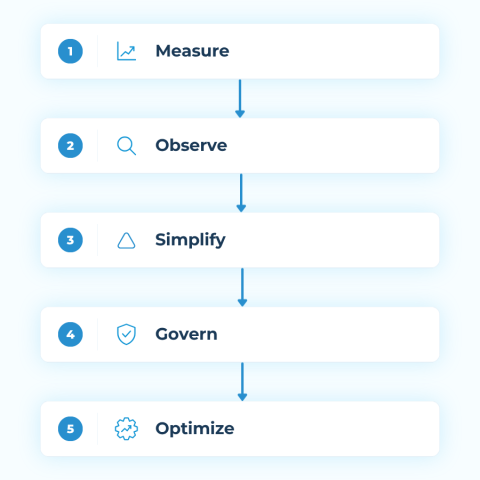
Source: Original visual by Peeklogic
Any good post-go-live scorecard should include commercial indicators such as win rate, pipeline velocity, renewal rate, and average order value; productivity outcomes such as logging time, case resolution time, reporting effort, and hours saved; and adoption or quality outcomes such as active usage, record completeness, duplicate rate, and data freshness.
This matters because usage alone can be misleading. A team can log in each day and still have critical notes on spreadsheets. Only after the deal has been moved, a sales rep has the ability to update an opportunity. A customer success manager can create tasks but still end up duplicating the same work across email, Slack, and Salesforce. This is where ROI starts to break down: Salesforce only delivers value when it becomes the easiest and most reliable way to get the work done.
Salesforce’s State of Sales report shows why this is urgent. Sales reps spend an average of 40% of their workweek selling and 60% on non-selling activities such as quotes, planning, training, and manual data entry. That same report revealed that 69% of sales individuals report that measurable ROI with customers has become even more significant than it was last year.
One common post-go-live mistake is reviewing Salesforce only from the administrator’s perspective. Configurations can look good in the page layouts, fields, automations, and dashboards. The real question is: what does the user need to do to get through a day's normal work?
A practical review should include observation. Observe sales, service, and customer success teams making records, handoffs, updating opportunities, closing cases, and making reports. Check the documented process against reality. These gaps often show the fastest path to ROI.
This is where organizations discover hidden friction. It is not always that users reject Salesforce simply because they need more training and experience. They might be avoiding it because a lot of manual work is needed, too many fields are required, the same information has to be updated twice, or there are too many systems to switch between.
When users invent workarounds, leaders should treat that as data. A workaround often signals that Salesforce does not match operational reality. The wrong response is to add more policy reminders. The right response is to ask why the workaround is easier than using the system.
When lead sources are inconsistent, accounts are duplicated, handoff fields are incomplete, or customer records are stale, more automation can simply move bad information faster.
According to Salesforce's 2026 State of Sales report, 84% of sales teams without an all-in-one platform are looking to consolidate technology, while 79% aim to simplify technology and unify data to enhance AI and agent outcomes. Practically speaking, data readiness is not an IT cleanup project; it's a revenue/service issue.
After go-live, companies should identify which records and fields are most important for decision-making. That could be an opportunity stage, close date, next step, lead source, and decision maker for sales. It can contain case reasons, priority, SLA status, and resolution type for the service. To support customer success, it could include health scores, renewal dates, product usage, and risk reasons.
Then, assign ownership. For each critical field, there should be a business owner, quality rule, and reporting purpose. If a field isn't used to determine an action, report, automation, compliance requirement, or customer outcome, it may not belong on the page.
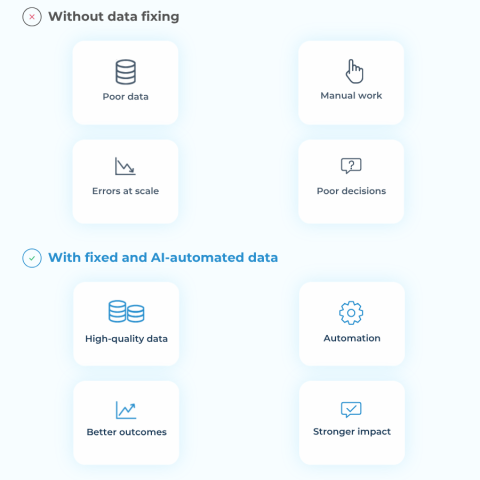
Source: Original visual by Peeklogic
When Salesforce does not deliver the expected results, the first choice is often to expand the system. However, more functionality does not always mean more value.
According to Sergii Grushai, CEO of Peeklogic, a Salesforce development and consulting company:
“When business leaders feel that Salesforce is not performing as well as it could, they often try to solve the problem by adding more dashboards, more automation, more integrations, more AI, or more licenses. Sometimes that is necessary. More often, it only adds complexity.”
The proper order is simplified first, automate second, and expand third. Simplification eliminates low-value fields, redundant steps, confusing layouts, and antiquated processes. Automation should then focus on repetitive work that users already perform on a regular basis. Expansion should be undertaken only when the organization has clear adoption, clean data, and governance capacity.
This method helps safeguard ROI. Each additional feature makes maintenance more complicated in the future. Each integration results in dependency. Monitoring is needed for any type of automation. Salesforce optimization should not be driven by platform enthusiasm. The focus needs to stay on business value.
Salesforce ROI improves when optimization becomes routine. At a minimum, companies should conduct a structured review every quarter. The review should answer five questions:
Business owners, Salesforce administrators, RevOps, sales or service leaders, and representative end users should be included in the optimization process. It is supposed to generate a prioritized backlog rather than a long list of wishes. The best backlog items relate directly to ROI: less manual effort, more accurate data, shorter cycle time, higher conversion, higher retention, or lower cost of service.
Adoption should also be measured behaviorally. Logins are not enough. Monitor user adoption for timely updates to vital records, completion of necessary follow-up actions, accurate forecasting, proper case closure, and use of Salesforce reports during management meetings. According to the CSO 2018 Sales Operations Optimization Study, organizations with more than 75% CRM adoption tended to have higher win rates and quota attainment, with even greater improvement when combined with a formal sales process.
Salesforce can deliver strong ROI, but only when it becomes part of how the business actually works. It depends on whether the platform is truly integrated into how the business operates. Some of the biggest post-go-live pitfalls are assuming adoption will happen on its own, measuring activity rather than outcomes, automating bad processes, neglecting data quality, and adding functionality before eliminating friction.
The companies that maximize ROI move in a different direction. They calculate value in business terms, understand how users actually use the system, streamline user experience, enhance data governance and data quality, and constantly optimize performance.
Rebuilding is not always the next step for organizations that have already started using Salesforce but aren't getting the return they expected. In many cases, the answer is a laser-focused Salesforce ROI health check: identify obstacles to adoption, measure the hours spent on manual processes, prioritize the value of automation, and create a realistic roadmap for optimization.