
Micro SaaS: How Solo Developers Build Profitable Products
Solo developers now make up 35% of startups. Discover how micro SaaS lets individuals build and launch profitable products without a big team.
Updated July 15, 2026

AI has collapsed the cost of building software and the cost of copying it. Features that once took quarters to ship now take days. The window for competitive advantage is shorter than ever.
That's the perspective this article is built around. Designli surveyed SaaS founders across AI and automation, fintech, cybersecurity, edtech, martech, and future-of-work to understand how they're actually building their moat and where the gaps are. A moat is the set of compounding advantages that make your product harder to replace over time. It's everything a competitor with unlimited resources would still need to do before they could offer what you already offer. A strong moat deepens over time. A weak one reveals itself the moment a founder with more capital decides to compete.
Today, AI is often perceived as a moat. But it's both a moat-builder and a moat-flattener. Which one it becomes depends entirely on how intentionally you use it.
Looking for a Software Development agency?
Compare our list of top Software Development companies near you
→ Explore the full findings in The Moat Report: How SaaS Founders Are Building Defensibility in 2026.
The data paints an honest picture. 35.7% of founders cite custom AI or machine learning models as their primary technical differentiator. 50% rated their technology's defensibility at 3 out of 5, the middle. Not a single respondent rated themselves a 5. And 71.4% are continuously shipping with moat-widening as an explicit goal.
Velocity is the default response to defensibility anxiety. But continuous shipping only builds a moat when what's being shipped compounds: creating switching costs, deepening data advantages, or improving with use. Features alone don't stack. Shipping more doesn't automatically mean you're building something a competitor would need years to replicate.
One in five founders surveyed said their edge isn't technical at all. Brand, relationships, and domain expertise are still considered moats. That raises the question every founder should be sitting with: if your technical advantage is moderate and replicable, what else is protecting you?
→ If you can't answer that cleanly, the moat is still being designed, even if the product is already on the market.
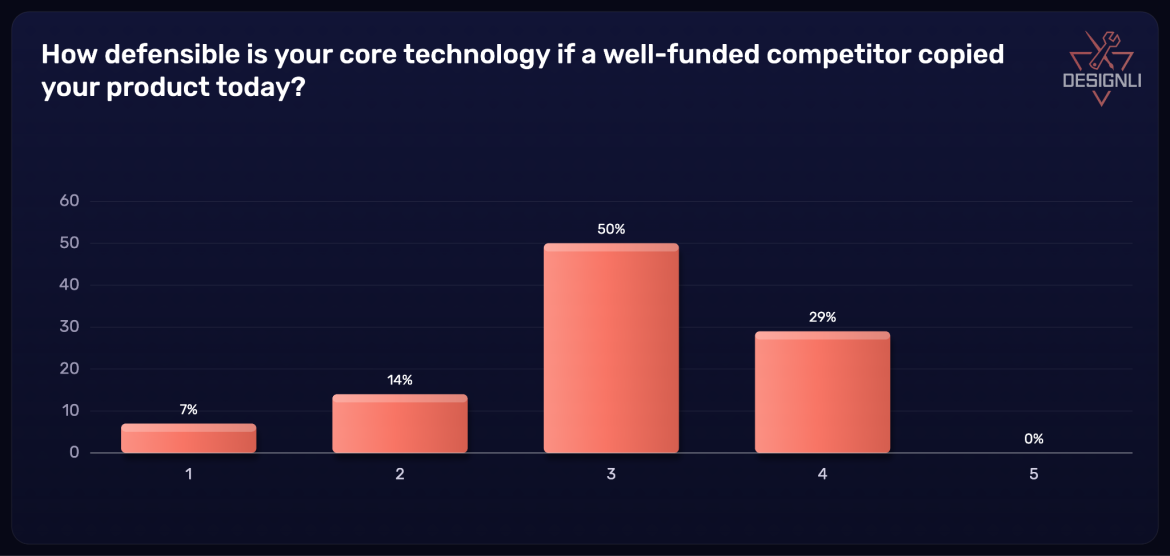
No one rated their defensibility a 5 out of 5. That honesty is telling founders to know that in 2026, strong technical output alone isn't enough. The variable that matters is whether what you're building compounds, and that requires balancing good technical practices with features that have actually been validated by the market.
42.9% of respondents said their product data actively trains and improves their AI. The flywheel is running. 57.1% have less than 12 months of proprietary data. Only 14.3% have accumulated five or more years. And here's the structural problem those numbers surface: Founders with a clear data moat strategy can describe exactly what they're building and why it's irreplaceable. Without that clarity, you can't.
There's a meaningful gap between "we're collecting data" and "our data is irreplaceable." Most products currently sit in that gap. The founders winning on data are building specific datasets no competitor could replicate without years of the same customer relationships and usage patterns. A flywheel that's been running for eight months is the beginning of a moat, not the moat itself.
Data moats take time to build properly. The time to start is before you need one. By the time a competitor copies your features, the window has already closed. A data moat takes years of consistent data collection to actually protect you.
→ If you can describe your data moat in a single concrete sentence: what it is, who generates it, and why it gets more valuable over time, you probably have one. If you need three paragraphs and still end up with something general, the moat is still in the concept phase.
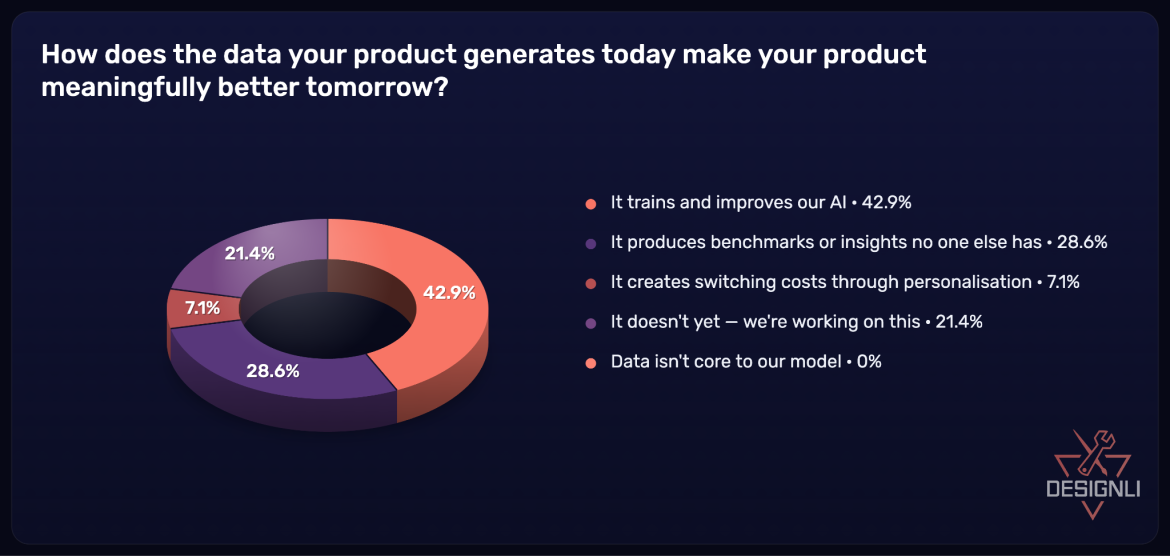
Founders increasingly recognize data as the hardest moat for competitors to replicate, and they know there's no shortcut to getting the flywheel moving. Accumulated data is what tells you whether the roadmap you're betting on actually makes sense before you've committed too far to change course.
Founders in our survey are using AI to justify price across three near-equal value propositions: automating manual tasks, surfacing unique insights, and reducing time-to-value, each at 28.6%. Churn attribution was equally fragmented: a competitor offered something better (21.4%), there was price pressure (21.4%), the product didn't deliver value fast enough (14.3%), and the customer outgrew the product (14.3%). The most concerning number: 21.4% of founders don't conduct exit interviews at all and genuinely don't know why customers leave.
If you don't know exactly why your customers are leaving, your retention strategy is guesswork. You can't build a real defensive moat when you're busy reacting to symptoms instead of fixing structural flaws.
That's especially true for teams developing custom features for high-ticket clients. Done with discipline, it deepens switching costs and anchors enterprise retention. Done reactively, which is what happens when you're guessing at churn instead of diagnosing it, it fragments the roadmap and creates technical debt that erodes the core product over time.
→ You cannot build a service moat around a business you're not measuring. Understanding why customers leave is one of the highest-leverage activities in SaaS, and one in five founders has deprioritized it.
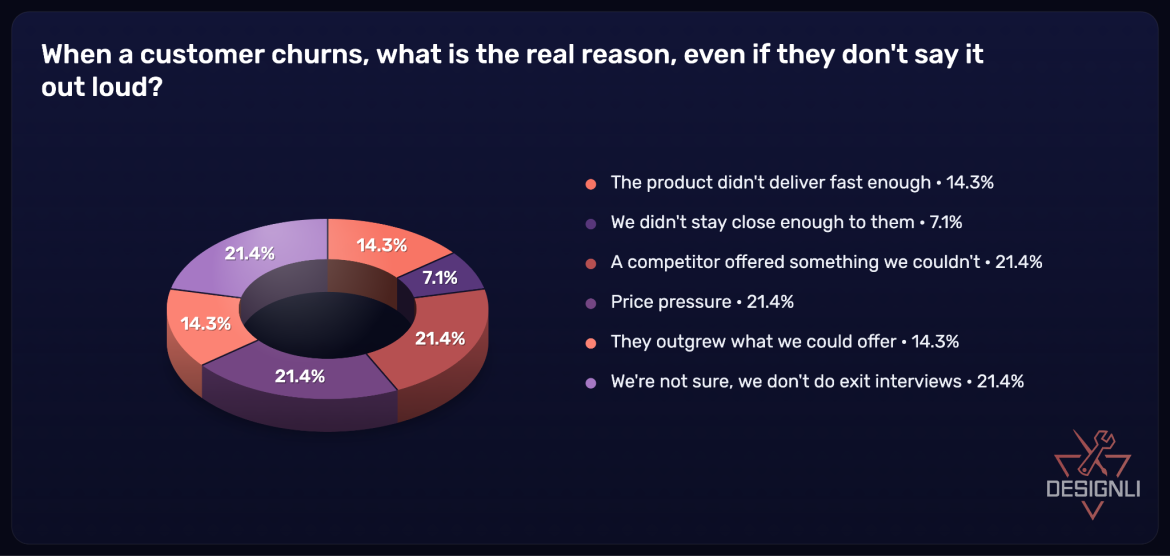
Founders without a clear feedback loop when a customer leaves are building their retention strategy on assumptions instead of insight. Even well-informed assumptions have limits; churn has a way of surprising you the moment you stop measuring it.
85.7% of founders are already treating AI discoverability as a distribution priority, optimizing for AI search engines and creating content designed to be cited by tools like ChatGPT, Claude, and Perplexity. Zero respondents said they'd lose nothing if their primary platform changed overnight. 35.7% rated their platform vulnerability at 4 out of 5, highly exposed. The 2026 distribution bets: SEO for ChatGPT, Claude skills, MCPs, X, Reddit, and quick-response content.
In previous years, there was a playbook: a mix of content marketing, paid social, and traditional SEO. In 2026, the playbook is being rewritten in real time. The absence of a consensus distribution bet is itself a signal. Founders are making individual bets, which is both an opportunity and a risk depending on how deliberately those bets are placed.
The founders ahead of this shift are thinking about distribution as a system to design, just as they think about products. Traditional SEO took years to compound into a distribution advantage. AI search optimization is relatively new, and the rules are still taking shape. The founders who build strong positioning in AI-cited results early will have a head start that's difficult to catch up to.
→ Owned distribution takes time to build. Most early-stage teams don't start until they need it. By then, the window had already narrowed.
Across all four dimensions, one pattern emerged more clearly than any single data point: founders are building moats reactively, not by design. The activity level is high, but the strategy isn't keeping pace. Founders are shipping without always building something that compounds, collecting data without a clear sense of what makes it irreplaceable, and adapting to AI-driven discovery without a fallback if that shift accelerates faster than expected.
A moat is most powerful when it's defined before the build, not retrofitted after the product is already in the market. For non-technical founders, that definition rarely comes from the product itself. Usually, it comes from stepping back and pressure-testing the assumptions behind it: what you're actually protecting, whether your current roadmap reinforces it, and where the next phase of the build should go. That's the work most teams skip, and it's what Designli helps founders do before committing to the next build.
To get accurate information for the software development industry, Designli surveyed SaaS founders and operators at industry conferences, founder communities, and professional networks across AI & Automation, Fintech, Cybersecurity, Edtech, Martech, Future of Work, Retail & Hospitality, and E-commerce.
The mix of technical and non-technical founders meant that the findings reflected both the product and business sides of building defensibility. The survey combined quantitative inputs, multiple-choice questions, and rating scales with qualitative open-text responses, allowing us to capture the reasoning behind those responses.
The race in 2026 is no longer about building faster or stacking AI features onto a roadmap. The real competition is between founders who ship and founders who compound, and the gap between them comes down to one early decision: what are you actually building a moat around?
The data from this survey shows the energy is there. Founders are shipping, integrating AI, collecting data, and adapting to new discovery channels. What's missing is design. A moat built reactively, in response to competitive pressure, will always be one step behind the threat it's trying to outrun.
The founders who win are the ones who answer that question deliberately before they build and make sure every subsequent product decision reinforces the same core defense.