
Website ROI: How to Measure, Calculate, and Improve Your Return
Website ROI measures the value your site generates relative to what you spend. Learn how to calculate it, track the right KPIs, and improve your return.
Updated July 22, 2025

Site search is no longer just a utility; it’s a core revenue driver. This post explores how leading e-commerce brands are using AI-powered search, natural language processing, and customizable solutions to turn product discovery into higher conversions.
Think about the last time you searched for something on an e-commerce site. Did you find what you wanted on the first try or did you bounce after five irrelevant results? For your customers, the search bar isn’t just a feature. It’s the fastest path to purchase or the fastest way to leave.
Here’s the reality: shoppers who use site search are more motivated to buy. They already know what they want. But if your search experience is slow, clunky, or irrelevant, you’re making it harder for them to give you their money.
In fact, site search users are 2 to 3 times more likely to convert than non-searchers. But most e-commerce sites still treat search like an afterthought, missing one of the most direct paths to revenue.
In this post, we’ll break down what great site search actually looks like, how AI and real-time personalization are raising the bar, and the tools top brands are using to turn searches into sales.
Most brands think of site search as a utility. Something that sits quietly in the header, there if someone needs it. But that mindset leaves money on the table.
When a customer uses the search bar, they’re not browsing. They’re hunting. They have intent and that intent is often closer to a purchase than any homepage scroll or category click.
Here’s what the data says:
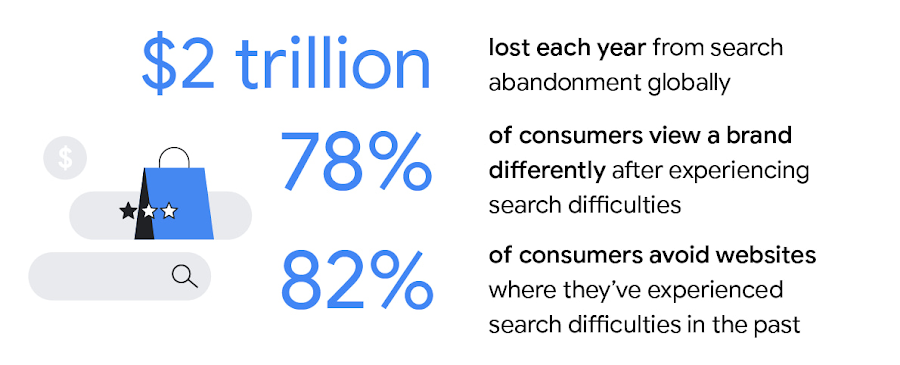
But it’s not just about functionality. It’s about speed, relevance, and trust. If your search experience doesn’t feel intuitive, meaning it returns dead ends or irrelevant results, your most valuable users will click away fast.
The brands that are winning here understand this:
Site search isn’t just a feature. It’s your most direct shot at conversion. So if you’re not optimizing it, you’re actively losing revenue.
Today’s shoppers expect search results that feel personalized, fast, and accurate, even if their query is vague, misspelled, or incomplete. That level of performance used to be a luxury. Now, it’s the baseline.
AI has changed the game. Instead of static keyword matching, modern search tools use real-time data to learn, adapt, and serve up exactly what the shopper is looking for. In fact, retailers using AI-powered site searches see an average conversion rate increase of 216% according to The Future of Commerce.
Here’s how AI is showing up inside the search bar:
Even though platforms like Shopify and Magento have made strides, there are many scalable AI tools available for retailers that return more relevant results across large catalogs using voice, camera, images, and multilingual and text-based searches as well. These tools analyze what users click on, what they skip, and what actually converts, optimizing the experience in real time.
Typing in exact product names and SKU codes is a thing of the past. Shoppers expect your site to understand what they mean, not just what they type.
That’s where Natural Language Processing (NLP) comes in. It lets your search engine interpret context, intent, and nuance like a real conversation. If a shopper types “running shoes for flat feet,” they’re not just looking for shoes. They want a specific solution. NLP helps your search engine connect those dots.
Even more, voice search is quickly becoming a real factor in e-commerce. With over 51% of consumers using voice assistants to search for products weekly, ignoring this trend means ignoring a growing group of buyers who prefer to speak, not type.
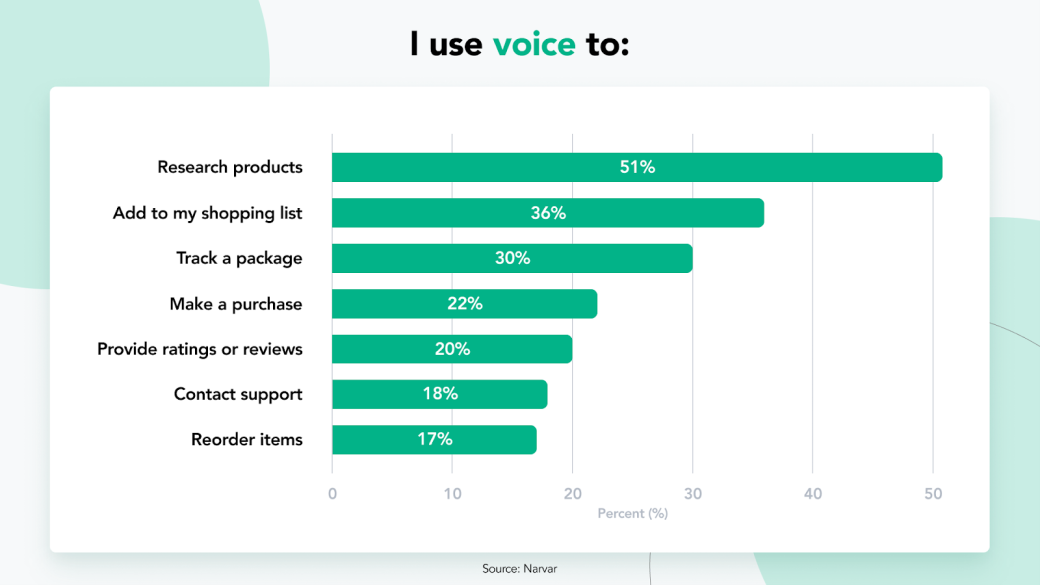
Here’s how top e-commerce brands are applying these technologies:
As search queries become more conversational, your site’s ability to interpret them needs to evolve. Otherwise, you risk sending a high-intent customer into a dead-end.
Every shopper has a different mission. Some know exactly what they want. Others are just browsing. The more your site search adapts to those different moments, the better it performs.
Out of the box, most e-commerce platforms return the same results for every user. But when you tailor the search experience by prioritizing bestsellers, boosting seasonal items, or displaying relevant filters. You, in turn, meet customers where they are in the buying journey.
Here’s what that looks like in practice:
Shopify lets you influence product orders through tools like Shopify Search & Discovery. In contrast, Magento’s rule-based product positioning gives you even more granular control over what appears at the top of results.
It’s not just about accuracy. It’s about intent.
When someone types “birthday gift for dad,” a personalized curation of top-reviewed, in-stock items with gift-wrapping options will convert better than a generic grid of random products.
Small adjustments to your search experience can lead to big results. Brands that customize search see higher conversion rates, longer time on site, and reduced bounce because customers don’t feel like they’re starting from zero every time they type something in.
It’s easy to get overwhelmed by the number of site search tools. They all promise better results, faster indexing, and smarter experiences. But choosing the right one for your business comes down to more than just feature lists.
Here’s what matters when evaluating a site search solution:
Your product catalog won’t look the same a year from now. Neither will your traffic. You need a tool that can grow with you, further handling more extensive inventories, spikes in traffic, and more complex filtering without sacrificing performance.
Not all AI is created equal. Look for platforms that offer true behavioral learning, synonym recognition, and context-aware results. Your shoppers won’t always search perfectly and your search engine shouldn’t expect them to.
Whether on Shopify, Magento, or any other platform, your search solution must fit into your stack without friction. Bonus points if it doesn’t require a developer for every single adjustment.
Search is more than relevant. It’s a merchandising tool. Look for features that let you pin products, promote collections, and adjust result rankings without touching code. And make sure you’re getting insights into what users are searching for, clicking on, and skipping.
Some tools come with enterprise-level pricing; if you’re not using 90% of the features, it won’t be worth it. Focus on value. How much more revenue can you generate by improving search? If the math adds up, it’s a smart investment.
The best search solutions don’t just improve UX. They pay for themselves by making it easier for people to buy what they came for.
Your search bar is no longer a “nice to have.” It’s one of your site's most powerful tools, and most brands aren’t using it to its full potential.
Shoppers expect relevance, speed, and intelligence. They won’t tolerate dead ends, broken filters, or irrelevant results. And if they can’t find what they’re looking for on your site, they’ll find it elsewhere.