
How to Choose a 3PL: 5 Mistakes E-Commerce Brands Make
Learn how to choose a 3PL that fits your channel mix, avoids hidden costs, and scales with your brand. Real selection criteria, and top providers compared.
Updated June 22, 2026

Businesses that serve customers in their native language see measurably higher satisfaction, loyalty, and revenue. This guide covers what multilingual customer support is, why it matters, and five practical tips for implementing it — whether you're running a mobile app, a SaaS product, or a global e-commerce store.
Multilingual customer support is the practice of providing customer service across multiple languages, allowing businesses to assist customers in their preferred language through channels like live chat, email, phone, and self-service help centers.
It differs from simple translation in one important way: true multilingual support accounts for cultural nuance, regional dialects, and local communication norms — not just word-for-word language conversion.
Looking for a BPO agency?
Compare our list of top BPO companies near you
Language is the foundation of customer trust. When customers can communicate in their native language, they're more likely to engage with a brand, complete a purchase, and return.
The data backs this up:
For businesses competing internationally, multilingual customer support is a practical differentiator: less than half of all brands currently offer it, which means implementing it well creates a meaningful competitive advantage.
Speaking your customer’s native language encourages customers to reach out and engage with a company. According to the icon below, 72% of app users are not native English speakers:
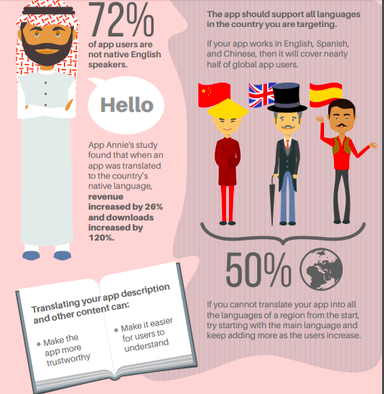
After an app switches to include a country’s native language in its settings, the number of downloads increases by 120%. People find it much easier to communicate using their native tongue, which means interacting with a multilingual app is a lot simpler.
Although English continues to represent the most common language on the Internet, almost 75% of app users do not speak English. This vast majority leaves a large market available for multilingual apps. According to Statista, the most common languages spoken by internet users in 2025 can be seen below:
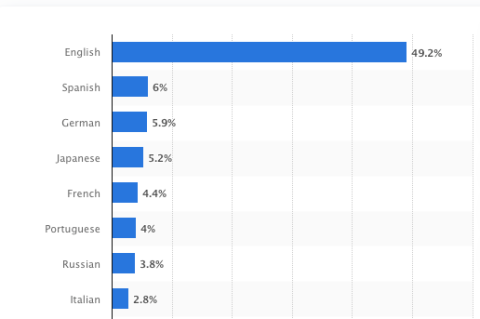
If your app targets only English-speaking users, you are missing out on three-quarters of global internet users who speak the other top languages.
Language, slang, symbols, and even colors carry different meanings in every culture. Some phrases that are neutral in one language may be offensive in another. If your brand is unaware of these nuances, it risks alienating the very customers it's trying to reach.
Consider the U.S. and Canada: both primarily use English, but localization still matters. Word choices, date formats, currency, and cultural references all differ. The same principle applies to every market you enter.
Color is a particularly underestimated variable in localization. The same color communicates different values in different regions — what signals trust in one country may signal caution or mourning in another.
McDonald's demonstrates this effectively. Each country's McDonald's website is customized for local color preferences, imagery, and layout rather than using a single global template. The McDonald's sites for South Korea, India, and Japan each reflect distinct regional visual languages — a practical example of localization done at scale.
Before selling to customers in a new country, research the cultural implications of your app's color palette, layout, dialect, and imagery. Work with local users or cultural consultants to validate your approach before launching.
Customers expect their problems to be solved quickly and easily. In fact, 7 out of every 10 customers prefer doing business with brands that deliver great service, states an American Express Study.
For example, the average company that generates $1 billion in annual revenue, can increase their revenue by $823 million over three years with moderate customer support.
The most commonly used customer support channels are:
Most businesses provide self-service guides to customers. These self-service programs benefit businesses who do not want to be overwhelmed with simple questions that take time to answer.
A staggering 81% of consumers handle simple issues themselves before reaching out to a customer care representative, reports Harvard Business Review.
Many companies would find it difficult to survive online if their business did not have a knowledge center. Using FAQs and brand content, businesses can answer questions easily.
Including a localized version of this guide would assist more people and ease the strain on customer service agents. Target languages facilitate self-service as people can read complex instructions in their own language. This localization, in turn, reduces the number of support cases and increases customer satisfaction.
Give customers a way to help themselves before reaching out to your company for support. Ideally, any content (customer support pages, guides, and blog content) that is available in the primary language should be localized into the target language.
The live chat box sits in the corner of an app or a website and pops up when the customer wants to know more about a product or service. With 79% of people using live chat, this channel offers the highest level of customer satisfaction.
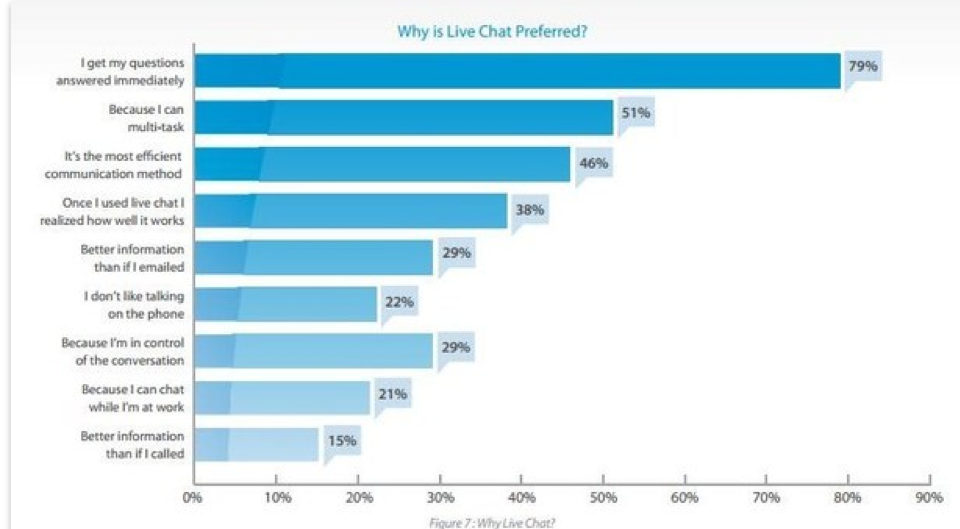
The way people communicate with each other and with brands varies in every country. Consider hiring a local translator who understands the communication nuances of that country to handle the live chat.
Social media has become an integral part of the customer service process.
Over 30% of customers who do not receive a reply to their complaints on social media will go to a competitor.
Meanwhile, 71% of consumers who have had a positive customer care experience on social media are likely to recommend the brand, says Cooler Insights.
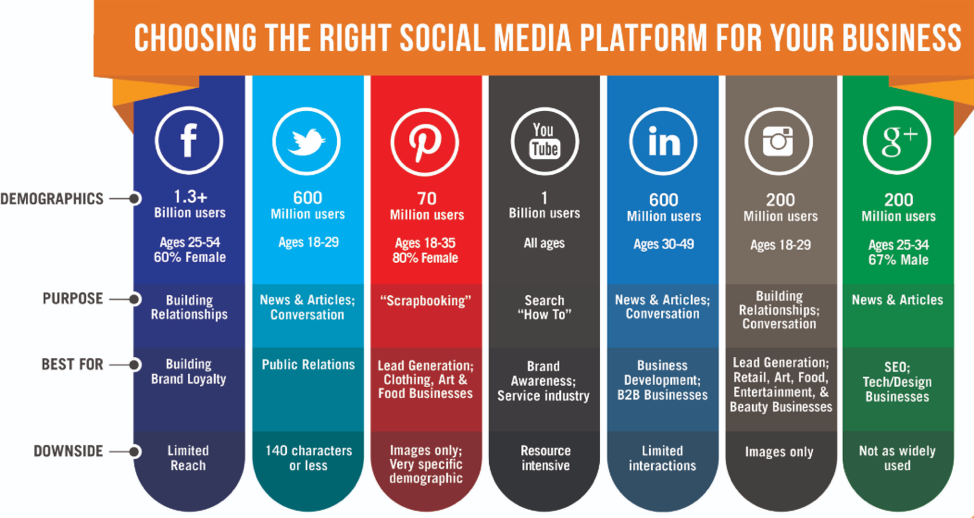
Social media habits vary by country when your company expands, internationally. To offer local social media customer support, analyze the popular social media networks in that country.
Adapt your company’s content to the type of content that people normally consume on those networks. For example, do these users watch more videos? Does this country have a lower number of mobile phones? Do users read more content? Offer localized customer support based on prevalent behaviors.
China, for example, prohibits access to YouTube, Twitter, and Facebook, which are otherwise popular globally. In such cases, a business would have to adapt its social media campaigns to the substitute platforms, such as WeChat and Sina Weibo.
AI-powered tools have fundamentally changed the economics of multilingual customer support. Where businesses once had to hire native-speaking agents for every language they wanted to cover, AI chatbots and translation layers can now handle a large share of multilingual interactions at scale.
Adoption of AI for customer support is widespread and growing: 87% of consumers have used AI customer support, with 72% using it regularly.
AI chatbots with real-time translation can detect the language a customer is using and respond automatically. Platforms like Zendesk, Intercom, and Freshchat offer built-in multilingual translation that routes to a live agent when needed.
Hybrid AI + human models are the current industry standard for global teams. AI handles 60–90% of repetitive queries across multiple languages simultaneously; human agents step in for complex, sensitive, or high-value interactions. This approach lowers cost per resolution while maintaining quality where it matters.
AI voice assistants handle phone support in multiple languages, resolving issues end-to-end by pulling from knowledge bases and CRM data — without requiring a full multilingual call center.
Not all AI-powered multilingual support delivers the same experience. Recent data shows the gaps as well: 59% of users have experienced slow or unresponsive AI support, and 45% are frustrated when they realize they're talking to AI rather than a human.
Ultimately, AI customer support is broadly accepted, but execution matters enormously. Poor handoffs, opaque escalation paths, and slow response times create as much risk as no multilingual support at all. Design your AI support with clear pathways to human agents, and make language switching frictionless.
Many businesses struggle to understand the difference between translation and localization and how to effectively implement both. The difference between translation and localization being:
Many businesses question whether to merely bridge the language gap (translate) or refine and attune the messaging (localize). The below chart explains the differences in translation, localization and copywriting. The chart outlines how each type of language has different characteristics and styles.
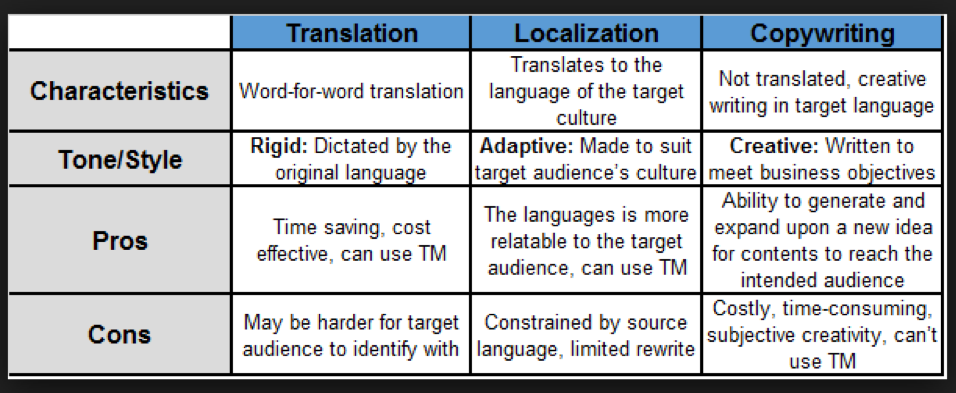
Further, the chart explains how translation is simply dictated by the original language while localization tailors content to the audience's culture. Copywriting is written to execute business goals.
While machine translation has evolved by leaps and bounds over the last few years, it is far from replacing human translators.
Localization and human translators always beat machine translators as customer support agents because they can:
In different languages, the same words have multiple meanings. Machine translators are unable to translate based on context. For example, “bear” in English could either refer to the animal or tolerance. For the machine, it becomes tricky to relate the word to the context simultaneously. This confusion could lead to inaccurate translation, and the sentences may end up not making sense. On the other hand, the human translator can localize and give correct meaning to the text.
Machine translators cannot pick up evolving dialects as fast as human translators. Complex algorithms would be needed to constantly learn new phrases, words, and their context. On the other hand, human translators can pick up dialects and localize them according to conversation quicker than machines. If your customer feeds new words to the machine, it may either result in no response or a strange combination of words.
Many brands have a distinct tone of conversation. If yours is funny or persuasive, machine translation misses that tone. Human translators are best suited when the content has a specific style and can incorporate the nuances of the original text.
Zendesk, a company that offers localized customer support, introduced a live chat application. Whenever a user receives a support message in a foreign language, the message gets machine translated into the native language.
As a customer support team answers the message in the native language, a human translator also personally translates the text. This answer is then sent back to the customer. This process allows companies to provide streamlined and frictionless support to foreign customers.
Self-service is your highest-leverage multilingual investment. Customers who can find answers in their own language without opening a ticket are more satisfied and cost less to serve.
Start with your existing help center content and identify the 10–20 articles that resolve the most tickets. Localize those first, in your highest-priority languages. Once localized content is live, track whether ticket volume drops in that locale — it usually does.
Practical steps:
Multilingual support means serving customers in multiple languages. Omnichannel support means serving customers consistently across multiple channels (chat, email, phone, social). The two work together: effective global customer support is typically both multilingual and omnichannel.
Multilingual support means serving customers in multiple languages. Omnichannel support means serving customers consistently across multiple channels (chat, email, phone, social). The two work together: effective global customer support is typically both multilingual and omnichannel.
AI translation handles routine support interactions reliably and 87% of consumers have already used AI for customer support. However, for complex, emotionally sensitive, or brand-voice-dependent interactions, a hybrid AI + human model consistently outperforms pure machine translation. Design your AI support with clear human escalation paths.
No. Social media platforms, messaging apps, and communication norms vary significantly by region. WeChat and Weibo dominate in China, while WhatsApp is the default in much of Latin America and the Middle East. Research channel preferences in each target market before investing in localized support infrastructure.
Offering customer support in the local language makes a business more familiar and relatable to users. Adding a human aspect to customer support allows users to see that your company values their presence. If you are interested in creating a stronger bond with consumers, hire a top translation services company to help make your app multilingual.
Based on location, every customer experiences language in a different way. Anticipate their needs and offer a localized language option for customer support.
Alpi Mantry is the VP of growth and relationships at Translate by Humans.
With 10 years of experience at Oracle, Deloitte, and Infosys, she now helps Translate By Humans caters to global brands such as Vogue, Nike, HSBC Europe, Amazon and many more. Translate by Humans offers human translation services for documents, apps, software, website and games across 75 languages and 50 countries.