How to Delegate: A Step-by-Step Guide for Agency Owners
Learn how to delegate effectively as an agency owner — what to delegate first, how to hand off work without losing quality, and the hiring sequence that...
Updated June 10, 2025

With AI-generated content flooding inboxes, misinformation circulating unchecked, and vendor exaggerations running rampant, skepticism has become the default mode of intelligent buyers. False claims and inflated testimonials only add to this distrust. Having a good product isn't enough, as buyers need evidence-based claims.
Buyer trust isn't just served on a platter anymore. Modern buyers are too experienced and too data-savvy to take your word at face value. Their trust has to be earned, be it through user reviews, third-party verification, independent certification, or transparent data.
With increasing competition and a growing need for transparency, buyers have become more cautious about where their money goes. Every purchase is a strategic decision, and every vendor claims a calculated risk.
As a result, decision-makers gravitate towards brands that feel grounded in credibility. They are more likely to buy from a company they trust since it's less of a risk. However, the reality is that today's buyer doesn't trust that easily. Nor should they.
Today, every business claims to be the best in the industry. So, buyers have learned to take bold claims with a grain of salt.
Self-claimed credibility statements made by companies about their own superiority often sound like noise because they're unproven and self-serving.
Buyers know one thing for sure: You're trying to sell them something.
When your voice is the only one vouching for your value, it raises a question rather than answers one.
The skepticism isn't irrational. Think about the last time you visited a software provider's homepage. You likely saw phrases like "world-class support" and "trusted by top brands." These sound impressive until you realize there's no source and no clear proof behind them.
Every competitor is using the same language. So, how can buyers tell who's truly exceptional and who's just echoing a good line?
Take, for example, a digital marketing agency that claims a 98% customer satisfaction rate. If there's no third-party data, client testimonials, or access to the methodology behind the stat, the number feels arbitrary. Is the number based on just five customers? When were they surveyed after onboarding? Is it even real? Without context or validation, the figure loses its power.
To make matters worse, there's evidence that customer reviews on certain websites are fake or exaggerated. One study found that Amazon vendors were asking for reviews in return for free products. Another study published in the International Journal of Research in Marketing found that exaggerated reviews were on the rise.
That's not to say self-promotion isn't expected. However, in many high-stakes environments, where product performance impacts everything from ROI to operations, decisions can't hinge on vague promises. Decision-makers need certainty, ideally from sources who don't have skin in the game.
Third-party verification means that an external, independent source confirms the claims a company makes about its products or services. In the SaaS space, it could be a security audit. For a marketing or advertising agency, it may be an industry certification or a review from a respected platform.
Third-party verification takes the power of proof out of the company's hands and places it in someone else's. That's mainly why it works.
As we've covered, in high-stakes environments, buyers are less interested in what a company says and more in what others can confirm about them. Third-party validation transforms marketing claims into evidence-backed insights. For executives and VPs who operate in a world of metrics, due diligence, and accountability, that kind of proof can sway decisions.
One of the most immediate benefits of third-party verification is enhanced credibility. A data privacy certification from ISO, SOC 2 compliance, or a verified badge from a platform like Clutch tells buyers that the company isn't just saying they're secure; someone else has also confirmed it.
These signals act as shortcuts to trust. They help buyers move forward with greater confidence and fewer objections, ultimately driving decisions.
Third-party verification also plays a role in mitigating risk. When an external auditor verifies your cybersecurity controls or a reputable publication features a customer case study, buyers see less room for exaggeration and more assurance that your product won't become a liability.
Such verification is especially impactful in finance, energy, healthcare, e-commerce, and technology industries, where data integrity and regulatory compliance are non-negotiable. It also shows prospects that you're not fraudulent since you were able to pass independent audits.
Besides trust and risk, transparency is also at play. Third-party verification signals that a company has nothing to hide and that it welcomes scrutiny. Empirical evidence shows that transparency allows customers to make decisions about a company's reliability and trustworthiness. The greater the transparency, the better.
Trust isn't a feature you add to your home page. Instead, it's something you earn through transparency and verification. Buyers want to see that an external source has looked under the hood and confirmed that what you're promising holds water.
Here are some ways to earn third-party verification to satisfy your prospects.
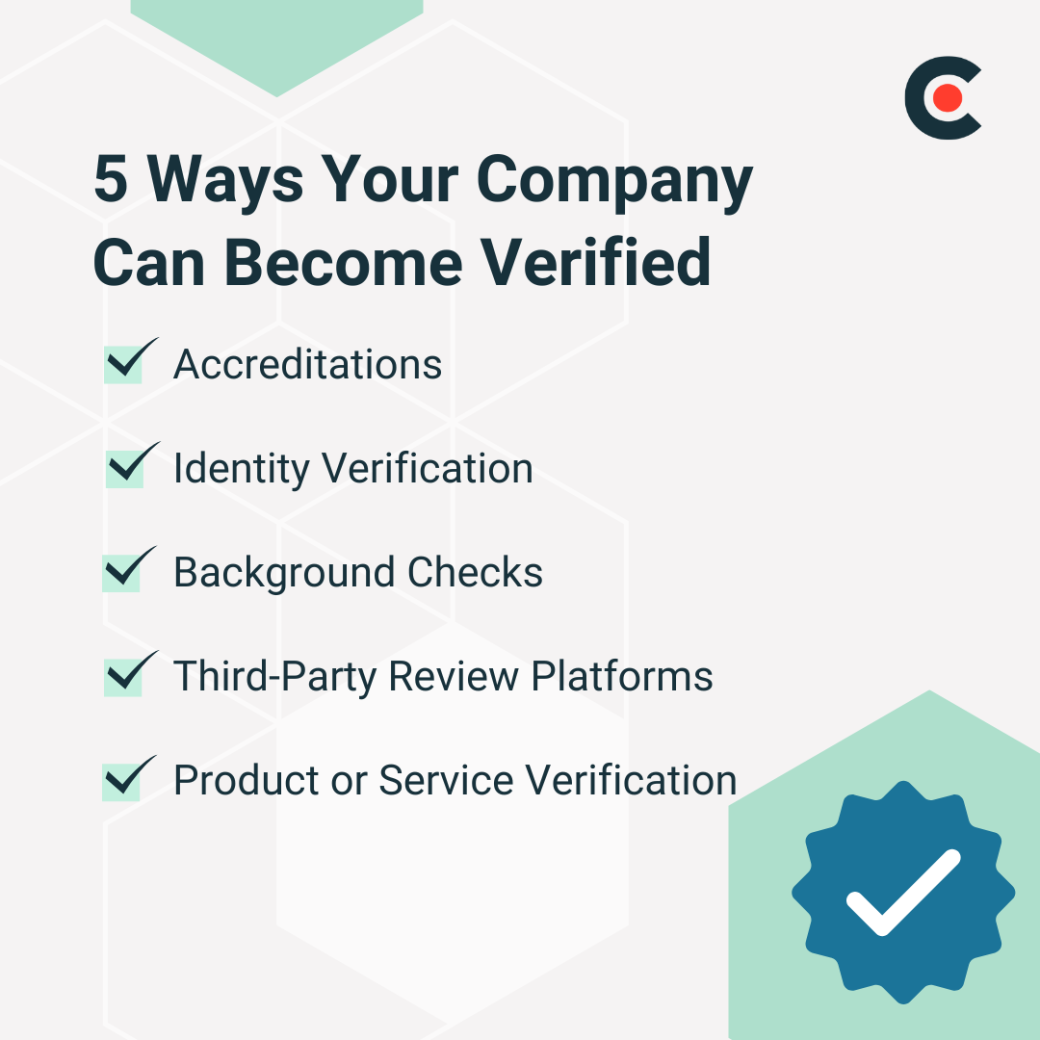
An accreditation is a formal recognition issued by an established authority or industry body that confirms your company meets specific standards. Accreditations can cover several areas, including business ethics, sustainability practices, security protocols, operational excellence, and so on.
These third-party stamps of approval communicate that your company isn't just self-regulating, but it's being held to widely accepted and independently enforced standards.
Some examples of accreditations are ISO certifications and SOC 2 compliance. Similarly, Better Business Bureau (BBB) accreditation shows that a company has committed to resolving customer complaints and upholding ethical business practices.
Another example is Clutch Verified, which is a certification that Clutch offers to companies that have undergone a rigorous vetting process. To earn this verification, businesses must undergo a credit check and collect verified Clutch reviews. This type of verification helps buyers feel confident that the B2B service provider that they hire is legitimate and trustworthy.
In identity verification, a third party confirms that your company and its key representatives are who they say they are. It usually involves documentation checks, government-issued IDs, and cross-referencing business records.
For example, government-issued DUNS numbers or EIN confirmations are a sort of identity verification, as are verified business profiles on platforms like LinkedIn.
Identity verification reassures buyers that there's a legitimate team behind the product or service and that the company exists beyond a polished website. Especially in cross-border collaborations or remote partnerships, identity verification gives buyers peace of mind that they're dealing with a real business, not a shell or fly-by-night operation.
Background checks evaluate a company's history and key personnel for any red flags, like financial history, past business conduct, criminal records, and legal issues. Partner screening from a service like Checkr is a good example here.
Similarly, business credit reports from providers like Experian or Dun & Bradstreet can give buyers an understanding of a company's financial stability and creditworthiness.
Background checks are imperative because buyers want to minimize reputational risk. If they partner with your company and you're later exposed for unethical practices, their brand suffers, too. A clean background establishes your company as a vetted and responsible entity.
Third-party review websites collect and publish customer reviews about products or services. The best ones vet reviewers to prevent fake feedback and give readers real-world insights into a vendor's strengths and weaknesses.
Clutch verifies reviews using reviewer-provided information and online research. This ensures that competitors don’t try to drive down client ratings and that businesses don’t try to artificially inflate their ratings with fake reviews. As a result, buyers can trust that the verified reviews they read are real and accurately represent real projects.
Ultimately, your portfolio of online reviews can help you add context and authenticity that your landing pages cannot fully replicate. Verified reviews across use cases and industries signal that your product performs well, not just occasionally, but reliably.
In this type of third-party verification, an external validator analyzes your product or service's performance, safety, and quality. It may be technical, legal, or experiential, based on the industry.
For example, physical products get third-party lab tests, while certifications like "Google Partner" or "Shopify Plus Certified" are experiential validations for digital products.
Product or service verification proves that your offering has been tested. It shows that you meet the performance criteria set by the leaders in the space. Also, buyers see that you're not operating in isolation but are a part of a verified network of credible providers.
Self-claimed credibility holds little weight. Buyers are too experienced and cautious to trust a company's word alone, especially when real business outcomes are on the line.
Independent verification removes the bias. It confirms performance, security, and reliability through objective, external sources. These signals, from verified reviews to certifications and background checks, help decision-makers assess a provider's trustworthiness.