Evaluating an Marketing Agency in the AI Search Era
AI search has completely changed how people interact with online content. When an AI summary appears at the top of search results, Google users only click a...
Updated March 25, 2026

B2B buyers don’t make impulse decisions — they need proof that your company is as trustworthy, capable, and legitimate as it claims to be. While building this type of trust is not easy, there are different types of verification strategies companies can implement to prove its credibility, reduce buyers’ hesitation, and grow their business.
B2B buying decisions go beyond the desk where it’s made. The ramifications of that decision reach the sales floor, the warehouse, and even the executive suite. A single purchasing misstep can cost their entire organization time, money, and credibility.
That kind of pressure shapes how B2B buyers think and the choices they make. B2B buyers aren't impulsive; instead, they’re skeptical — understandably so. They're looking for credible vendors they can trust, but trust doesn’t come easily anymore. Misinformation spreads far and fast, scams look more legitimate by the day, and vague promises don’t cut it when the stakes are high.
These buyers want proof. They want to see solid evidence. They want to know who they’re working with before they commit.
That’s why verification matters — it builds the type of B2B trust and confidence that spurs action. It shortens sales cycles, strengthens business partnerships, and helps buyers move forward with clarity instead of caution.
Let’s start by breaking down the various types of verification, how each one promotes trust, and the best practices for using verification to encourage potential buyers to trust you.
When it comes to business, verification is about backing up your claims with facts and proving you’re honest and legitimate. It’s how businesses prove they are who they say they are, keep their promises, and operate with integrity, even behind the scenes.
For buyers, verification removes the guesswork from decision-making. Instead of relying on hope or gut instinct, B2B buyers can rely on verified data, confirmed identities, and proven histories. It helps them separate the real from the risky before they place a large order, sign a contract, or commit.
Before trust can exist, business verification must prove that a company is legitimate, registered, and qualified to operate. This step typically includes confirming your business credentials, verifying your certifications, and running background checks on your key personnel.
Business identity verification reassures buyers that the organization they plan to work with is real, not a shell company or scam operation. This type of verification is critical when large orders, sensitive data, or long-term contracts are at stake.
Clutch Verified is an excellent example of this kind of verification. Each verified company has undergone our rigorous multi-step vetting process, including a business credit check, and has been deemed legitimate and trustworthy. Consequently, potential buyers can feel confident in hiring your business for their upcoming project.
Sure, your product descriptions sound good on paper, but verification confirms that you consistently deliver what you promise. That generally includes quality assurance documentation, third-party testing, and compliance certifications that shore up your claims with concrete, measurable evidence.
Product verification occurs in nearly every industry, from cybersecurity to food and beverage. For instance, independent labs play a crucial role in verifying the safety and regulatory compliance of cosmetics. This includes rigorous testing for the presence of heavy metals, microbes, and allergens. At the same time, software developers may rely on third-party security experts to identify vulnerabilities in their computer systems and networks.
Seeing that a product or service has been independently evaluated and meets the standards it claims to meet erases doubt from buyers’ minds and nudges them to proceed with the transaction.
While most buyers read online reviews and testimonials, they also know that not all reviews are genuine. Some companies may go as far as posting fake reviews to manipulate public perception of their brand. For this reason, verified reviews are particularly valuable for potential buyers.
Verified purchase badges and third-party review platforms help buyers separate authentic feedback from filler. For instance, an internal Clutch team verifies every review posted on our platform using reviewer-provided information and online research. This type of verification shows that the people vouching for you as a vendor have truly used your product or service.
For vendors, it’s a way to build credibility. For buyers, it’s a way to read authentic reviews about a company before doing business.
Your product isn’t the be-all, end-all of earning trust. The steps you take to make that product also shape B2B trust. Buyers want to see your production methods, supply chain details, and behind-the-scenes processes that affect (and validate) quality and delivery.
Transparency here can also mean providing potential buyers access to your audits, background checks, or third-party inspections. The more you share about your operations, the more trust can develop between you and potential buyers.
Buyers don’t just want to hear promises; they need to see proof. In a market where every purchase can affect profits, timelines, and reputations, verified information gives buyers something to hold onto. It tells them your company is real, your product works, and your claims check out.
Here’s how verification turns uncertainty into confidence.
Verification acts like a safety net. When a product is certified or a company is registered and vetted, the buyer’s chance of getting burned decreases. Verification tells buyers that working with your company isn’t guesswork — someone has already tested your product and brand, and you passed.
Third-party validation adds weight to your company’s claims. Being backed by recognized standards like an ISO certification or a trusted client’s endorsement tells buyers that others have already done their homework, and your company earned their trust.
Why is credibility important? It shortens the distance between consideration and conversion. A credible business doesn’t have to jump through hoops to convince buyers of its legitimacy, quality, or trustworthiness because its documented and verified track record does the heavy lifting.
Buyers trust what they can see. Verification helps bring what’s behind the scenes to the forefront:
When you open your doors and let people look inside, it shows you have nothing to hide.
There’s a chasm between “someone said this worked” and “someone verified that it did.” Verified reviews, confirmed purchases, and honest user feedback add authenticity that anonymous testimonials can’t come close to matching.
Social proof works best when it’s specific, recent, and backed by evidence instead of vague praise buried in a sea of generic — and questionable — five-star ratings.
Verification is a quiet way of saying that you stand by your claims. Audit trails, background checks, and certifications demonstrate that your company is open to scrutiny and confident in its offerings. That kind of accountability grows trust faster than glib, well-phrased promises ever could.
Verification alone won’t make a difference if no one sees it or understands what it means. If you genuinely want to build B2B trust, you need to go beyond collecting badges and certificates. It’s just as important to display verification in a way that’s clear, timely, and relevant to buyer concerns.
These best practices will help your company do it right.
Best Practices for Building Trust Through Verification
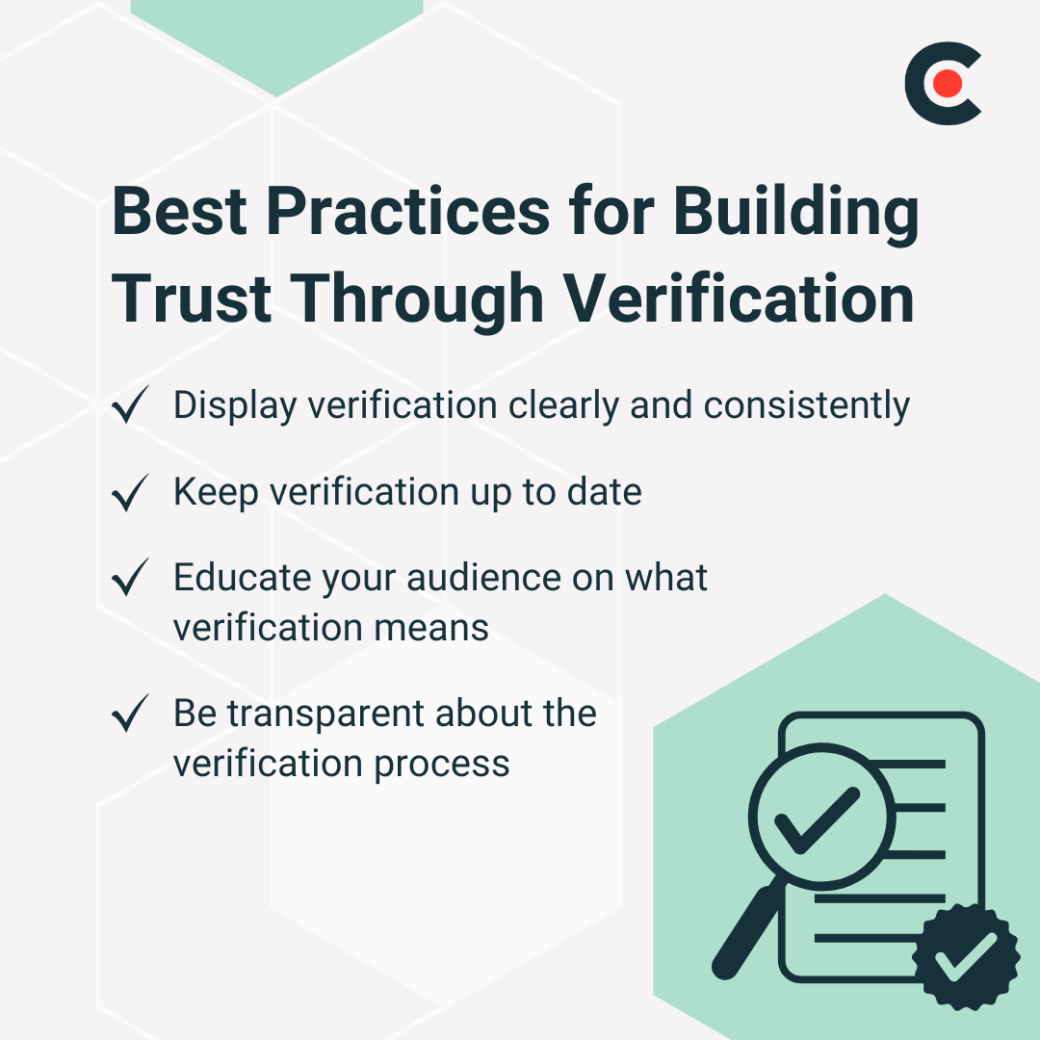
If your trust signals are buried at the bottom of your webpage or scattered inconsistently across your marketing materials, they lose their impact. Buyers need to see them early and often on your homepage, product pages, pitch decks, and sales emails.
For example, UK-based full-service digital agency Soap Media prominently features its 2024 Clutch 1000 badge and a carousel of verified Clutch reviews on its homepage, keeping its verification status squarely in front of its audience's eyes. It also repeatedly mentions its multiple Clutch accolades throughout its "About Us" timeline.
Verification should never feel like fine print. Instead, treat it like a headline feature. Industry certifications, Clutch Verified badges, and third-party review scores — no matter what kind of verification you have, the more prominently you feature it, the more confidence potential buyers will develop in you.
Consistency matters, too. Use the same badges and language across channels. Repetition reinforces your credibility and prevents buyers from wondering if your trust signals are outdated or only relevant to a single product or moment.
Verifications aren’t necessarily forever. Some expire, and others lose relevance over time or as industry standards evolve. Letting them go stale can quietly erode trust, especially if potential buyers catch it before you do.
Build a schedule to review and renew certifications. Check links to third-party validations, and confirm that your trust signals reflect your current offerings. A compliance certificate from three years ago might have been meaningful then, but if it’s out of date now, it may do more harm than good.
For example, a restaurant’s website still touts its 2000 win for “best pizza in the county” but displays no more recent accolades. Potential customers have to wonder what happened to their pizza quality over the past 25 years since their big win. It’s better to let that go — and work toward a new win — than continue displaying a relic of past success.
Up-to-date verification shows you’re still doing excellent work and not coasting on ancient credentials.
A badge alone won’t always make sense to a buyer. Industry jargon, unfamiliar logos, and technical certifications can look impressive without actually communicating meaningful value.
Take a moment to explain what the verification means:
Framing it in terms of how it benefits the buyer makes verification clearer. Here are some examples:
Clarifying these points sets you apart from competitors who list credentials without context and hope they stand on their own merit.
Buyers are more likely to trust verification when they understand the verification process. Was there a third-party audit? Did it involve interviews, inspections, or testing? Did a known authority grant the status, or was it self-reported?
When possible, offer a peek behind the curtain. Link to the issuing body, provide documentation, or outline the steps you took to earn the credential. Transparency adds weight and shows you’re not afraid to be held accountable.
For example, an accounting firm may want to explain the value of an SOC 2 certification, which validates that they use robust security controls and are compliant with industry standards. On their website, they might write, "To become SOC 2 certified, we went through a months-long audit by an independent firm that reviewed our data security practices. You can learn more about the criteria here, and read our summary report.”
Because they have a better understanding of what the certification means, potential customers can feel more confident when hiring an accountant from this firm.
This kind of openness can also prompt questions — the good kind. Buyers who take the time to learn more about you are often ready to move deeper into the buying process. They’re engaging, evaluating, and envisioning what it’s like to work with you.
B2B trust isn’t freely given; it must be earned, and verification is how you earn it. Brands that back up their claims with real evidence stand out in today’s skeptical B2B environment.
Each act of verification — proving your identity, confirming your product’s quality, showcasing verified reviews, and being transparent about your processes — chips away at buyer doubt. B2B buyers want to feel confident that they’re making smart, safe, informed decisions. The more you clearly, consistently, and credibly show them, the faster they’ll move from cautious to committed.