7 Tips For Designing Web Forms
Clutch surveyed 502 web users about what they actually want from form design. Here are 7 data-backed UX principles that reduce abandonment and improve...
Updated June 4, 2026

Social proof can build trust and increase conversions, but placement matters. By featuring customer reviews, ratings, testimonials, and user-generated content in strategic areas of your website, you can guide shoppers and reinforce confidence throughout the buying journey.
Customers are savvy researchers, especially when they come across new brands. They skim reviews, watch testimonials, and even check out Reddit threads.
These interactions are examples of social proof, which is evidence that other customers are satisfied with your products. A few well-placed reviews or five-star ratings can help convince even the most skeptical people to buy.
Looking for a Web Design agency?
Compare our list of top Web Design companies near you
Social proof is often highly influential. In a Clutch survey, 37% of consumers say customer reviews are more likely to win them over when they’re on the fence about an unfamiliar brand, compared to 17% who said the same about brand-controlled copy. Despite this, many brands focus on their own words more than their customers’.
Tamara Hofer, Copywriter and Marketing Assistant at The Branx, sees a lack of proof as one of the biggest conversion leaks on client websites. She explains, “Some companies pour everything into the hero and then drop the visitor into a generic contact form three clicks deeper. No proof in between. No specificity. No momentum, and no real benefit or trust. It asks a stranger to go from ‘interesting’ to ‘meeting to close the deal’ in one move.”
Collecting social proof isn’t enough. To build credibility, you need to show off your evidence in the right places.
Anyone can create a convincing website, especially in the AI era. When people land on your homepage, they’re looking for signs that your brand is real and trustworthy.
Use this space to build credibility instead of jumping straight into a sales pitch. New visitors usually don’t have any intent yet. They just want to learn more about your brand.
Start by including a rotating customer testimonial above the fold. This evidence appears before visitors have to scroll, so they’re more likely to spot it. Keep it short but enticing.
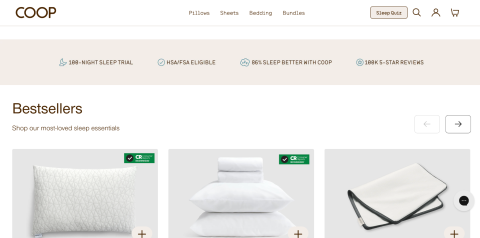
Aggregate ratings and customer counts use numbers to quickly capture attention. For example, Coop’s homepage boasts that it has “100,000+ 5-star reviews.” That’s more concrete than something like “Thousands of customers love our pillows!”
Press mentions are another persuasive type of social proof because they come from reputable outlets. If a newspaper features your company, include a quote on your homepage. This is also a good place to spotlight top rankings and awards from review sites.
As you design your homepage, avoid bogging it down with long-form reviews and walls of text. Visitors probably won’t read them, especially if they’re on mobile devices. You should also steer clear of generic “verified buyer” stamps without context and aim to showcase quality evidence.
Shoppers are almost always looking for specific types of products. Organizing your content into categories and collection pages helps them find what they need quickly.
You can use these pages for item-specific social proof. Sephora, for instance, includes a star rating and review count under each product title to show that real people have already bought the item and liked it.
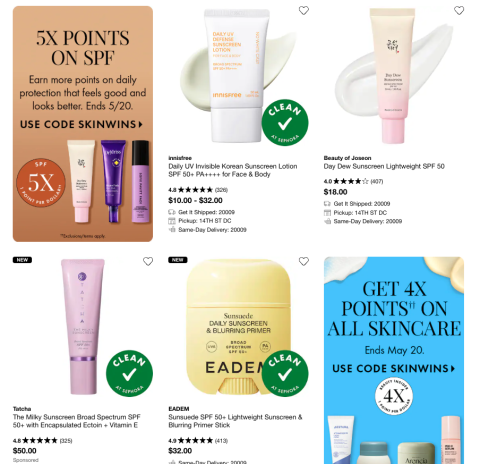
Don’t get too hung up on individual ratings. Review volume usually matters more than the stars — it shows how much customer feedback you’ve received. Many reviews are less prone to bias, too. Many people would trust a 4.1-star product rated by 300 people more than a 5-star one with only a single review.
Use tags to spotlight a few products with lots of reviews or high ratings. A highly reviewed product could get a “bestseller” tag, while one that consistently earns five stars gets tagged as “most-loved.” These trust signals encourage visitors to take a closer look at the reviews to figure out why customers value them.
Once visitors arrive on your product page, they’re usually at least somewhat receptive to your brand. Now, they’re trying to confirm if this specific product is right for them.
However, you can still strengthen their trust with this layout:
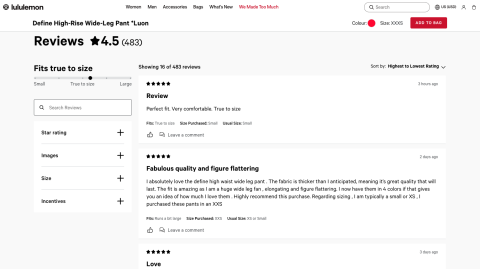
Lululemon is one brand that makes social proof a core part of its product pages. For example, this page for high-rise pants puts key product details at the top. Visitors only need to scroll for a few seconds to find a reviews tab with a star rating and the number of reviews. They can search these comments for keywords or filter them by size and other categories.
Resist the urge to bury or erase negative reviews. If your product pages only have five-star reviews, customers will get suspicious — and rightfully so.
Instead, let customers filter reviews by rating to see both positive and negative feedback. You should also respond tactfully to at least some of the negative reviews on the product pages. If someone complains that your sizing is off, offer to send the correct size for free. If they’re unhappy with the quality, apologize and ask whether they'd like a refund.
Being upfront is key. When customers see that your brand isn’t hiding unflattering reviews, they’re more likely to trust you.
Shoppers may still hesitate after they add products to their carts, especially if they haven’t purchased from your brand before. Social proof reassures them that they’re making the right call, which can help reduce cart abandonment.
One simple tactic is to include a short testimonial or star rating next to each line item. If a customer is on the fence, a 4.8-star rating or a positive comment could convince them to complete their purchase. You should also add a brief note, such as “80 customers bought this in the last 30 days.”
Etsy’s cart pages usually include star ratings and demand-related messages. If you add a sweatshirt to your cart, you might see something like this: “In 152 carts, 6 bought in the past 24 hours.” This text often appears in red, creating a sense of urgency while leaving the available inventory unclear. Shoppers can’t tell if there’s one sweatshirt left or 200, which encourages faster decisions.
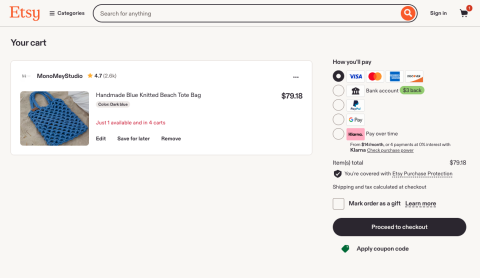
These updates also serve as effective social proof. After all, if 152 other people are considering an item, it must be desirable.
You may feel tempted to link to a reviews page or add a pop-up here. That’s usually a mistake. If you divert shoppers' attention from the checkout call-to-action button, they may not come back. Instead, give them a sprinkle of social proof that reassures them without distracting from your ultimate goal: getting them to make a purchase.
Just because a shopper makes it all the way to check out doesn’t mean they’ll follow through. In fact, 84% of shoppers regularly start and abandon checkouts.
It often comes down to uncertainty about value. As customers gaze at the total price, they might question if the purchase is actually worth it.
Give shoppers one last confidence boost before they complete their purchase. A short customer testimonial placed near the payment button, along with a satisfaction guarantee badge, can help ease any final hesitation.
Secure checkout signals are green flags for customers, too. These include:
When customers trust that your site is secure, they’ll feel more confident entering their credit card details. Transparent return and shipping information also helps reassure buyers that you care about their experience.
Don’t forget about your new customers after their first purchase. Use social proof to close the loop and keep them coming back.
After they check out, take them to a thank-you page that confirms their order and explains what happens next. Some brands also include more social proof with messages like, “Congratulations! You’ve joined 10,000+ customers who love our software.” This evidence can help prevent post-purchase regret.
Keep the momentum by encouraging shoppers to create their own social proof. Around 48 hours after delivery, send a friendly email inviting them to review your products and share photos. Be sure to include a direct link to your review page to minimize friction.
UGC hashtag prompts are another practical way to encourage involvement. Invite customers to post photos and videos on social media using your brand hashtags. For example, Aerie customers often use the hashtag #aeriereal to share their favorite outfits on Instagram. This authentic content can strengthen your reputation and help attract more customers.

And don’t forget about cross-selling. Use sales data to analyze your audience’s buying habits and spot trends. Then send periodic “people also love this” emails with complementary products. If a customer buys a tent, a timely cross-selling message could motivate them to buy a camping stove, too.
Keep in touch with customers by sending regular follow-up emails. Use these messages to share positive reviews and UGC. This could be anything from photos shared by social media followers to a hilarious video someone filmed of their cat playing with your products.
Of course, always ask creators for permission before reposting their content. Otherwise, you risk shattering the trust you’ve been working so hard to build.
This type of content reinforces that customers made the right decision, since others obviously appreciate your products. As they skim reviews and admire social media photos, they may feel inspired to share their own experiences. Or they might return to your website to order something else.
Social proof can also make abandoned cart emails more persuasive. Include the top review of the abandoned item, along with its star rating. You could even add customer photos or testimonials. This content reminds visitors why they liked the product in the first place and can encourage them to complete checkout.
Win-back campaigns are another excellent way to use UGC. A detailed testimonial or a collection of reviews is often all it takes to overcome hesitation and bring customers back. Plus, this tactic is more affordable than offering huge discounts.
Even the best social proof won’t help much if you put it in the wrong place. Avoid these common errors:
Be sure to test your design across many devices to ensure everyone can easily see your social proof.
Social proof isn’t about gathering the most glowing reviews or getting five-star ratings every time. It’s about placing the evidence you have in the right locations where visitors will actually see it.
Get started by auditing one page this week with the framework from above. Begin with an aggregate rating and review count above the fold, then zoom in with a filterable review module in the middle of the page. Round out the space with a gallery of UGC and a “customers also asked” box.
For more practical tips, check out this guide to earning more positive reviews without buying them.