Mobile Apps vs. Web Apps vs. Websites: What Does Your Business Need?
Should you build a mobile app, web app, or website? Learn the key differences, costs, and use cases to choose the right platform for your product and users.
Updated May 27, 2026

According to new Clutch data, two in five (42%) consumers say there are specific permissions they would never grant to social media apps. Explore the types of data social media platforms collect, how they monetize it, and what users can do to better protect their privacy.
For many people, posting, sharing, and messaging on social media is a part of everyday life. But with every scroll, click, connection, and like, social media apps collect massive amounts of data and monetize it.
Still, privacy is a growing concern for many users. According to a Clutch survey, 42% of users say there are certain permissions they would never allow on social media. With so many stories about data misuse in the news, it’s no wonder people are becoming more concerned.
Social media apps stand apart from other platforms because of the sheer volume and sensitivity of the information they collect, often giving companies an unusually detailed picture of users’ identities, relationships, behaviors, and interests.
Looking for a Mobile App Development agency?
Compare our list of top Mobile App Development companies near you
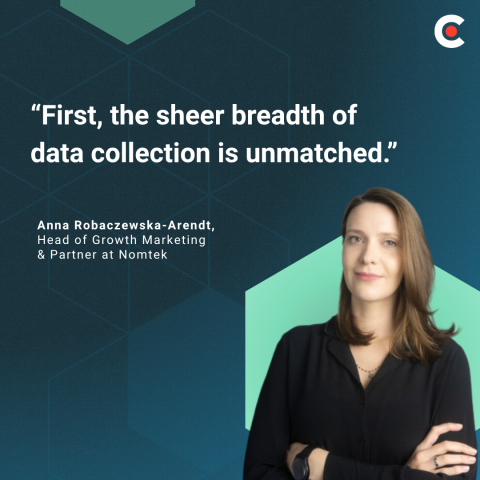
“First, the sheer breadth of data collection is unmatched,” explains Anna Robaczewska-Arendt, Head of Growth Marketing & Partner at Nomtek. “The 2025 Incogni Social Media Privacy Ranking found that Meta's platforms and TikTok are the most privacy-invasive apps studied, collecting data across every category measured — and some of it shockingly sensitive. LinkedIn's app, for instance, indicates it may collect race or ethnicity data. Meta's platforms may collect sexual orientation and health information.”
In this piece, you'll learn more about the types of data social media apps collect and how they're monetizing it. You'll also learn some tips to help you protect your social media privacy without going completely off the grid.
It's easy to see why users are cautious about protecting their privacy on social media. In 2018, the Cambridge Analytica scandal dominated headlines, and millions of users learned that a lighthearted Facebook quiz app had harvested their data for a political consulting firm.
The news hasn't been any better since. Facebook and its parent company, Meta, have been the target of multiple lawsuits touching on privacy concerns, including a $725 million class action regarding Cambridge Analytica that settled in 2022, and an $8 billion lawsuit by investors that settled in 2025.
Meta isn't alone. FTC regulators fined Twitter for misusing data in 2022. Now called X, the company was hit by a massive data breach in 2025.
Consumers are increasingly aware of how much personal data social media has on them. A weather app may know where you live, but a social media app knows that information, plus your name, your face, who your close friends and family are, and many of your interests.
Beyond that information, they can use inferred data to predict your behavior, preferences, purchasing habits, and political views, often with surprising accuracy.
“One of the most underestimated privacy loopholes associated with social media applications is something known as 'inference,’ said Gagan Singh Shekhawat, a Growth Marketing Manager at Konstant Infosolutions. “This simply means that social media platforms not only collect the information that a user shares, such as profile details, photos, or messages, they also monitor user preferences and behavior to get detailed insights about a user.”
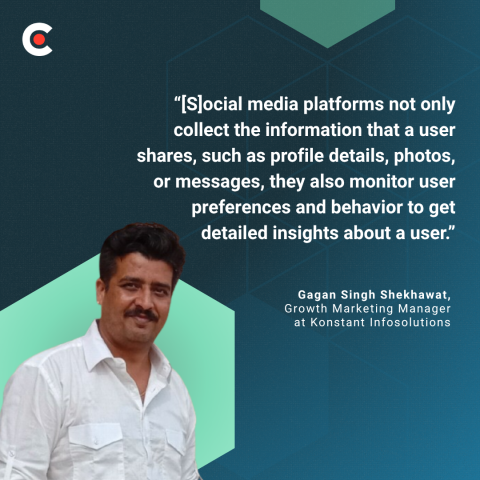
This means that social media platforms are collecting even more data than most users think. Shekhawat provided more information, saying, “For example, social media platforms can monitor users are engaging with what type of content, what products they are searching, and even the time they are active on the app. With this data, applications can build detailed profiles about user’s daily routines, location behavior, shopping habits, and personal interests.”
The problem with inferred data is that it can paint a really detailed picture of you without you ever saying it outright. That can lead to hyper-targeted ads, feeds that quietly shape what you see and think, and in some cases, assumptions about you that affect things like job opportunities or services. It also raises the stakes if there’s a data breach, since even sensitive info you never actually shared can still be exposed.
When users think about the data social media collects, they might think of the things they know they share: profile info, posts, messages, photos, and search queries. However, there's an additional layer of data that apps collect passively.
Users may not even realize that social media apps could have access to their:
Companies can piece together an accurate portrait of you from these data points, which they can use when selling to advertisers. A profile of you might include your:
While it's good to be careful of what you post, that's only a small amount of what you're actually sharing on social media.
Social media companies are hungry for your data because they can monetize it. Most people are aware of targeted advertising, where companies pay social media to show ads to people of a certain demographic. For instance, targeted local ads may use your location information, or you may get ads based on your online shopping patterns.
Meta and Google take it even further, using data to create lookalike audiences, or groups similar to those an advertiser is already targeting. Social media companies may also have partnerships with third-party data brokers, allowing them to use even more information to build your advertising profile.
Social media companies have a double motive for keeping you glued to your phone. By using personal information to curate users' feeds, social media companies create a captive audience attractive to advertisers. And the more time a user spends on social media, the more information they provide.
More revenue opportunities are emerging. Social media apps increasingly function as online marketplaces, providing another stream of data on purchase intent. Increasing numbers of people also use apps for purchases, leaving behind data that can give marketers insights into shopping behavior and finances. Posts, photos, and comments can also be used for training AI models.
Clutch also asked the 42% of users concerned about social media about which specific permissions they wouldn't grant. Overall, users are most hesitant to grant app permissions for payment methods (31%), followed by location data (23%) and contacts (19%).
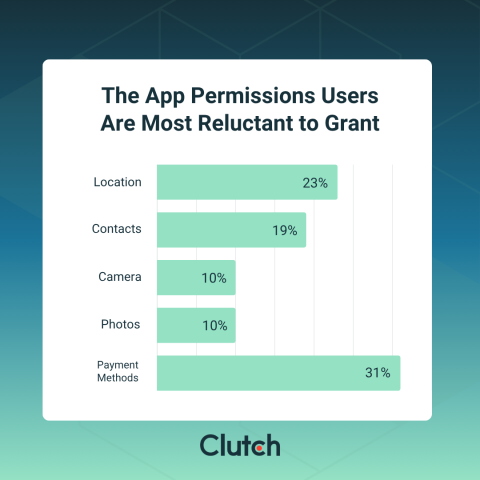
One location check while you're using an app may not yield much information for data collectors, but location patterns do. Someone could accurately infer where you live, work, and spend your free time from just a few days of that data. A contacts list situates you within multiple social networks. And of course, the microphone and camera on your phone can reveal highly private information if they're accessed without your knowledge.
When you download an app, you typically receive multiple notifications requesting various permissions. Many users, anxious to get started, just tap "Allow," even for permissions not needed for an app's core function. That's permission creep, and it can seriously impact your privacy.
App developers are wise to it, too. Some apps specifically ask for broad permissions, both to make it easier for developers and better for the app’s analytics. Years after you initially downloaded it, you may have stopped using an app, but the permissions you granted are still active, allowing the app to collect and sell your data without you noticing.
Social media companies are aggressive in collecting data, but there are things regular users can do to protect themselves.
Dig into your settings to see the permissions you've given your social media apps. iOS users can open Settings, then Privacy and Security, to check which apps have certain permissions. You can also check who has access to your Microphone, Contacts, and Photos by tapping App Settings, then Privacy and Security.
The process is similar for Android users. Open Settings, then Privacy, then Permission Manager. You'll see a list of permissions and which apps have access to them.
Remove any permissions that seem suspicious or aren't core to an app's functionality. The only apps that need access to your location are location-based apps, such as workout trackers and driving navigation. The only apps that need access to your camera are photo apps.
To see fewer targeted ads, you can turn off ad personalization in your phone's settings. iOS users can open Settings, go to Privacy and Security, and then Apple Advertising to toggle targeted ads on or off. To stop social media apps from tracking your activity across other companies' apps, go to Privacy and Security, then Tracking. There, you can change the settings for individual apps.
Android users can open Settings, then Google, then All Services. Under Privacy & Security, you'll see the Ads section. There, you can delete the targeted-advertiser ID Android uses on your device.
To stop activity tracking, go to Google and tap on Manage My Google Account. Select Data & Privacy, then under Activity Controls, tap Web & App Activity. There, you can disable tracking to prevent all apps from collecting data on other apps, web searches, and browser activity.
Social media companies collect data on users through background tracking, but there's plenty of information they can get straight from you. Your profile details, posts, comments, and photos can all be quite revealing.
Users don't need to stop sharing entirely, but they should consider their online boundaries. You may decide to hold back some family photos from your posts or refrain from discussing certain personal information online.
Remember, social media and data companies string together little crumbs of information from across your account. One post might not give away much, but your posting history is another story.
Growing user awareness of social media privacy means more alternatives. If you want a Twitter-like experience, you can hop over to apps like Bluesky or Mastodon. Encrypted messaging apps, such as Signal, are a better place for sensitive information than Facebook Messenger. Proton Mail is more protective of user data than Gmail.
Not all of these privacy-focused alternatives are as easy to use as traditional social media, and since they're used by fewer people, they may not be a good way to stay in touch or keep a group visible. However, they're worth checking out if you're concerned about privacy.
Instead of downloading an app, you can also use the browser-based version of a social media network. This keeps the social media company off your contacts list and prevents them from using the app to collect background data. Using your phone's browser to visit social media is unwieldy, but it may be a worthwhile trade-off.
State and federal governments are aware of the unique privacy threats posed by social media. Many states have their own data privacy laws, with California's Consumer Privacy Act (CCPA) among the most prominent. CCPA gives consumers the right to know what data an organization collects, the right to opt out of having their data sold, and more. Users also have the right to request the deletion of their data, subject to certain exceptions.
Other states have similar consumer privacy laws, though not all offer protections as broad as California's. States offering these laws typically have official websites designed to help residents exercise their rights.
The European Union has the General Data Protection Act, or GDPR, which gives European residents broad protections, including the right to correct their data and, under certain circumstances, the right to have it deleted. The law applies to anyone staying in the EU, including Americans working or traveling there. Notably, non-EU companies must comply with GDPR when they offer goods or services to EU residents.
Many other countries, including Canada, India, and the United Kingdom, have their own data privacy laws. Though these laws vary in their protections, they all provide their residents with tools to protect their personal information.
While many apps on your phone pose potential privacy risks, social media apps are unique in the amount of data they collect and how they monetize what they know.
Completely opting out of social media and the data economy may not be possible for most of us, but users who understand the risks are better able to set boundaries that make sense for them.