Lead Quality vs. Lead Quantity: Why B2B Teams Are Rethinking Their Funnel in 2026
Bigger buying committees and tighter budgets are forcing B2B teams to rethink lead quality vs. quantity. Here's how top teams rebalance the tradeoff in 2026.
Updated May 26, 2026

Social listening and social monitoring can help your brand thrive in different ways. Knowing when to use each is essential. This article explores key differences, best practices, and other tips for success.
Social listening and monitoring can sound like nearly the same thing. Both involve watching social media platforms to gain valuable insights from potential customers. But the two practices deliver distinct insights.
Understanding their differences can help your brand make more informed marketing decisions, fine-tune strategies, and connect with new leads. This guide will help you do this, exploring each concept, best practices for success, and more tips to help your company benefit from these growing marketing trends.
Looking for a Digital Marketing agency?
Compare our list of top Digital Marketing companies near you
Social listening and monitoring both involve tracking posts on social media platforms like Instagram, X, TikTok, and Facebook. But they differ in their focus. Social listening is more general, while social monitoring watches for direct engagements with your brand.
Christopher Savage, president and founder of Savage Global Marketing, summarizes the distinct value proposition of each: “Social listening digs deeper into customer sentiment and emerging trends, while social monitoring tracks brand mentions in real time. Together, they offer a fuller picture and enable a more agile approach [to marketing].”

Here’s a closer look.
Social monitoring focuses on tracking real-time engagements with your brand across platforms. This includes mentions, comments, tags, and messages, among others. The goals of the strategy include:
Peter Palarchio of NAV43 says his company uses social monitoring to “maintain strong customer engagement in real time.”
By watching social mentions, NAV43 builds stronger relationships with potential clients. This can boost sales, turning natural social media chatter into a powerful tool for moving your business forward.
Social listening is more general than social monitoring. Instead of focusing on direct engagements with your brand, it looks at broader conversations, trends, and evolving sentiments. The goals of the strategy include:
For example, a sneaker company that deploys social listening would likely be interested in any conversation users have about shopping for shoes. These could help the brand understand how users feel about different e-commerce platforms, potentially revealing valuable insights.
Based on these conversations, the sneaker company could decide to advertise more heavily on a favored e-commerce platform or discontinue efforts on sites that have fallen out of fashion.
Rachel Cunningham, content marketing director at Bop Design, explains the kind of value this process delivers: “Social listening enables companies to adapt and anticipate market changes without falling behind or becoming outdated.”
Social listening equips brands with the insights needed to stay relevant, responsive, and strategically ahead in a shifting digital landscape.
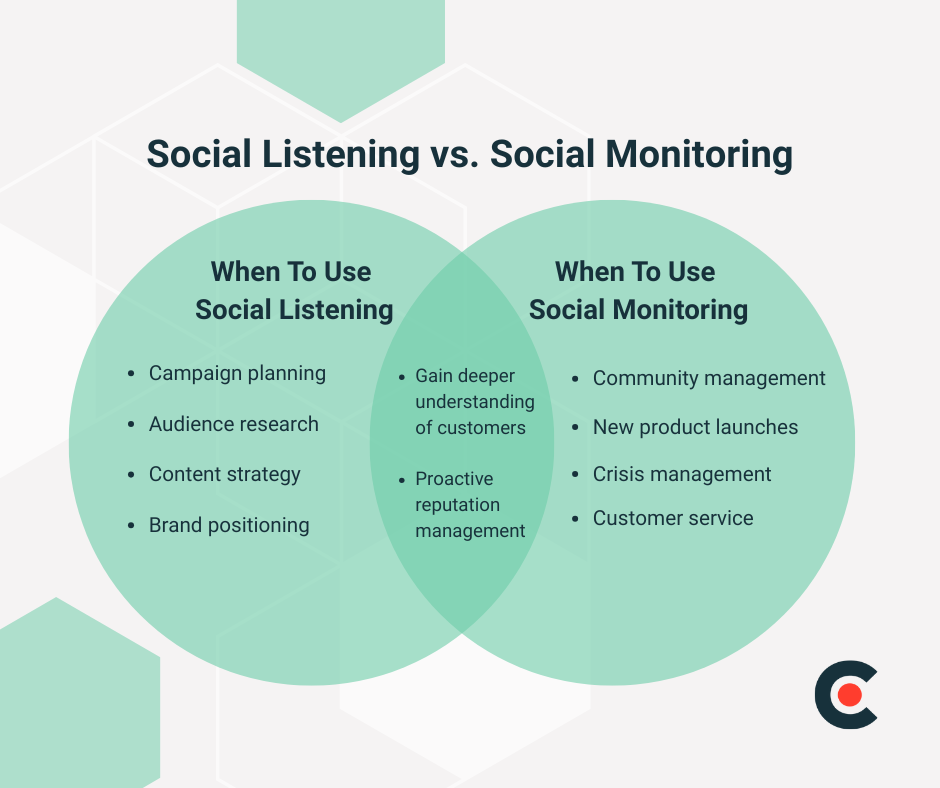
If social monitoring and listening offer distinct benefits to your brand, the next obvious question is when to use each. Social monitoring is great for direct customer engagement. Brands use it for:
Building out your social monitoring capabilities makes real-time problem-solving easier. Many brands leverage tools that deliver automatic alerts. These can monitor social chatter on your company’s behalf and escalate to the appropriate parties when responses are needed.
Social listening is more about improving your understanding of your target audience and the broader market. It helps companies identify trends, revise their strategic positioning, and develop more refined marketing campaigns, among other use cases.
You can use social listening for:
Utilizing social listening can be a powerful tool for strategic planning. It helps brands learn more about their target consumer groups to target them more effectively in the future. Social monitoring, on the other hand, is more immediate. It’s about finding and responding to direct customer engagements now, not learning about their preferences so you can refine a future strategy.
Social listening and monitoring are two different processes with their own benefits. However, brands often face similar challenges when pursuing them. We explore the major examples below.
One of the most common challenges is data overload. Social media platforms contain vast amounts of posts, and finding the most important ones for your brand can be challenging. Even when you do, turning these disparate data points into an effective strategy can be hard.
Khalil Kanbar, founder and CEO of Kanbar Digital, LLC, explains: “The problem companies run into is that they don’t know how to turn this data into actionable insights. Social listening and social monitoring both require a strategy and a process.”
So, you’ll need an overarching strategy for gathering, analyzing, and acting on social media data. You’ll have an easier time getting there if you leverage a platform that automates much of this process.
Another common issue is accurately interpreting customer sentiment. Social media users often speak in slang, sarcasm, and inside references. If you don’t have a clear understanding of this native language, your brand could make inaccurate decisions. For instance, it may interpret a well-natured joke as a serious complaint. This makes putting the right people in charge of sentiment analysis essential.
Next, you should develop a unified process for social listening and monitoring instead of letting each department pursue its own strategy. If marketing and sales each have their own processes, your company may get fragmented insights, which lead to missed opportunities.
You can avoid these by creating a cross-departmental working group. Or, put one team in charge of your strategy and have them share insights in regular meetings. However you do it, the key is making sure everyone in the company has access to whatever you learn.
Finally, not all social tools are created equal. Some are better at monitoring than listening, and vice versa. You could also face challenges with steep learning curves or integrating with existing platforms, like your customer relationship management (CRM) platform. This just makes it important to shop around for a social tool that suits your needs as best as possible, instead of picking one of the first you find.
You can leverage the following best practices to get more out of each of these strategies:
Monitoring social media conversations can help your brand make more informed strategic decisions to drive additional revenue. Social listening and monitoring are two distinct processes for doing that, but they’re best used in combination. Social listening is for direct engagement, while social monitoring can help your brand take advantage of emerging trends and conversations.