
TikTok vs. Meta vs. YouTube: How to Adapt Ad Creative for Each Platform in 2027
TikTok, Meta, and YouTube reward different hooks, lengths, and storytelling styles. This guide covers how to adapt a campaign's creative for each platform...
Updated September 22, 2026

AI has made building software fast and cheap. It has also made copying software fast and cheap. A feature that used to take a competitor six months to replicate can now take a few weeks, sometimes days. That shift changes what "worth building" actually means.
In SaaS, a moat is any structural advantage that makes a product harder to displace over time, something a well-funded competitor would still need months or years to work around even after copying your feature. AI is compressing a lot of those advantages faster than most roadmaps have caught up to.
Designli recently ran two SaaS founder surveys that take different approaches. One asked SaaS founders how they decide whether an AI feature is worth building in the first place.
The other asked a separate question entirely: once something is built, what's actually protecting it from being copied. Neither survey set out to connect to the other.
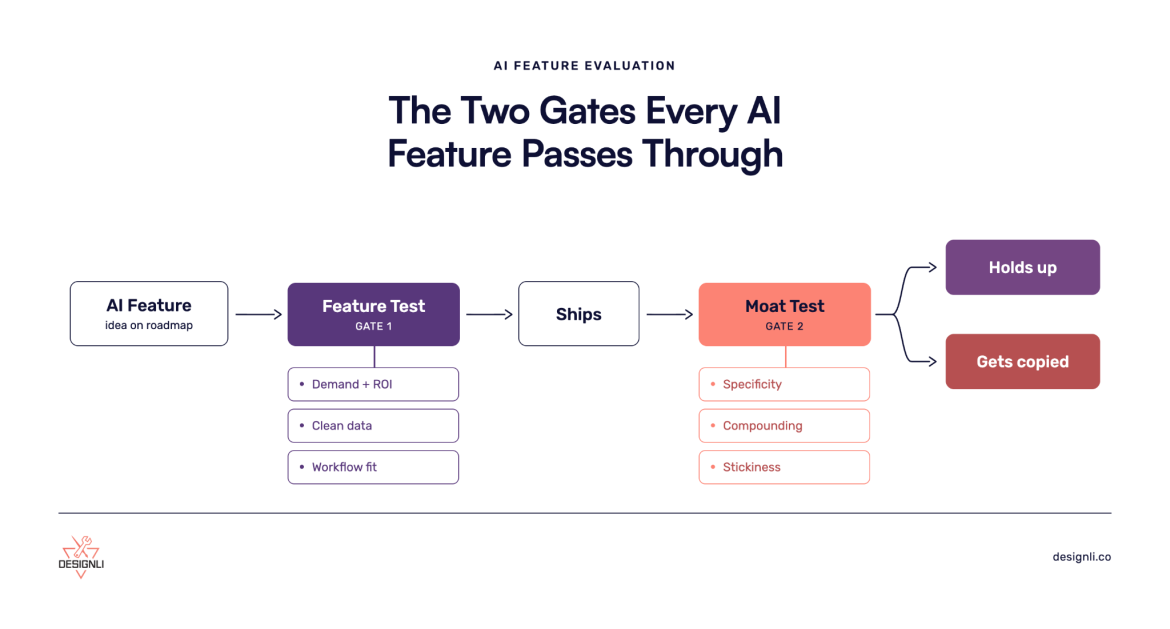
Read together, they expose a gap that shows up in almost every SaaS roadmap: founders have a solid process for the first question and almost no process for the second.
Designli's AI adoption survey asked SaaS founders a specific question: how do you decide an AI feature is actually worth building? The answers, across technical and non-technical founders alike, converged on a consistent checklist and a shared set of worries sitting underneath it.
Founders said they'd feel confident moving forward when four conditions lined up:
The report simplified the mindset down to one line: founders ask, "Should we build this now?" rarely, "Can we build this?"
That discipline showed up again in how founders described prioritizing their roadmaps more broadly. What actually drove the decisions:
Not big AI announcements. When asked how often major AI trends, such as new model releases, influenced their roadmap, responses clustered into two camps: "frequently, we align fast with real use cases" or "sometimes, if we see real use cases emerge." Nobody described constant, automatic influence, and nobody described total disregard either. AI trends set the agenda for what founders focus on.
The worry list was consistent, too, and none of it was about hype. Founders wanted proof of demand before committing. They were skeptical of what a feature costs to maintain once it's live: the updates and the slow creep of technical debt that comes with it.
Overcomplicating a clean product came up often, and so did the exposure that comes with handling sensitive data once AI is woven into core workflows. None of these worries is about AI being overhyped. They're practical, day-to-day problems that suit founders who don't build anything without proof that it's needed first.
The same caution carried into how teams tested features before launch: internal dogfooding to catch obvious failures, limited betas to observe real behavior, and public iteration to shorten feedback loops, all in service of speed of learning rather than a "perfect first release."
Notice what none of this asks. Demand, ROI, clean data, workflow fit, and careful testing all of it describes whether a feature deserves to exist and whether it's likely to work. None of it asks whether the feature is hard for someone else to build, too.
A feature can clear every item on this list, exactly as designed, and still be trivial for a well-funded competitor to copy the week it ships.
Founders even flagged a list of AI capabilities they wanted but hadn't built yet (intelligent automation, smarter dashboards, and more context-aware interfaces), largely stalled by unclear ROI relative to effort rather than a lack of ambition. The checklist answers one question well: is this worth building? It was never built to answer the other one: can anyone else build it just as easily?
Where the AI adoption survey asked founders how they decide to build, the Moat Report asked a completely different question: Once a product ships, what's actually protecting it?
The report breaks that question into four dimensions, and the answers are direct in a way that's worth sitting with.
Founders are honest that their technology alone isn't much of a protection, and they're responding by shipping constantly, even though shipping fast isn't the same as being hard to copy. Half rated their own technical defensibility a 3 out of 5, and not one founder rated it a 5, a real admission that a well-funded competitor could catch up.
Meanwhile, 71.4% are shipping continuously, citing widening their moat as an explicit goal. But the report's own caveat matters: shipping fast only builds a moat when what ships creates switching costs or a data advantage.
Otherwise, it gets matched just as fast as it's released.
Most companies are still in the early, accumulating phase of a data advantage, not yet at the point where that data is actually protecting them. 42.9% said their product data already trains and improves their AI, but 57.1% have collected less than 12 months of that data, and only 14.3% have five years or more.
The report's test for telling the two stages apart is simple: can you describe in one sentence what makes your data irreplaceable: what it is, who generates it, why it gets more valuable over time. Most founders couldn't.
Vague answers like "our database" were common; specific ones were the exception, and being specific was the actual sign of an intentional strategy rather than an accidental one.
Founders are using AI inside their product to justify charging more, but many don't actually know why customers leave, which undercuts the whole strategy. Asked how AI justifies its price, founders split almost evenly three ways: automating tasks, surfacing insights, and cutting time-to-value, with no single answer dominating.
Asked why customers churn, the reasons were just as scattered: a better competitor, price pressure, slow time-to-value, and outgrowing the product. The number that stands out: 21.4% of founders don't run exit interviews at all. You can't defend a relationship you're not measuring.
This is the one area with no established playbook left to default into, and founders already know it. 85.7% are treating AI discoverability (showing up in answers from tools like ChatGPT, Claude, and Perplexity) as a real distribution priority.
At the same time, over a third rate their dependence on a single acquisition platform as high risk, and zero founders said they'd be unaffected if that platform changed its algorithm tomorrow. The best founders are placing instead (AI search optimization, community-led growth, custom AI integrations, rapid-response content), all share one thing in common: none of them is the old SEO-and-paid-social formula.
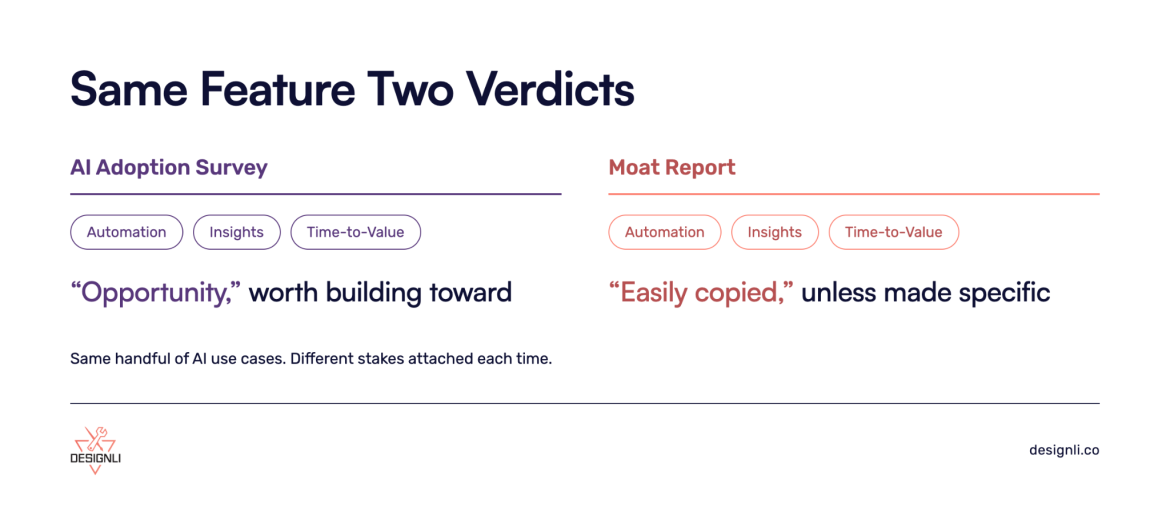
Line up the categories from both reports, and something clicks that neither one says: founders are describing the same handful of AI use cases twice, just with different stakes attached each time. The adoption survey's favorite applications for AI (automating internal tasks, speeding up workflows, smarter onboarding, and predictive insight) are nearly identical to what the Moat Report found founders using to justify their pricing: automating manual tasks, surfacing insights, and reducing time-to-value, each cited by 28.6% of founders.
What changed is the stakes attached to them. In the AI adoption survey, these are opportunities worth building toward. In the Moat Report, those same pitches are described as "easily copied by competitors" unless a founder ties them to something specific: a named workflow, proven with a customer's own historical data, rather than a generic promise like "it saves time."
Here's why that overlap happens. The checklist behind the feature test checks one thing: is this worth building for us? It never checks whether someone else is building the same thing at the same time. Picture thousands of founders running that same checklist on their own. Each one looks at the same handful of obvious AI opportunities (automating busywork, surfacing insights, and speeding up onboarding), and each one gets a green light, because for their own customers, it makes sense.
None of them can see what everyone else is doing. One sound decision, multiplied by thousands of founders making it at the same time, turns into hundreds of nearly identical features hitting the market together. That's the mechanism. The checklist works for one company at a time. It has no way to account for the rest of the market.
The Moat Report's quieter finding backs this up from another angle. 21.4% of founders located their real competitive edge entirely outside the tech stack, in brand, relationships, or domain expertise. That lines up with something the adoption survey found first, without calling it a moat: when founders described what actually helped them differentiate while scaling, AI barely came up.
Niche specialization, workflow and UX improvements, service quality, and doing fewer things well were the answers instead.
Two separate surveys, asking two separate questions, landed on the same place: technical features are compressing into table stakes fast, and what's still holding a customer in place is mostly what a competitor can't copy by reverse-engineering a feature.
That's the actual collision. Passing the Feature Test tells you a feature is worth shipping. It says nothing about whether it's still yours once everyone else running the same checklist ships it too.
Before shipping anything that's already cleared the Feature Test, run it through:
Rather than chasing a technical edge that compresses fast, put the effort where it compounds instead:
Neither survey was built to make this argument. One was measuring how founders adopt AI. The other was measuring what protects a product once it's built. Taken together, they describe a permanent split in how SaaS roadmaps are decided: a well-run process for whether something deserves to exist and almost no process for whether it can survive being seen.
This gap doesn't close as AI gets better at building things; it actually gets more common. Every feature that clears the feature test still needs the second gate. Skip it, and the answer to whether a feature was ever really yours comes from a competitor's launch page instead.