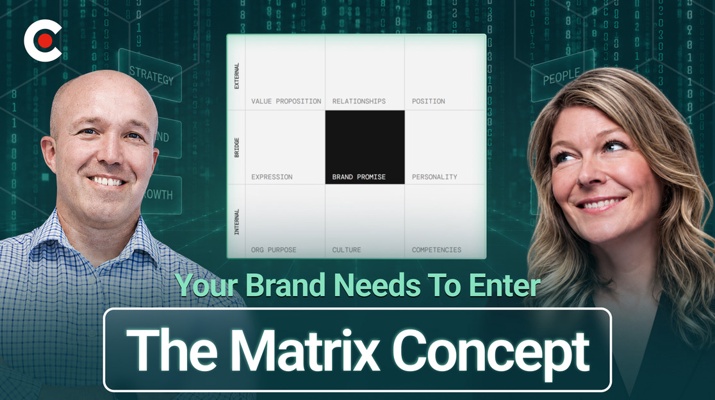
Testing Your Brand Identity And The Brand Identity Matrix
Tim (00:26): Welcome to Clutch Conversations, where we unpack real decisions business leaders face on a daily basis. I'm Tim Condon, the CRO at Clutch....
Updated September 21, 2026

Search rankings and traffic used to be the end-all-be-all for SEO agencies. Companies would boast about how they increased a client's traffic by 300% in one quarter or show off their #1 ranking web pages.
Those metrics don't necessarily get results anymore.
AI search has completely changed how people interact with online content. When an AI summary appears at the top of search results, Google users only click a traditional link 8% of the time, according to the Pew Research Center. The behavioral study also found that Google users only clicked a link in the AI summary in 1% of visits.
That means a brand could show up in all sorts of AI summaries but get almost no traffic from them. Likewise, content that does well in traditional SEO won't necessarily appear in AI search. Same search results page, different paths.
In other words, good SEO doesn't equal good AI search, and not every SEO agency can tell the difference. The agencies worth hiring know that they need to look beyond rankings and keyword volume to metrics like citations and mentions. Here's what to look for when hiring an SEO agency, plus questions to ask before you commit.
For over 20 years, search rankings have been a relatively easy way to measure SEO success. If your blog post jumped from spot 15 to spot 3, it was safe to assume that more people would click it. And some of those clicks would hopefully lead to sales.
That's not necessarily true anymore. More people are doing zero-click searches, which means they get all the information they need from the results page itself. In fact, many people may never scroll past the AI Overview at the top.
When the Pew Research Center analyzed Google queries, it found that clicks fell from 15% to 8% when an AI summary appeared. Users were also more likely to end their browsing session entirely when the page included an AI summary (26%) compared to traditional search results (16%).
Similarly, Ahrefs analyzed 300,000 keywords and found that the click-through rate (CTR) for the top-ranking pages dropped by 34.5% when an AI Overview was present. While this data only comes from a single vendor, it reinforces that AI is changing search habits.
For Allyson Cochran, CRO at Silverback Strategies, this change began soon after Google launched AI Overviews.
She explains, "We first really started to feel it around mid to late Q1 2024. We noticed that upper-funnel informational queries and how-to content were no longer driving meaningful clicks to our clients' websites. So we saw the bifurcation or the decoupling, I guess, if you will, of rankings and traffic at that time."
If you're looking to hire a marketing agency, that means you can't assume that high rankings will bring more people to your site. Your agency also needs to know how to create content that will be visible in AI search.
It's natural to view clicks as the gold standard for marketing.
Cochran observes, "In the performance marketing industry, we've really done clients dirty, a disservice really, over the last 20 years thanks to getting everybody addicted to click-based attribution."
She adds, "Platforms like Google Ads or Meta are all taking credit for leads, revenue, and sales that they probably were just last in line for versus actually had an influence in contributing."
For example, someone may have seen a product on social media or heard about it from a friend long before they clicked a Google Ad. If you're only tracking clicks, though, you'll miss that part of their journey.
The problem isn't limited to paid ads. Cochran explains, "Rankings and traffic have always been a signal for traditional SEO. In the AI environment, they are still a signal for certain types of intent, but they are only a signal. They are not the end goal or North Star."
Suppose that Google's AI frequently cites your brand. However, users only click the links in AI summaries 1% of the time, according to the Pew Research Center. They might still remember your company and come back later when they're actually ready to buy something. After all, citations don't have to lead to clicks to make an impact.
There are two ways that your brand can appear in AI results: as a citation or a mention.
Cochran explains, "If you can envision going to ChatGPT and typing in any prompt, what you'll see is that there's a sidebar of where they're deriving those answers from. Those are the citations."
"These citations aren't necessarily equivalent to what is mentioned in the answer," she continues. "The answer or the mention being part of that recommendation is where the value is."
For example, if a ChatGPT user asks for advice about styling their denim shorts, the AI might cite a fashion retailer's how-to guide. However, unless it mentions that company by name in the response, that citation might not help much.
As Cochran puts it, "There's a decoupling of citations and being part of the recommendation. So unless you just really care to have a lot of people coming to your site and grabbing your content, but not mentioning your brand or recommending it, citation volume isn't a fitting metric."
However, a May 2026 ChatGPT update has made citations more valuable. The AI started linking directly to brands in its answers. As a result, the share of AI referrals landing on homepages surged from around 25% to almost 60% in three weeks.
Still, it's better to be directly named in the recommendation than simply cited.
People tend to ask chatbots long, conversational questions. A ChatGPT user might input, "Are there any Italian restaurants in my city with homemade tiramisu and vegetarian options for my mom?"
Even when users still rely on Google, longer, natural-language searches are more likely to produce AI summaries. Over half (53%) of searches with 10 words or more triggered an AI summary, compared to 8% of one- or two-word searches, according to the Pew Research Center.
That makes content planning tricky. Instead of targeting traditional keywords, you need to predict what questions your audience might ask AI and then answer them.
"With AI prompts, there's not going to be any search volume associated with that same prompt," says Cochran. "So the key to AI search is really getting away from looking at volume as an indicator of what we should prioritize. Instead, we need to start looking at who do we want to do more business with? Who are our best customers?"
Prompt tracking software can help you understand what your audience asks and track how often your brand appears in AI search results, so you can see if you're on the right track.
Traditional SEO tactics, such as using schema and making content easy to extract, can still help increase your content's visibility. However, the best marketing agencies are expanding their focus to answer engine optimization (AEO) and generative engine optimization (GEO).
These newer approaches focus on helping your brand appear in AI-generated responses. After all, it's better to answer your audience's questions than to have a shiny, keyword-stuffed website.
Cochran explains, "If you're mostly solid technically and you have an excellent content strategy, that's going to outdo an excellent technical foundation and a very so-so content strategy."
Of course, it's not just about your own website. The Pew Research Center found that Wikipedia, YouTube, and Reddit are the most-cited sources in AI summaries. Additionally, 6% of linked sources were to government websites, compared to only 2% of standard search results.
"You really need to expand the breadth of your content," says Cochran. "The four blogs a month and optimizing your service or product pages just isn't going to cut it these days."
For instance, Ahrefs found that YouTube mentions are strongly correlated with AI visibility. Try creating Shorts or longer videos with transcripts and descriptions that are optimized for AI search.
Not all marketing agencies have embraced AEO yet or even fully understand what it is.
Cochran warns, "A lot of the marketers we talked to initially are coming in with the delusion that SEO and AEO, GEO, AI search, whatever you want to call it, they're the same thing. Good SEO is good AI search, and that couldn't be more wrong."
These questions will help you determine if an agency actually understands how AI search works and how to get results for your company.
"If an agency says that you don't need to do anything differently, run for the exits," Cochran remarks. "They are very different, and there are different approaches that will get you visibility on different channels."
Look for an agency that adapts its methods to the situation. For instance, they might create FAQs for AI search while targeting specific keywords in blog posts for SEO.
Cochran asks, "What's their focus on actual business growth and revenue growth versus some of the visibility gains? Because it's very easy to drive visibility across all these channels, but sometimes that visibility doesn't always lead down to what matters."
Savvy agencies pay attention to business outcomes, including organic revenue and conversions, while also tracking mention share and citations.
Above all, don't get hung up on visibility. It's never been easier to get eyes on your brand, but that doesn't always translate to revenue. The best agencies recognize this and have a game plan for turning AI visibility into actual growth for your company.