
Why Searching for a Specialized Dev Agency Takes Longer Than It Should — And What to Do About It
Looking for a niche software development agency? Learn how to define your requirements, find specialized providers, and vet their experience.
Updated May 29, 2026

Being first to market can give you a competitive advantage that can last for years, effectively managing your resources can help you deliver better projects faster. Learn the top eight resource management tips and how they can help you drive success for your organization.
It's vital to plan, allocate, and schedule all of your people, technology, and budget to achieve the best results for your organization. Following resource management best practices ensures your team has what they need when they need it to do their jobs quickly and efficiently.
When business leaders fail to manage their resources effectively, it affects all aspects of product development. Your team’s morale and motivation will be lower. Code quality falters, and deadlines slip by while costs spiral out of control.
Looking for a Software Development agency?
Compare our list of top Software Development companies near you
This guide will highlight the eight most important resource management tips and provide advice from top experts on how to implement them.
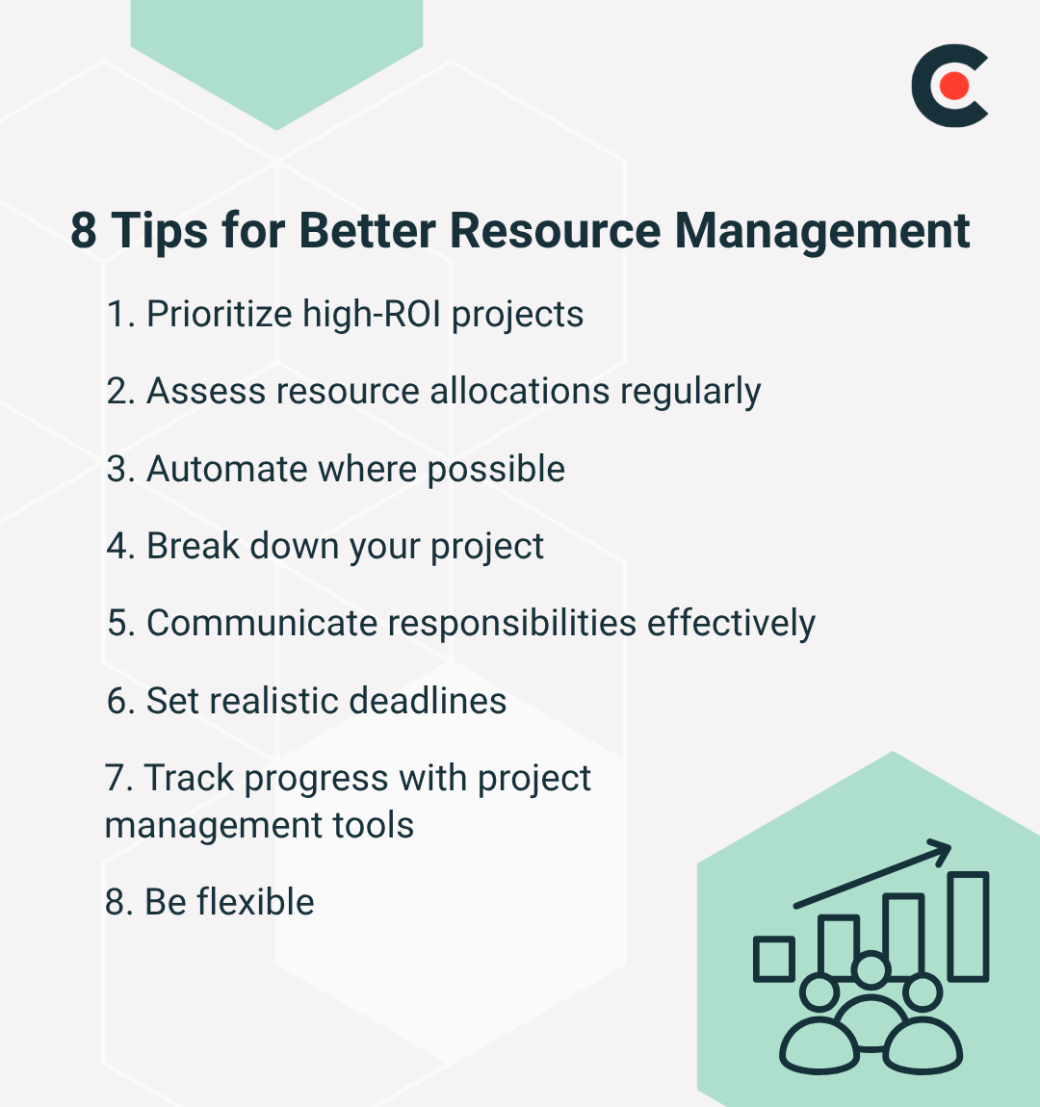
When you’re planning projects, everything is finite: time, money, and energy. Tasks and projects that have the highest return on investment, such as those that attract new customers or significantly reduce support tickets, will have a bigger impact compared to cosmetic adjustments. This will accelerate your outcomes and justify future investments in tech and talent.
If your priorities aren’t clear, your teams are more likely to work on tasks that are easiest or seem the most pressing. This can lead to delays or duplicate work that wastes resources.
To prioritize your projects, start by aligning tasks with your business objectives. Rank tasks based on how they support your goals and user outcomes. Specifically, prioritize tasks that contribute to:
You can use an impact/effort framework, such as a value vs. effort matrix. This involves determining the impact a task will have when it’s completed, how much effort it will take to complete it, and how confident you are about the impact. Tasks that score high in impact and confidence and low in effort should rank highest.
Over time, priorities, available staff, tools, and capital will change. Regularly reassessing how you've allocated your resources prevents misalignment. You can make sure your critical tasks get the most attention and identify bottlenecks earlier.
“Regularly reassess resource allocations, encourage open communication about bandwidth, and leverage automation to streamline routine tasks," advises Deepak Wadhwani, CEO and founder of PROS. "Clearly defining roles and responsibilities early prevents overlaps and gaps in resource utilization.”
Encourage open communication with your team about their bandwidth and workload. When your developers feel free to let you know when they’re reaching capacity or are overloaded, you can identify potential burnout before it occurs.
Clear communication also improves your team’s morale and productivity. These discussions can play a critical role in revealing the need to adjust your resource management to meet changing priorities.
Automation is one of the most effective ways to reduce your team’s workload and scale development. In DevOps, automating repetitive and time-consuming processes frees up your team to focus on high-value tasks.
Kate Pyle, Growth Marketing Specialist at Workshop Digital, leans on automation to provide direction for her team, explaining, “Building repeatable processes, frameworks, and templates and using automation wherever possible eliminates guesswork and lets teams focus on what actually matters." Strategies like this can reduce the workload for many team members and can help maximize their output.
There are a number of areas where you can incorporate automation in development, including CI/CD pipelines and in the testing phase.
CI/CD pipelines use GitHub Actions or Jenkins to automate building, testing, and deploying code when developers push changes. By automating testing, you can catch bugs and performance issues early before they’re committed to the codebase. You also reduce wasted time in handoffs between dev, QA, and ops teams.
Testing is a time-consuming but critical activity in development. Tools such as Selenium and PyTest automatically run unit tests, integration tests, and end-to-end tests during the development process. This speeds up feedback for continuous improvement and lets you get more done without hiring additional QA team members.
Modern DevOps teams are incorporating automation throughout the software development lifecycle. CI/CD pipelines are capable of running hundreds of tests across different microservices in minutes.
Developer environments can be created immediately and drastically reduce onboarding time. Security teams can implement feature flags and automated rollbacks to allow for safe and incremental deployments without manual supervision.
Tackling a large project all at once sets your team up for failure and makes it difficult to allocate resources effectively. Breaking it up into smaller chunks gives you better visibility into the scope of each phase, so you can allocate your resources based on both your immediate and long-term needs.
To organize your project, start with your ultimate objective. Determine what success will look like at the end of your project so you can reverse-engineer the process. From there, divide the project based on specific deliverables for each phase, such as user journeys or system components.
Identify dependencies by mapping tasks that must run consecutively and those that can run concurrently. This will help you avoid potential bottlenecks. Finally, group related tasks into separate phases.
Once you have your project broken down and mapped out, you can see when you’ll need resources for each. Allocate resources based on short, intermediate, and long-term needs to avoid over- or under-committing.
Development teams that are juggling multiple priorities need to communicate clearly and often to keep everyone on the same page. Establishing clear ownership and conducting regular stand-ups and planning meetings, as well as asynchronous updates, prevents bottlenecks and makes your workflow smoother.
The CEO of Stubbs, Mykola Bilous, prioritizes communicating clearly and directly with his team: “Try to keep things clear and predictable. Make sure everyone knows what they’re responsible for, and leave room for unexpected work. Tracking is helpful, but regular conversations do more to keep things moving."
When everyone knows what their responsibilities are, you eliminate overlaps, where two people are working on the same task, and gaps, where critical items are dropped or never started. Roles and responsibilities should be visible in your project planning tools so there’s no ambiguity.
At the beginning, when everyone is excited about getting started on a project, it’s easy to set ambitious deadlines. However, being unrealistic about your timetable can backfire in the long run. Deadlines that are too tight cause stakeholders, leaders, and team members to lose faith in each other.
Teams that are pushed to meet crushing deadlines may take on technical debt and cut corners. They may skip security tests and deliver incomplete features. This can open you up to security risks and increase your expenses down the road.
Here are ways you can set realistic deadlines:
Teams that have enough time to accomplish their objectives without rushing will generate better outcomes and are less likely to burn out.
It’s easy to lose track of where you are on tasks when your work is scattered across Slack messages and emails. Project management tools will keep your work organized and visible so everyone knows what’s due when and what’s been completed.
Ryan Matthews, Co-Founder and UX Lead at Neuron, has found project management tools to be crucial to his team's productivity, explaining, “We rely on a combination of FigJam and Asana to manage design resources effectively.”
Tools like FigJam provide a visual way to map complex workflows. They’re ideal for system mapping and collaboration. Pairing them with more task-focused tools, such as Asana, can give you a complete overview of exactly where your project stands at any given time.
Many project management tools include built-in metrics so you can track KPIs. These help you refine your deadline estimates and evaluate how effectively you're allocating your resources. You can use this data as a feedback mechanism to drive continuous improvement.
In resource management, being too rigid is a liability. Taking a flexible approach can help you deliver high-quality work without burning out your team or exceeding your budget.
Regardless of how effectively you plan, you’re bound to run into unexpected events, like a key team member taking leave or a third-party integration breaking. If you build a margin into your schedule and budget, your entire project won’t derail because of a few glitches. Bilous suggests adding "a 20–30% buffer to timelines, since things almost never go exactly as planned.”
In addition to adding a buffer to your schedule, you can increase your flexibility by cross-training team members for redundancy and planning time to address urgent requests.
Following resource management best practices is essential for building a flexible, adaptable team that can deliver results on time and on budget. You can distribute your resources where and when they’re most needed. Establishing a transparent workflow, setting clear priorities, and communicating regularly are fundamental aspects of better resource allocation.