
Creating and Optimizing Cross-Channel Advertising Strategies for Lead Acquisition
Cross-channel advertising is the new meta for marketing. Learn how to create, launch, and optimize such strategies and what to pay attention to.
Updated December 19, 2024

For the better part of the last decade, new marketers to the workforce have been educated in the field of inbound marketing, a methodology propelled primarily by the leading marketing automation platform, HubSpot. But is inbound marketing the right method for your business?
The idea behind inbound marketing is to deliver the right content to the right person at the right time. In order for this method to work, buyers must follow a predictable trajectory.
First, they must become aware of the need and then consider different options to solve that need. They then make a decision and ultimately become an evangelist for the product or service acquired. It provides users with useful information at the start of the journey. With those promises inbound, they’ll eventually put their trust and faith in your product or service.
Looking for a Digital Marketing agency?
Compare our list of top Digital Marketing companies near you
Inbound marketing’s notoriety is a result of its merit: recognizing the limitations of the methods and approaches perfected by the older generation of advertisers that were formed in an age of information scarcity and media concentration. Inbound marketing proposed a novel concept: advertising as an exchange of value between advertisers and audiences.
In the age of attention fragmentation, the theory goes, the line between advertising and content becomes blurred. Rather than buying our audience’s attention, attention has to be earned by advertisers producing content that is ultimately useful for the end user. With the new year approaching, businesses can look ahead and find the benefits of techniques outside of inbound marketing.
From the beginning, there were some signs that the hype around inbound might be overblown. For starters, HubSpot itself has not always been clear about for whom inbound marketing works. Rather than acknowledging that inbound marketing as a theory works best for B2B companies as well as big-ticket B2C purchases due to the research involved prior to purchase, HubSpot has promoted its product as a tool for all businesses.
As seen in the image above, HubSpot declares that they service over 64,000 growing businesses all over the world. As a result, HubSpot has suffered higher than average churn rates, and increasing customer-acquisition costs, throwing into doubt how well HubSpot can survive on an inbound-marketing strategy alone.
A number of other problems emerged for the practitioners of inbound marketing. Buying a marketing automation platform before experiencing market traction can increase a company’s fixed costs dramatically. Those resources are often better-served in other areas of a marketing operation.
In addition, clients also have to assume the cost of either hiring an agency or investing in internal resources to manage HubSpot’s sophisticated and powerful platform. Once mastered, the over reliance on automation can make a company’s communications seem stiff and bland.
No matter how much companies personalize that automation, many consumers will prefer one-on-one attention and first-class service from a human being. Forgetting the value of individual service can lead companies down the wrong path.
The pull-don’t-push approach inherent in inbound marketing can be effective, but relying on traffic sources such as organic search can take time and results are never guaranteed. Inbound marketing is definitely a long-term strategy, and one that requires a lot of up-front investment with often little immediate feedback. Of course, if a company claims to not see the results, the response is often, “you’re doing it wrong.” The methodology itself is never to blame.
As more and more digital agencies became inbound proficient, many adopted a religious-like dedication to the methodology and an intolerance to other approaches such as outbound marketing. As stated in the image below, outbound marketing pushes a business offering while inbound deals with drawing customers in.

Outbound marketing is one of the traditional marketing approaches. Even if outbound marketing is often practiced in invasive forms, outright dismissing outbound marketing would be the equivalent of adopting an approach to dating whereby one is never to show interest but instead wait for the other person to always make the first-move. While flattering, such an approach is not very practical.
Just as outbound marketing can be practiced in aggressive ways, so too can inbound marketing. By putting its focus on content, inbound marketing encourages the production of a lot of low-quality content, including the re-writing and re-packaging of other people’s articles and whitepapers. Below is a graphic that goes through the step-by-step process involved through attracting, engaging, and experiencing.
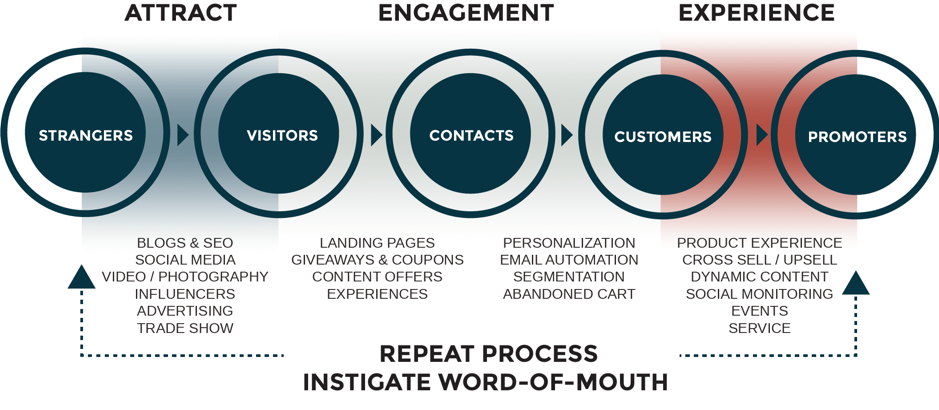
Users can be attracted through a variety of content. For example, blogs, social media, and trade shows are primary examples of ways to attract users. HubSpot itself is a promoter of this trend by releasing “white paper” reports which its agencies partners are supposed to re-brand and promote as their own. Such behaviour seeks to create efficiencies but ultimately sucks the creativity out of the marketing process and replaces it with strict adherence to someone else’s thought process.
Possibly inbound marketing’s gravest oversight is to ignore branding from the marketing equation. According to the inbound methodology, users move from awareness to consideration to decision thanks to the content offered by service providers. The problem with this assumption of fluidity in the buyer’s journey is that being a trusted provider of information is not the same as being a trusted solution provider.
The old adage “nobody ever got fired for hiring IBM” demonstrates the value of branding in the purchasing process. Creating a brand that is recognized, respected, and even loved is an endeavour that is more emotional than logical and includes a number of factors that are difficult to measure and completely absent in the funnel-based approach to measuring inbound success.
The intangibility of branding is missing from the inbound methodology and therefore often dismissed by inbound marketers. As a consequence, prospects may consume a company’s awareness and decision-stage content before ultimately deciding to hire the company whose brand will ensure the decision-maker doesn’t get fired for her decision.
Don’t get me wrong: inbound marketing is a ground-breaking approach to marketing and should be celebrated as such. Nonetheless, honest marketers will acknowledge that it’s not for everyone: indeed, it works best for well-established B2B and big-ticket B2C brands that already manage a significant influx of leads.
For others, inbound may be directionally correct but may also provide little guidance as to how to build a world-class brand, which we know to be key in moving people from consideration to decision. Even HubSpot is moving away from the funnel approach is promoted with zeal for most if its existing, instead promoting a new fly-wheel methodology.
As 2020 nears, it’s worth it for marketers to consider the best of what inbound has to offer, but also be aware and open to other approaches that include re-visiting traditional marketing practices that also take into consideration the need for brands to evoke feelings of confidence, trust or authority.
The promise of the internet is the free circulation of information: blind adherence to an ideology is not only counter to the internet’s culture, but also represents a lost opportunity to take advantage of marketing’s enduring ingredient: creativity.
Matthew Carpenter-Arévalo is a former Google & Twitter manager as well as an occasional TechCrunch columnist. He is the founder and CEO of Centrico Digital, a boutique managed marketing services company.
See full profile