Evaluating an Marketing Agency in the AI Search Era
AI search has completely changed how people interact with online content. When an AI summary appears at the top of search results, Google users only click a...
Updated April 24, 2026

Both online and offline marketing can help you reach customers, but they work differently. This guide breaks down which one to use based on a variety of factors.
In a perfect world, you’d have an unlimited marketing budget and a team that could do it all — audio editing, photography, you name it. But in reality, resources are limited. If you want your marketing to really pay off, you must choose your strategies carefully.
One of the biggest decisions you'll need to make is whether to focus on online or offline marketing. Regarding flexibility and reach, online marketing comes out on top. But don’t underestimate the power of offline strategies. They might seem a bit old-fashioned, but they can still be incredibly effective.
Understanding the differences between offline marketing vs. online marketing is key to promoting your business.
Offline marketing uses traditional, real-world strategies to promote your business. It takes place in the physical world, not online.
You’re probably already familiar with some common examples of offline marketing, including:
These strategies are highly effective for connecting with customers in your city or region.
Rafal Blecharz, VP and Head of Creatives at Animwood, explains, “Offline marketing works best for local markets, especially if you provide services or products within a specific area, such as car washes, gyms, or bakeries.”
Offline marketing can also help you reach specific demographics. For instance, if you sell fishing gear, you might place print ads in the top hobby magazines. Or you could attend trade shows to meet avid fishers in person.
Face-to-face interactions build trust, too. When you engage customers in person, you humanize your brand and give them a better sense of your values. Plus, you can connect with people who may spend little time online — like fishing enthusiasts who'd rather be on the river — or avoid social media. If you only rely on digital marketing, this audience might never discover your brand.
Online marketing uses digital tools to promote products and services. Here are a few popular examples:
Online advertising has a much greater reach than offline methods. While a traditional billboard or newspaper ad might be seen only by local residents, a digital ad can be viewed by people worldwide, raising brand awareness.
These methods can also be surprisingly cost-effective. With PPC ads, for example, you only pay when customers interact with them. Plus, sharing organic content on Instagram or adding keywords to blog posts is free.
Digital tools make it easy to track performance, too. While you can estimate how many people see a print ad or billboard, you’ll never have an exact count. Online, though, you can monitor all sorts of metrics, from clicks to impressions.
There are also things you can only do online. Take automation software, for example. This technology lets you automatically send emails, schedule posts, and more. Plus, you can use digital tools to personalize your marketing — something that’s just not possible with radio commercials or physical newspaper ads.
There’s no magic marketing formula. One business might get the best results with online methods, while another business might swear by offline techniques. Here are a few major differences to help you decide what’s best for your company.
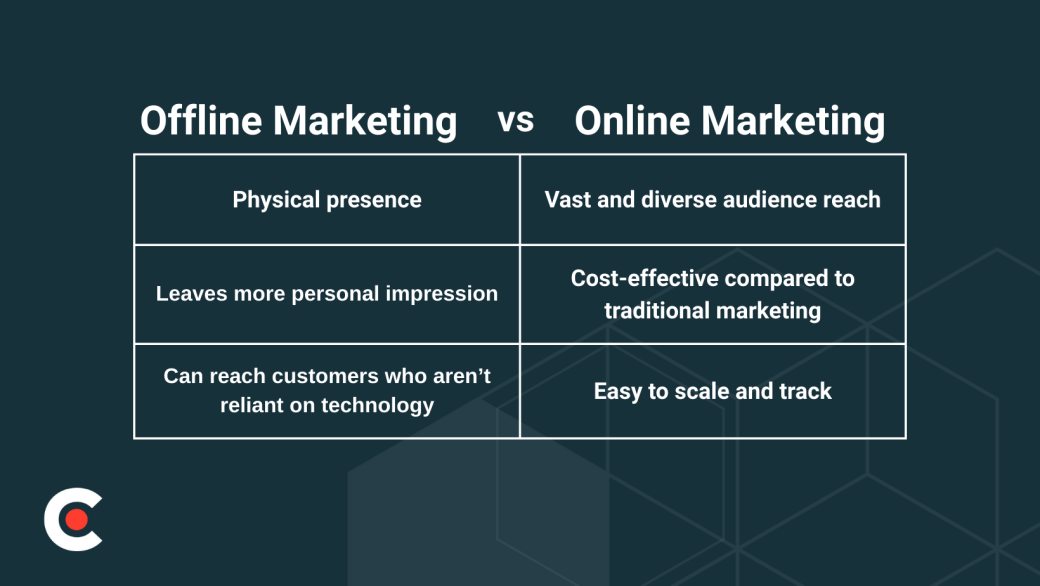
When it comes to pricing, online marketing is the clear winner.
According to Blecharz, “Online marketing is definitely more affordable than offline. Whether you’re producing content, recording yourself, sharing the posts or engaging with the viewers via social media, it’s the cheapest and most effective solution to start with. That’s especially true if you have a low marketing budget, which is pretty common for the small businesses, especially in recent years of economic turmoil.”
But that doesn’t mean offline methods can’t be cost-effective. Simple strategies — such as hanging flyers or passing out business cards at events — can spread the word without straining your budget.
As we’ve already noted, digital marketing has a broader reach. However, offline methods can be more effective for local businesses. After all, a clothing shop in Kansas doesn’t need to connect with customers in Canada or Europe—it just needs to reach people down the road.
Online marketing gives you more opportunities to engage customers. For example, you might email them coupons one day and share a video on social media the next.
Engaging customers across multiple channels has enormous benefits.
“By regularly interacting with potential clients through content,” Blecharz explains, “businesses can increase touchpoints, build trust, and accelerate the decision-making process.”
Blecharz continues, “The more a lead engages with your content, the more familiar and comfortable they become with your brand — making them more likely to convert faster.” In other words, more online interactions can directly boost sales.
However, many customers value the authenticity and human connection of offline marketing. While you may not engage them as frequently in the real world, each interaction could leave a stronger impression.
Online marketing gives you more flexibility to change tactics on the fly. It’s much easier to tweak a digital ad than to revise a physical billboard or thousands of printed flyers.
With online marketing, you can gather precise data for every aspect of your campaign. In fact, many platforms — like Meta and Mailchimp — have built-in tools that automatically track these metrics.
Offline marketing can be just as impactful, but it’s trickier to measure. Instead of opening something like Google Analytics, you must rely on metrics like sales figures and customer feedback. Give it time to truly understand your results.
Offline marketing is often an excellent choice for local businesses. These tactics help you build close relationships and trust within your community. A simple flyer or fundraiser for the high school football team can go a long way in establishing your business’s reputation.
Older demographics often prefer offline marketing, too. They may read the local newspaper daily but rarely venture onto social media. By using traditional methods, you can reach these customers on familiar ground.
Many industries also still benefit from a physical presence. Take restaurants, for instance. They often mail coupons and run ads in the local paper to draw in customers. And if you pass by a car dealership on the weekend, you might spot an open house, with sales reps busy connecting with potential car buyers.
Digital marketing is the way to go if you're targeting younger clients. Over 60% of people aged 18 to 29 are almost constantly online. Stay in contact with these customers by sharing content on social media platforms like Instagram and TikTok. You can also promote products through email, video, and other digital channels.
Online marketing is also the best way to reach a global audience. With PPC ads and social media, you can easily advertise your business in multiple countries with just a few clicks. That’s great news for e-commerce companies and other businesses that want to tap into international markets.
Plus, this approach can get fast results. Need to generate sales or leads quickly? You could get instant engagement with a well-designed Meta ad or YouTube video.
Don’t get too caught up in the online vs. offline marketing debate. These methods often work hand-in-hand, so you don’t need to limit yourself to just one.
“I recommend combining both approaches,” Blecharz says. “Consider leveraging online exposure through social media while also engaging in in-person networking at events and trade shows.”

For Blecharz, this strategy has paid off handsomely. He reports, “It’s worked well for us at Animwood, leading to over a 20% increase in business in 2024, despite operating in the highly competitive global animated video production market.”
Look for ways to combine digital tools with more traditional techniques. One simple solution is to add QR codes to print ads, allowing customers to quickly access your website. Another is to promote in-person events on social media.
With these dual approaches, you can truly get the best of both worlds: innovative technology and the authentic connections many customers crave.
When you have limited resources, choosing between online and offline marketing can be a monumental decision. But don’t get stuck in decision paralysis.
At the end of the day, it all comes down to your goals and business type. Offline marketing can be a game-changer if you’re running a local company. But if you want to reach as many people as possible, online advertising can’t go wrong.
Remember your customers’ preferences. Blecharz notes, “Both online and offline marketing can be highly effective if you understand your target audience well.”
Combining both methods, a balanced approach often yields the best results in today's increasingly digital world. By leveraging the strengths of each, businesses can maximize their reach and impact.