
How to Delegate: A Step-by-Step Guide for Agency Owners
Learn how to delegate effectively as an agency owner — what to delegate first, how to hand off work without losing quality, and the hiring sequence that...
Updated April 8, 2026

A retainer is an ongoing agreement in which clients pay a set fee for continued access to your services rather than a one-off project. This guide shows how retainers can create stronger relationships and more stable income by helping you spot and pitch opportunities as well as build long-term partnerships.
A retainer is an ongoing agreement where a client pays a set fee (monthly or quarterly) for continued access to your services. You agree on a steady cadence of work and outcomes rather than scoping a project and delivering.
The difference matters. Why? One-time projects solve a defined problem with a start and finish. However, retainers create a relationship where you're continually responsible for results. Not just deliverables!
Many of the most valuable challenges clients face don't wrap up neatly in six weeks. As you can see, markets shift. Products evolve. Strategies get tested and tweaked.
That said, retainers bring consistency to your revenue. It also gives clarity to your team's planning. Most importantly, it creates a deeper sense of partnership with clients who need your ongoing support.
As a business leader, keep reading to learn how to turn a one-time project into a long-term retainer.
A retainer is a recurring fee your clients pay for your ongoing services. It isn’t a one-time charge for a one-time project. Here’s how the two types of pricing models differ (see the table below):
| Key Features | Retainer Model | Project-Based Model |
| Revenue | Predictable, recurring | Variable, one-time |
| Relationship | Strategic partner | Transactional |
| Scope | Flexible/changing | Fixed & defined |
| Best For | SEO, content creation, business support | Web design, graphic design, project audits |
| Risk | High commitment | Income volatility |
As you can see, both the retainer and project-based models align with business situations and client needs. While project-based pricing is beneficial for clearly defined work with fixed deliverables and timelines, it enables quick execution and easy scoping for you and your client.
Meanwhile, a retainer can be part of your small business growth playbook. It lets you create a steady source of income instead of chasing new projects every month. However, it entails building long-term relationships and delivering consistent results, which ultimately contribute to stronger business profitability.
So, if you’re looking to turn a one-time project into a long-term retainer, here’s how:
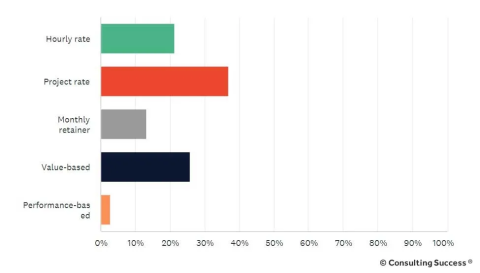
Not all companies and organizations rely on the retainer models for their clients. In business consulting, for instance, only nearly 15% of consultants use the monthly retainers.
That’s why it’s best to start by understanding the benefits of the retainer model. The goal is to see if it’s the right fit for your business and/or clients:
For example:
If you run a blank t-shirt collection business, you might start by fulfilling one-off bulk orders for a brand testing a new apparel line. But once that brand starts launching regular seasonal drops, it may make more sense to move into a retainer.
This model allows you to handle monthly restocks and ongoing production needs. Ultimately, it shifts the relationship from one-off transactions to a steady partnership that supports their growth.
Not every project should turn into a retainer. Some jobs are better left as one-and-done builds.
As such, look for work that naturally leads to iteration, requires optimization, needs ongoing guidance, or calls for long-term projects. When a client's needs evolve month to month, explore a longer-term support arc.
Learn from Brandy Hastings, SEO Strategist at SmartSites, who applies retainer models to clients who need digital marketing services. She notes that the best retainer opportunities often reveal themselves through patterns.
Hastings says, "When clients consistently return with similar challenges, or when their industry requires ongoing adaptation, you're looking at a natural fit. Pay attention to clients who value your strategic thinking beyond just task completion."
So, what patterns to look for? Hastings suggests checking for the following:
These signals point to one thing: continuity creates more value than isolated deliverables. When you see this pattern, position your support as an ongoing partnership focused on progress and outcomes. That shift makes the move to a retainer feel natural rather than forced.
A retainer conversation should be a thoughtful recommendation. Not an upsell. You're connecting the dots between what the client values most and what steady collaboration can unlock.
Studies show that companies with strong alignment between client needs and service delivery are 60% more likely to retain customers long term.
Clients are also more receptive when value is clearly tied to outcomes. Something McKinsey notes can increase marketing ROI by 10–30% through better personalization and alignment.
So, here’s how to pitch with confidence to ensure personalization and alignment:
Rawad Baroud, CEO of ZeroGPT, recommends focusing on client value and impact to retain the retainer model. He has numerous global businesses subscribed to their AI detection tool.
When pitching, Baroud suggests, “Shift the conversation away from hours and deliverables and focus on the business outcomes you can consistently drive over time. Clients don’t stay for activity, they stay for impact they can measure and rely on. A strong retainer pitch makes that impact feel predictable and scalable…something worth committing for the long term.”When you frame the conversation this way, the retainer becomes the next logical step. You're showing clients a clearer, more efficient path to the outcomes they already care about. Backed by consistency and momentum.
Landing a retainer is step one. Keeping it healthy is where the real work begins.
To begin, set expectations early and deliver measurable progress. Likewise, stay a step ahead of the client's questions. When something changes on their side (say, a product launch slips, a new region opens, a regulation shifts), your plan should flex without drama.
Take it from Tyler Denk, Co-founder and CEO at beehiiv. He has his fair share of experience offering retainer-based newsletter services to clients. He has learned what keeps partnerships strong.
Denk explains, "Successful retainers thrive on transparency and anticipation. Regular reporting isn't just about showing what you've done. It's about demonstrating your ongoing understanding of their evolving needs. When clients see you're thinking ahead for them, they recognize the value."
Denk recommends a few practical steps:
Introduce flexible terms to handle workload fluctuations without renegotiating the whole contract every quarter.
Over time, consistency and proactivity are what turn a retainer into a true partnership. When clients feel supported and informed, they’re far more likely to stay and grow with you.
In many service-based businesses, the most sustainable growth comes from shifting one-time projects into long-term retainers. This transition not only stabilizes revenue but also deepens client relationships and increases lifetime value.
Here are real examples of how companies and freelancers have successfully made that shift:
Manchester-based agency Six & Flow initially helped a client implement HubSpot CRM and deliver early wins with free tools and workshops. That project's success built trust and demonstrated value. This led the client to expand the relationship into a full ongoing marketing and sales retainer with recurring monthly revenue.

Huble Digital began by supporting The NAV | 365 People with specific HubSpot tasks and PPC work. As the client’s needs grew beyond discrete projects, they shifted into an “agile support retainer” covering SEO, content, paid social, and ongoing optimization. This gave both sides a predictable, flexible long-term engagement.
Turning projects into retainers works when ongoing collaboration will save your client time. When it reduces risk and drives better outcomes.
Start where the signals are strongest: recurring requests, complex environments, and clients who lean on your strategic judgment.
Retainers work when they make life easier for both sides. Keep your offer focused on what matters most to your client. Likewise, stay transparent and flexible as their world changes.
Over time, you'll find the calm that comes from predictable work. You’ll earn the creative energy that comes from knowing a partner has your back.