
Creating and Optimizing Cross-Channel Advertising Strategies for Lead Acquisition
Cross-channel advertising is the new meta for marketing. Learn how to create, launch, and optimize such strategies and what to pay attention to.
Updated January 3, 2025

Our interview with Rand Fishkin, Founder of Moz, shows how he built the company into a renowned content hub. What lessons did he learn throughout the process, and how can you apply the same approach to your company?


Looking for a Digital Marketing agency?
Compare our list of top Digital Marketing companies near you

In a survey of 300 content marketers in the US, 99% identified at least one area where they want to improve their company’s content.
Clutch, like the companies surveyed, always seeks to improve its content and serve its audience better. Over the past two years creating authoritative, helpful content, fueled by data and in-depth client reviews, we found ourselves asking three questions:
So, to begin to answer these questions, we collected data and spoke with Rand Fishkin, Founder of Moz, an SEO software company known for its comprehensive and active blog, especially its “Whiteboard Friday” video content.
We walk you through our interview with Fishkin, highlighting his experience building Moz into a go-to content hub for all things SEO and inbound marketing and how you can tailor his approach to your company.
Content marketing is about providing lasting value by dissecting complex topics, organizing the information, and presenting it to your audience.
Revenue gains from content creation come in time, but only after you build trust through helpful content.

Consider the story of Moz, a company whose founder, Rand Fishkin, is committed to creating content that “helps people do better marketing and SEO.”
Since its founding in 2004, Moz built its business model around creating helpful content and tools for its growing audience.

“Historically, for the first six years of Moz, [our content] consisted of me blogging every day,” said Fishkin.
But, what began as a brand-building strategy evolved into a sophisticated content hub with a cult-like following of SEO gurus, content marketing fanatics, and mustache admirers.
Now, Fishkin characterizes Moz as “big content producers,” publishing about one article per day for a total of seven to eight pieces every week.
“Eventually, we grew big enough to hire an audience development team, which now manages the blog,” Fishkin said. “We now have many guest contributors and in-house writers who are prominent in the SEO field and have something special to share.”
Despite the additional resources dedicated to creating and managing Moz’s content, Fishkin still makes regular appearances, showing up to play host to Moz’s weekly “Whiteboard Friday” video series, which takes a marketing topic, explains it, and walks listeners through how to apply the concept to their business.
What hasn’t changed throughout Moz’s 13 years of growth and content production is its founding goal of creating insight- and tactic-driven content that makes navigating the often confusing and complicated realms of search engines easier for everyone.
“We want to make the operations of search engines accessible and understandable to anyone and everyone. While the SEO professionals audience is our core group, we try to help everyone, from travel bloggers, to real estate professionals, to small business owners.” – Rand Fishkin, Moz
SEO plays an important role for online businesses. (If you don’t show up high in a search engine result, how will potential customers find you?) And Moz gets it. Regardless of experience level, every online business needs to think about and apply SEO basic.
So, what’s Moz’s secret for helping such a broad audience, instead of unashamedly promoting their brand – seeking a direct return on its content investment?
The secret to success is tackling the difficult and complex topics that stop marketers and SEOs in their tracks.
“A big thing that has been successful for us is taking secret, hidden, or hard-to-understand information and making it transparent,” Fishkin said.
Essentially, Moz does the work for you:
They see the advantage of having a happy and successful audience base that returns time and again to consume the content they create, and therefore they invest time and money in providing value to readers.
Creating insight- and tactic-driven content with the goal of helping people only works under two conditions.
Fulfilling these two criteria is the crux of the “content creation challenge.”
Thankfully, Fishkin developed an approach to tackling the content creation challenge: “create content that’s 10 times better than anything else on the first page.”
“10x content was really a response from me to something I’d been hearing a lot from folks who create content for SEO. They basically type in keywords, look at the top 10 results, and determine that they can make something that is as good or even better. By doing that, they figure that they should get to rank within those positions. They make those kinds of investments and find themselves on page three or four and wonder why they’re not having success.”
You may think that you can create content that’s “good or even better” than what ranks on the first page of Google, but succeeding in this endeavor demands more than throwing out more information about an already well-covered topic.
There’s a barrier to entry for ranking on the first page of Google.
Have you encountered the following scenario?
You search, “how to plan a content marketing strategy.”

Four ads show up, but the first organic results come from inbound marketing platform HubSpot, “How to Plan a Content Market Strategy: A Start-to-Finish Guide,” followed by an article from the Content Marketing Institute.
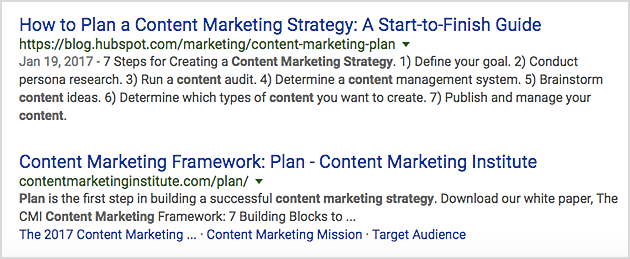
After some analysis, you notice that HubSpot’s article advises readers to conduct a content audit but forgets to tell you what to explore in the audit.
You want to rank for content about creating a content marketing strategy.
You have a lot of experience conducting content audits and think you can write a better section on the topic than HubSpot.
So you go for it; write an article titled, “How to Create a Content Strategy” that includes detailed guidance on conducting a content audit.
Then, you wait a few months. And nothing happens.
You’re on page four, where few people will find you (because, in reality, how many people click through to page four of Google search results?)
The example highlights the barrier to entry that makes it difficult for new content – and new websites – to outrank popular, high-traffic sites.
“It’s sort of a rich-gets-richer phenomenon. If you get to the top of Google, you get more people clicking on your link, linking to you, sharing your content, and engaging with you. Those signals are all going to help keep the top positions propped-up.” – Fishkin
Your article on creating a content strategy may be more comprehensive than HubSpot’s, but HubSpot remains the “go-to source” for marketers.
Creating 10x content isn’t supposed to be easy. If it were, then everyone would create it, and you’d be back at square one – blocked from the first pages, unable to surpass the competition.
It all comes back to the user.
“It’s not only about the specific query they’ve made but also about the insight in knowing what the intent behind that query was, what they want to do next, and serving that intent as well,” Fishkin said.
The 10x content criteria all close in on a core tenant: create content that provides value to your user.
Creating 10x content is no easy feat. It requires practicing your content creation skills, investing time and resources in experiments that are bound to fail, and learning about your audience.
Publishing low-quality content is not a good use of resources or time, but creating and publishing content frequently to learn what works and what does not is a positive step. It’s a way to practice your content creation skills.
“We can think of the quantity of content as being a form of practice. If we want to win a soccer game, we need to go to a lot of practices, get on the field and take many shots at the goalie.” – Fishkin
Comparing content creation to soccer practice shows that not all content projects result in “wins.” However, the act of creating content, regardless of results, becomes a learning experience.
“Sometimes, something magical is going to come out of content pieces, and we will learn a tremendous amount and have a bunch of success,” Fishkin said. “[You] can’t simply expect to produce one piece of content in a year and have it be the best thing in the world.”
Continuous improvement when it comes to content entails a series of experiments, analysis, and redirection.
Practicing and refining your content creation skills will help you identify a content style that works best for you.
Failure is inevitable when it comes to content marketing. Instead of shying away from investing resources in content creation, embrace the risk in order to learn what works best for you.
 “I would urge folks to experiment and expect to fail,” Fishkin said.
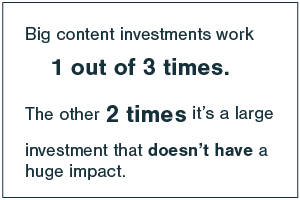
“Even in the case of Moz, when we make big content investments, it will work well one out of three times.
For the other two out of three, even though it’s a large investment, it doesn’t have a huge impact.
We need to be comfortable with the fact that it takes two people 10 weeks to produce, and, at the end, they may come up with something that isn’t very successful.”
Approaching content creation with the expectation of failure in the back of your mind means investing everything you can – time, resources, creativity, and passion – in creating something great.
Don’t shy away from the commitment because the outcome seems hazy.
On the other hand, if you’re more risk-averse because you’re a small business with few resources or don’t have the skills needed to create content, don’t worry.
“If someone isn’t comfortable with it, I wouldn’t urge them to make the investment,” Fishkin said. “Content isn’t the only way to do marketing, and there are other places where someone can put their dollars and time.”
Keep your budget, business goals, and aversion to risk in mind when deciding whether to invest in content marketing full throttle. There are ways to dip your toe in before putting a strain on your resources.
Your audience should determine the type of content you create.
“Our general approach is that the content format and the type of content produced is based on what we find to be the best answer to the audience’s problem,” Fishkin said.
For each topic Moz addresses, the team considers how to present the information in a way that helps the reader – an approach you also should apply.
For example, to explain the importance of a broad concept, like “How to Prioritize Your Link Building Efforts & Opportunities,” Moz may produce a video with a transcript and embedded visuals.
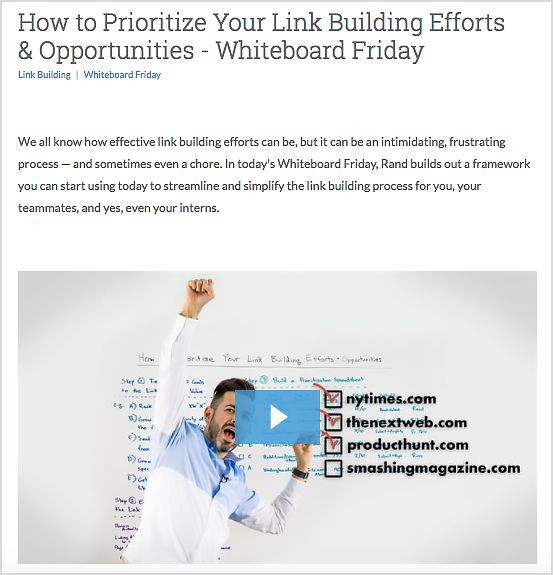
The video makes the information easy to consume on-the-go, while the transcript helps the reader dissect more complex parts of the video.
For a how-to guide, a traditional blog post format with step-by-step instructions and screenshots will seamlessly guide the reader through a process, acting like an instruction manual.
Understanding what content types meet your audience’s needs takes time.
One way to get started, though is to embed yourself with your audience – put yourself in their shoes to learn what they need.
“One of the things that has worked well for us is spending time in-person with the audience. This gave me a much better sense of empathy for all the challenges faced, and it has made me a better content creator and predictor of what will work or not.” – Fishkin
Talk to conference attendees, take phone calls, answer emails, and participate in question and answer forums and social media chats.
Your audience will tell you outright what they like, what they do not, and what they need from you.
After surveying 300 content marketers and interviewing Moz’s founder, Rand Fishkin, we set out to answer three questions that content marketers grapple with on a regular basis.
Our exploration revealed that there’s no single answer to these pressing questions, but if you gear all content efforts toward providing value to your audience, then other factors, like content type, metrics, and promotion will become easier to tackle.
When it came to answering these questions for Moz, Fishkin never strayed too far away from his main call to action: keep your audience top of mind.
What’s Moz's content vision? Create content to help people.
What content should we create?
Create content that’s 10 times better than anything else out there by considering everything from the writing, to the information structure, to visuals, to your ability to answer the reader’s questions.
How do you create comprehensive, value-driven, helpful content?

Sarah Patrick is a senior content strategist at Clutch, a B2B research firm in the heart of Washington, DC. She leads research on digital marketing topics and manages Clutch's guest writers' program. Connect with Sarah on LinkedIn or Twitter. Reach out with questions, comments, or concerns at sarah@clutch.co or (202) 350-4344.
Subscribe to Clutch’s Newsletter