
Evaluating an Marketing Agency in the AI Search Era
AI search has completely changed how people interact with online content. When an AI summary appears at the top of search results, Google users only click a...
Updated May 29, 2026

Too many cybersecurity firms waste marketing dollars on strategies that fall flat. Why? They skip the research.
Instead of guessing what clients want, it's better to research first and market second. You don't need an endless budget, dozens of cold outreach specialists, or questionable lead generation schemes.
What you need is intelligence-driven marketing that speaks directly to your clients' actual security challenges.
This article will break down exactly how you can use research to fuel cybersecurity marketing that resonates with executive decision-makers and generates qualified leads.
Research forms the backbone of effective cybersecurity marketing.
Before launching campaigns or creating content, you need solid intelligence about industry dynamics, competitor positioning, and client pain points. This info will shape every aspect of your marketing strategy, from messaging to channel selection.
Security threats evolve daily, but your marketing can't chase every headline. You need systematic research to identify which trends actually matter to your buyers. Here are steps you can take to do so:
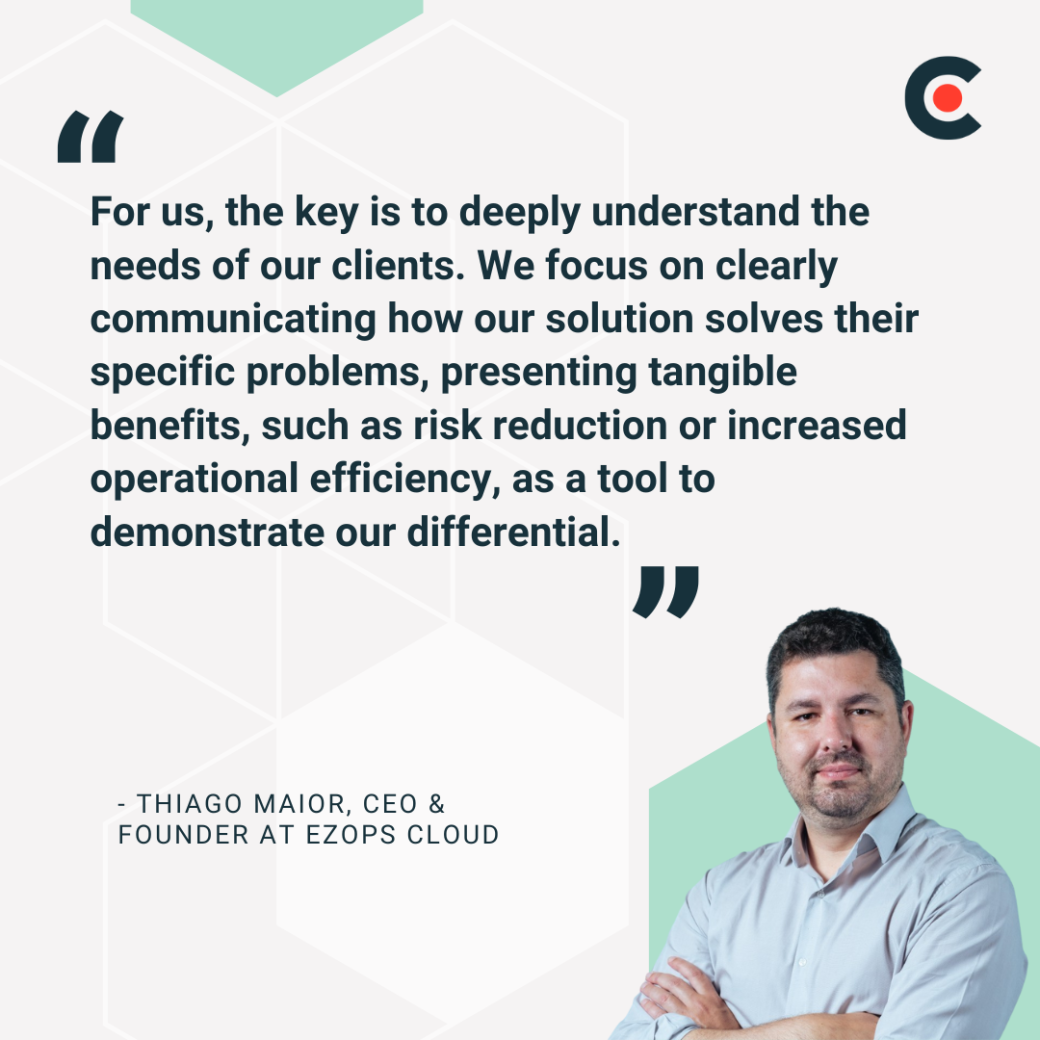
Thiago Maior, CEO & Founder at EZOps Cloud, reveals his team's strategy. "For us, the key is to deeply understand the needs of our clients. We focus on clearly communicating how our solution solves their specific problems, presenting tangible benefits, such as risk reduction or increased operational efficiency, as a tool to demonstrate our differential.”
Generic "IT decision-maker" targeting wastes your budget. You need nuanced audience understanding based on rigorous research.
Start by interviewing your existing clients with focused questions. Ask what security challenges genuinely concern them regarding their specific operational realities. The most effective cybersecurity marketers go beyond one-off surveys and build ongoing research relationships with their target audience. “We have regular conversations with clients about their business goals, join their industry groups, and talk directly to company leaders,” says Paul Mai, Digital Marketing Manager at IT Goat.
Through methodical client conversations, you'll often uncover surprising insights.
Many cybersecurity firms discover that approval processes hinge on factors they never emphasized in marketing. For instance, compliance documentation support might matter more than advanced technical capabilities for mid-sized managed service providers. Without direct research, these critical decision factors remain hidden.
Another research tip is to go beyond asking what security solutions prospects want. Ask about their last security incident:
The answers reveal emotional drivers that your marketing should address.
Also, segment your audience based on their security maturity, not just company size. Organizations with intermediate security maturity often make excellent clients, sophisticated enough to value outside expertise but not so advanced that they can handle everything internally. This approach goes beyond basic demographics to focus on behavioral patterns and specific pain points. As Maior explains, “It's important to segment the audience based on customer behavior and specific interests so it is possible to create personalized ads that directly address the identified needs.”
Use customer surveys to understand specific compliance challenges by industry. Many security buyers feel vendors don't understand their regulatory environment. Create industry-specific compliance guides that map your solutions to regulatory requirements.
Remember that the "buying committee" for security solutions typically includes multiple stakeholders. Each has different concerns:
Your marketing must address all these perspectives.
With solid research as your foundation, you can build marketing initiatives that connect with technical buyers and business decision-makers alike.
These tasks transform your research insights into marketing that drives business growth while establishing your brand as a trusted security partner.
Your brand isn't just your logo or tagline; it's the perception in your prospect's mind when they hear your company name.
Let your research guide your brand positioning. Analyze voice-of-customer data to identify what clients truly value. For example, for IT Goat's business audience, Mai shares that their "marketing focuses on business benefits like protecting your assets." If the client mentions your proactive threat-hunting more than your automated detection tools, consider shifting your brand story to emphasize the human expertise behind your technology.
To structure this research-driven positioning effectively, use a clear framework that enables you to articulate your unique value proposition based on actual client insights rather than internal assumptions, such as this:
Remember that consistency matters across channels. Technical prospects are likely to spot inconsistencies immediately, which damages trust. Create a unified "capabilities glossary" that aligns messaging across your website, sales materials, and customer communications.
Technical complexity kills conversions. Your content must translate security concepts into business language without sacrificing accuracy. Here are some ways to create helpful content for your clients:
Use this framework to organize your technical content in a way that builds understanding rather than overwhelming prospects with jargon:
Content Framework for Technical Topics
Generic cybersecurity advertising consistently underperforms compared to research-informed campaigns that connect with qualified prospects.
The most effective campaigns target their audiences based on specific technical challenges uncovered in your research:
Structure your campaigns around distinct decision stages to match content with buyer readiness:
Similarly, retargeting strategies work differently in cybersecurity than in consumer marketing.
The most effective approaches segment their audience by observed behaviors that signal buying intent and role. The content topics that prospects engage with often indicate specific security concerns — someone reading about SOC 2 compliance likely has different needs than someone researching endpoint protection.
Beyond behavioral targeting, successful cybersecurity campaigns also require strategic timing and placement decisions. “Place ads in business publications, focus on business benefits not technical features, and time campaigns around business events like mergers when security becomes more important,” suggests Mai.
Additionally, different job functions require distinct follow-up messaging. For instance, technical audiences respond to capability details, while business executives prioritize risk reduction and ROI messaging.
Strategic partnerships can significantly amplify your market reach when research guides your selection criteria. The most valuable partnerships emerge from thorough analysis rather than opportunistic connections.
Choose integration partners based on user research. Study your customers' technology environments to identify common platforms. If most of your ideal prospects use a specific cloud provider, consider building a deeper integration and co-creating technical content with that provider.
Here are a few partnership evaluation criteria:
It's also a good idea to develop co-branded content that addresses specific knowledge gaps. If your research shows customers struggle with cloud security misconfigurations, partner with complementary solution providers to create joint workshops addressing this challenge.
A great-fit partner can help expand brand credibility and reach.
Your website must skillfully balance SEO performance with security credibility. It's a uniquely important requirement in cybersecurity marketing.
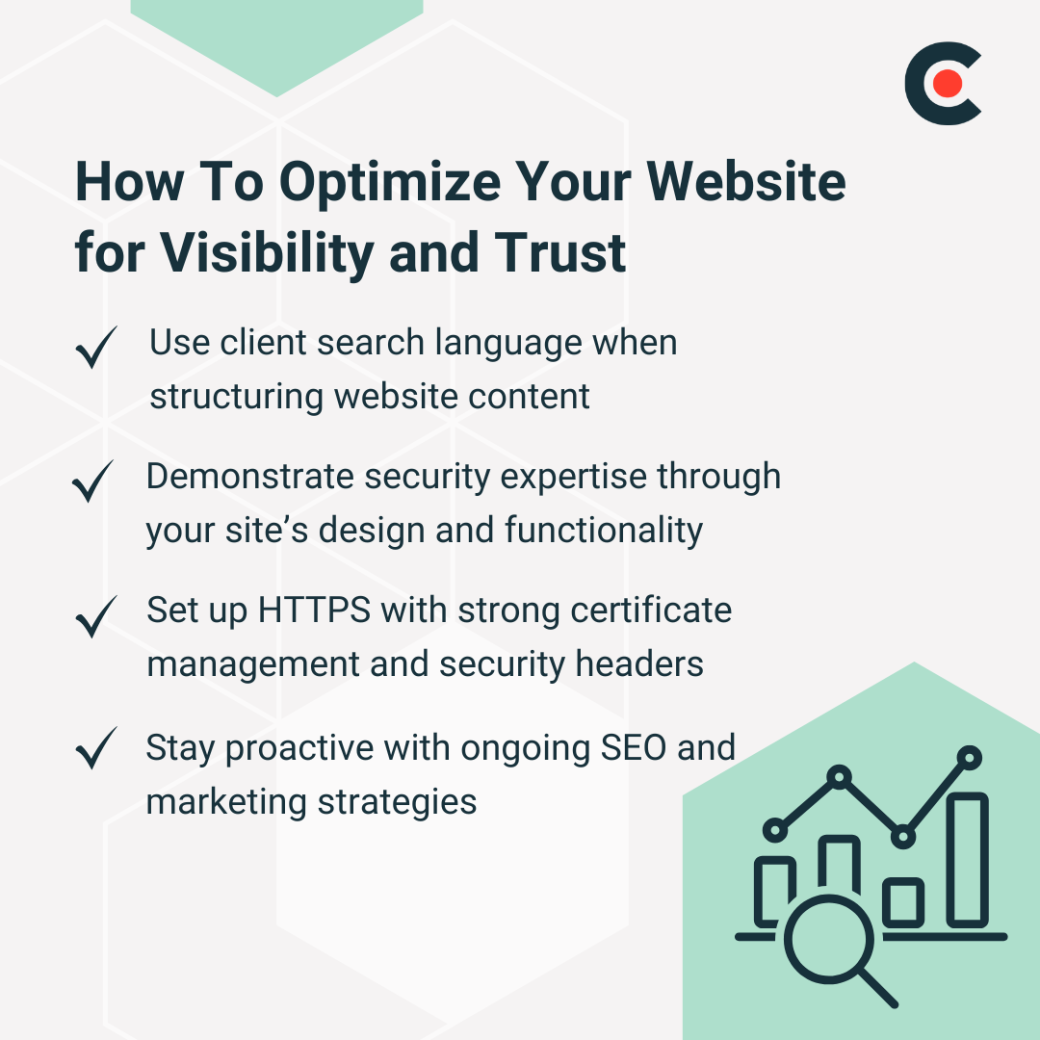
Structure your website content around the specific language prospects use when searching for solutions.
For example:
Also, be sure to demonstrate security expertise through your own website implementation, a factor that many cybersecurity prospects actively evaluate.
Implement flawless HTTPS configuration with proper certificate management and security headers that showcase your attention to detail. Document your own security practices transparently to demonstrate your commitment to the principles you advocate.
Moreover, remain proactive in your SEO and marketing efforts. Regularly monitor search analytics to identify important market signals that should influence your content strategy. Continue to watch for emerging security concerns driving new search patterns that might indicate shifting market priorities.
Effective marketing in cybersecurity projects isn't about flashy designs or clever headlines. It starts with disciplined research that reveals what your buyers actually care about.
Start every marketing initiative with intelligence gathering, then build your marketing strategy on this foundation and watch your close rates climb.
Remember: In cybersecurity marketing, trust precedes transactions. Each marketing element should reinforce your credibility and demonstrate your understanding of both technical and business challenges.
Ready to transform your cybersecurity marketing approach?
Check out our 7-point cybersecurity checklist to identify quick wins and strategic opportunities for connecting with prospects who need your solutions.