
Task Automation: How to Cut Repetitive Work
Task automation saves time, gets work done faster, and reduces errors. Learn how to automate repetitive tasks step-by-step and how to decide what to automate.
Updated January 13, 2026

Customer experience expectations have risen, and improvements are becoming more of a necessity than a luxury. Learn how AI enhances the customer journey while easing the workload of staff members.
Customer experience is what sets top companies apart from their competition. Keeping customer interactions seamless, intuitive, and always accessible has become an expectation rather than a luxury.
To guarantee long-term success and customer loyalty, companies are turning to AI-powered solutions and modern tech. In fact, a recent Clutch survey of 400 small business owners found that 55% of companies are now investing in technology to meet customer expectations.
Looking for a Artificial Intelligence agency?
Compare our list of top Artificial Intelligence companies near you
Customer expectations are evolving rapidly. Whether they’re entering search terms on Amazon to find a specific product, browsing personalized movie recommendations on Netflix, or asking Siri for help on an Apple device, AI is shaping how customers interact with brands.
Positive customer experiences now revolve around fast, frictionless interactions, tailored recommendations, and around-the-clock support.
These expectations make it impossible for companies with manual customer experience processes to keep up. Businesses looking to keep customers engaged and reduce churn must adapt by embracing the new AI technology.
AI has emerged as a powerful way to create a smoother, more efficient customer journey. By processing large amounts of data quickly and making adjustments from repeated patterns, the technology can deliver a customer experience that excels in multiple areas.
Because AI automates repetitive tasks, customers receive responses and solutions at lightning speed. This significantly reduces customer wait times, as common questions and requests take seconds instead of minutes. AI also increases first-contact resolutions, simplifying the customer support process and boosting customer satisfaction.
Using AI to improve the customer experience also helps by cutting down on generic advertisements, offers, and recommendations that customers often ignore. AI analyzes customer behavior patterns across multiple touchpoints, such as past orders, browsing history, and overall engagement, to tailor content automatically. Receiving relevant recommendations helps customers feel understood. This strengthens trust with the brand, drives engagement, and leads to higher conversion rates.
AI’s predictive intelligence identifies and capitalizes on patterns that humans often overlook. Using a vast pool of customer data and previous behavior, AI can anticipate what steps a customer will likely take next.
These predictive data and insights that AI provides allow companies to shift from a reactive to a proactive strategy. This strengthens the customer experience as they deal with fewer issues and receive immediate assistance before frustration sets in.
One of AI’s most valuable contributions is consistency. When customers switch between different channels, such as live chat, email, mobile apps, and websites, they can grow frustrated by conflicting information or repeated explanations. AI provides a uniform experience across all channels, reducing unnecessary handoffs and clarification requests.
AI enhances the customer experience in several key ways. By effectively taking advantage of AI, companies can reduce the workload of human agents, boost customer satisfaction, and scale their operations.
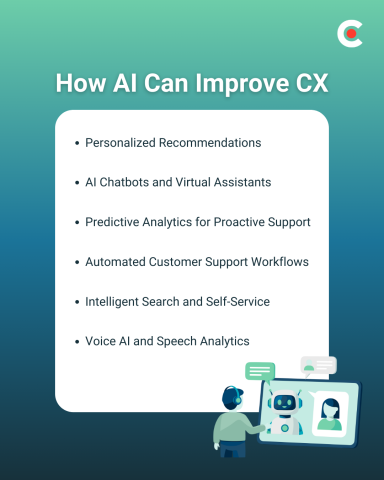
One of the best ways to take advantage of AI and connect with customers is by offering personalized recommendations. Machine learning can gather data, identify patterns, and make decisions about what is learned. When applied to creating a better customer experience, machine learning can tailor product suggestions, content, and messaging to individual preferences.
Personalized recommendations can fit into multiple customer journeys. In e-commerce, machine learning offers customized product recommendations that show potential customers items they’re more likely to buy. While relevant recommendations keep users engaged and on media platforms. Finally, this AI can also support upselling by correctly identifying when customers are ready for upgrades or other related products.
When customers receive recommendations that match what they’re looking for, it comes across as a genuine connection rather than a marketing effort. This translates to more trust and satisfaction overall and leads to higher average order values.
AI chatbots and virtual assistants provide fast and accurate responses, which further enhance the customer experience. Human customer service agents operate within limited hours and may not always have immediate access to every piece of information. However, AI chatbots can provide 24/7 support and give instant answers to most inquiries. This reduces wait time by processing routine requests, such as pricing, status, and basic questions.
Modern chatbots are able to go beyond reciting programmed scripts and give intelligent responses with natural language understanding (NLU). AI chatbots that use NLU can interpret customer inputs and give relevant responses in real time. These bots also learn from past interactions to predict needs and give better solutions faster.
Despite the capabilities of these AI chatbots and virtual assistants, in some instances, customers will need to speak with human agents. The bots can determine when customers need more support and pass them on to agents, while simultaneously filtering out the more repetitive tasks to conserve resources.
Offering proactive support through predictive analytics is another key way AI improves customer experience. By analyzing large amounts of customer data, AI can determine churn risks, customer needs, and the best way forward with each individual customer.
If AI detects that a customer may experience issues with a product, it can determine solutions and recommend preventative actions before problems arise. AI can also predict when the best time is to deliver renewal offers or when to push initiatives to improve retention. These types of proactive support help build stronger customer relationships.
Using AI to automate customer support workflows goes a long way in improving support teams. When AI automates routine tasks, customers receive solutions quickly, and satisfaction increases. Human agents also benefit as their ability to avoid these mundane tasks decreases the risk of burnout. Some examples of where automated customer support workflows deliver measurable impact include:
Companies that take advantage of automated customer support workflows make better use of their available resources, allowing them to scale at a faster rate.
Customers experiencing issues with a product or service may rely on a search for answers. Basic search functions that don’t take advantage of AI depend on keyword matches. If the customer doesn’t use the exact words needed to receive the support they need, it can lead to frustration. However, AI-powered intelligent search can detect behavior patterns, intent, and context to deliver the results the customer is looking for. When AI delivers the right answers, customers can fix their problems on their own. This not only improves customer satisfaction but also reduces the volume of support requests handled by service teams.
AI also improves customer experience for those keen on speaking with a representative instead of typing out their questions. Voice AI can create and analyze transcripts of customer calls to identify trends, sentiment, and issues. Customer support teams can then use this data to improve training and service quality for future calls. Advanced systems can also use AI agents that respond to calls in real time, which provides fast responses to customers and frees up staff resources.
The benefits of AI are vast, but technology without proper integration won’t deliver results. Here are four steps to take to make sure AI improves your customers’ experience.
The customer journey begins when an individual first learns about a brand's product or service and extends through purchase and post-sale interactions. Making sure this is a smooth experience is critical for driving conversions. The best way to determine where to integrate AI into your customer experience strategy is to identify where friction exists and where speed or personalization will improve engagement.
To start, determine which areas will provide the most impact and value for customers. Using AI to improve elements such as customer support, onboarding, and purchase flow can have lasting positive effects on customer experience and result in not only conversions but repeat purchases.
Enhancing the customer experience with AI can yield excellent results. However, depending on AI alone can produce an impersonal customer journey that only resolves basic issues. The best customer experience strategies pair AI with human representatives. This approach balances AI’s ability to scale and precision with the emotional intelligence of humans. To guarantee success, it’s essential to define the ideal handoff points where bots send automated responses to live agents that can deal with more complex requests.
AI depends on vast amounts of data, and even though customers want personalized experiences, they also want to know their data is used responsibly. To maximize trust with customers, companies must communicate how they collect, store, and use data. Maintaining transparency, keeping data private, and handling data ethically are the only ways to meet customer expectations as well as legal requirements.
Companies that engage in poor data practices risk alienating customers. Additionally, the AI isn’t as effective, and outputs can lead to irrelevant product recommendations, unhelpful solutions, and general errors. This will eventually lead to frustrated customers who move on to competitors for better service.
While custom-built AI solutions can differentiate companies from competitors, buying pre-existing tools presents its own set of advantages. Purchasing ready-made chatbots or predictive analytics tools can result in faster implementation and proven performance for companies that don’t have the time or resources to build their own. On the other hand, investing the time and money needed to create an in-house AI platform allows companies to use advanced, highly specialized models that they can tailor to their unique business needs.
Companies that know the impact of AI on customer experience can fine-tune their strategy to maximize its effectiveness. Tracking the right KPIs allows businesses to see how AI is improving outcomes and where gaps and weaknesses exist. Some key customer experience KPIs to use include:
A major KPI to keep an eye on is the overall ROI that AI delivers. Using AI to improve customer experience should lead to reduced support costs, faster response times, higher conversions, and increased customer lifetime value. Taking all of these KPIs into consideration can paint a picture of how effective the AI is.
While AI can improve customer experience in several key ways, poor implementation can leave a bad taste in the customer’s mouth. Some common mistakes to avoid include:
As more companies use AI, more customers expect seamless, personalized, and proactive experiences. Implementing AI can take your customers’ experiences to the next level with personalized recommendations, proactive support, faster responses, and consistency across channels. AI does not replace human service. Instead, it amplifies and enhances it, creating more meaningful and effective customer experiences.