
Why Searching for a Specialized Dev Agency Takes Longer Than It Should — And What to Do About It
Looking for a niche software development agency? Learn how to define your requirements, find specialized providers, and vet their experience.
Updated March 31, 2026

Getting leadership to approve new product features comes down to proving their business value. To get the green light, come prepared with clear, strategic talking points for your pitch.
You've got a brilliant idea for a new product feature, and you can see exactly how it'll transform the business's bottom line and drive revenue. However, your leadership team might not have caught the vision yet.
Between focusing on budgets, timelines, and a dozen other priorities, your product features might not only seem necessary, but they might come across as scope creep.
Looking for a Software Development agency?
Compare our list of top Software Development companies near you
One of the effective ways to get a green light from leadership for new features is to speak the language of business outcomes that align with company goals. Master the art of presenting product features to leadership with this article's step-by-step pitching tactics.
Executives live and breathe numbers. So when you walk into that room, you better come armed with data that connects directly to business outcomes.
Start with customer insights. Pull those support tickets, analyze feature requests, and show them how many customers are asking for this exact functionality. But don't stop there. Go a step further to explain how this customer want translates to business impact. For instance, if it's a B2C product, don't just say, "Users want this." Show them that "users who have this feature stay 40% longer and spend 25% more."
Competitive analysis matters, too. When your biggest competitor launches something and starts stealing market share, executives pay attention. Track your competitors' feature releases and customer reviews. Find the gaps where they're winning and show how your proposed features close those gaps.
ROI projections speak the loudest. Build a simple model that shows the potential revenue impact. If adding this feature could increase retention by just 5%, what does that mean in actual dollars?
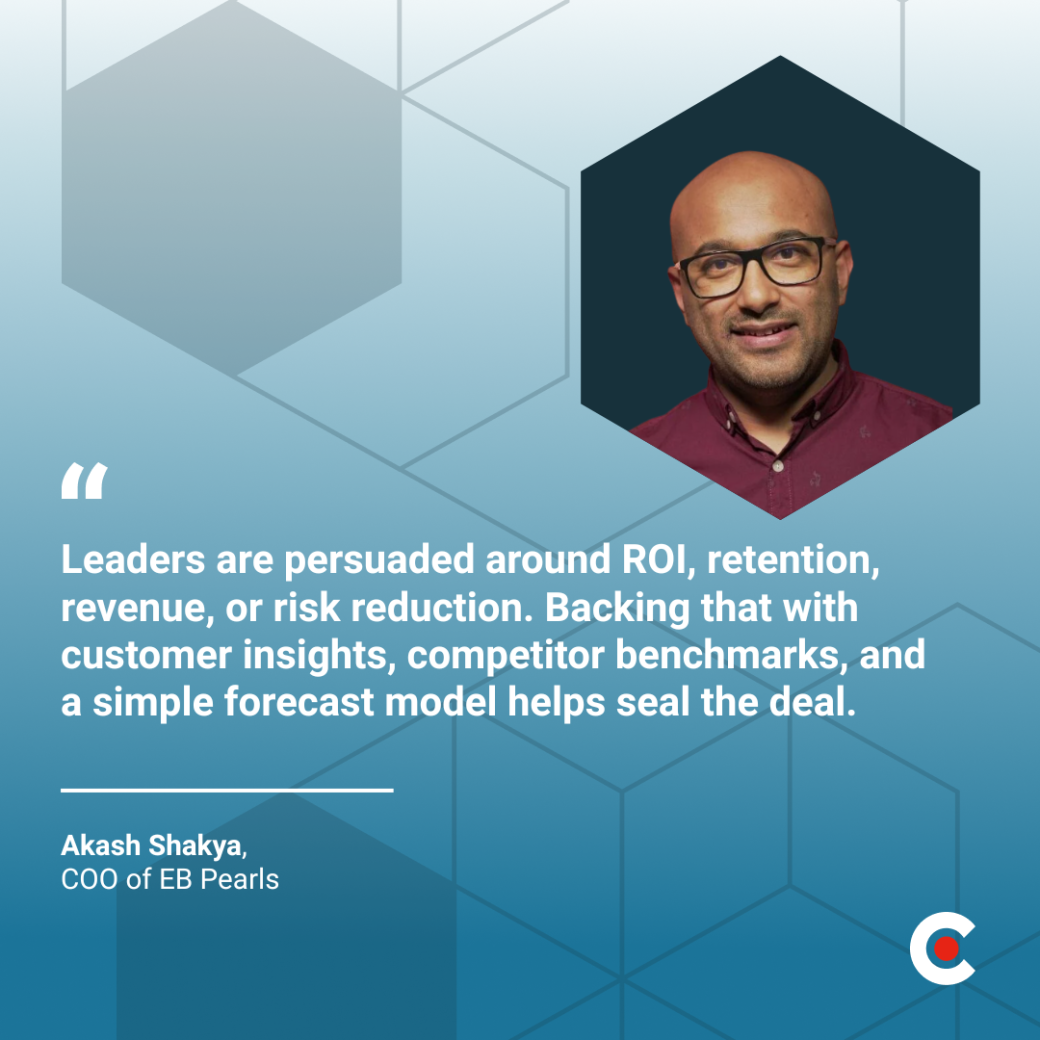
All these concrete data points are what leadership values. "Leaders are persuaded around ROI, retention, revenue, or risk reduction. Backing that with customer insights, competitor benchmarks, and a simple forecast model helps seal the deal," says Akash Shakya, COO of EB Pearls.
Where do you find this data?
Even if you have the coolest feature idea, it's dead on arrival if it doesn't push the needle on company objectives.
Every company has its North Star metrics. Maybe this quarter, yours is all about user acquisition. Or perhaps retention is the name of the game. Some organizations even obsess over reducing support costs, while others chase market expansion.
Your job? Show how your product features directly impact your company's goals. "It helps to pitch features that align with company goals," notes Cyrus Kiani, Founder of TouchZen Media, adding that it's even better if the products "are relatively straightforward to build."
Let's say your company aims to expand into health care markets, and you're proposing an AI chatbot feature. Show how HIPAA-compliant messaging capabilities open doors to hospital systems worth millions in annual contracts. That's alignment in action.
Aligning to objectives and key results (OKRs) and key performance indicators (KPIs) is your roadmap to executive buy-in. Here are a few ways to map your features to strategic priorities:
You can get leadership on board faster when you frame features as accelerators for existing goals, not distractions from them. Your leadership is already committed to these objectives. You're just showing them a faster route.
A proof of concept transforms abstract ideas into tangible experiences. It's the difference between describing an app or letting someone see or click around it. Suddenly, executives stop asking, "What if?" and start asking, "How soon?"
You don't need a fully polished feature — just enough to communicate the vision and validate the approach.
Whether it's a clickable prototype in Figma or a small-scale pilot with a handful of beta users, "A working proof of concept or design prototype can go a long way," explains Kiani. "Leadership doesn't always connect with ideas from a product requirements doc alone; they can understand the vision more clearly if they can see a concept in motion. This makes the vision more tangible and easier to support."
While you want your proof of concept to impress leadership, you also don't want to lose too many hours to the build. Use these short-term goals, long-term metrics, and guiding questions to help you with your proof of concept creation:
Short-term validation goals:
Long-term success metrics:
Your proof of concept should answer three questions:
Define those goals, metrics, and answers, and you've got your green light.
Nothing builds confidence like a track record of success. When you show leadership that similar features have delivered results, either internally or at comparable companies, you shift the conversation from, "Will this work?" to, "How do we make this work for us?"
Smart product managers document every feature launch, tracking metrics before and after. They build a library of success stories that prove their judgment.
Internal wins carry the most weight. It could be a small usability improvement from last quarter, like the one that reduced support tickets by 30%. Or that integration you pushed through six months ago, which opened up a new market segment worth $2M in ARR. Your work's results are your proof that incremental features deliver outsized returns.
External examples work, too, especially from companies your leadership admires. Find parallel examples in your industry.
Structure your evidence like this:
Overall, the best strategy is to show how similar customer segments, comparable development efforts, and aligned go-to-market strategies yield equally positive outcomes. "We complement technical specifications with case studies from similar implementations, highlighting measurable improvements in efficiency, user satisfaction, or revenue generation," shares Vishal Bhatia from Dedicated Developers.
In the end, getting leadership buy-in for your new product features comes down to effective presentation and connecting features to business goals.
You've got four levers to pull:
The leadership across the table from you might have seen hundreds of product feature pitches. What separates successful proposals from rejected ones is methodical preparation. So, before presenting product features:
Skip the vision speeches and focus on demonstrable value. Your leadership team already knows the market is competitive and customers are demanding. What they need from you is a clear path from investment to return.
Are you ready to transform your leadership team from gatekeepers into partners who champion your product vision? Implement these strategies today.