
How to Delegate: A Step-by-Step Guide for Agency Owners
Learn how to delegate effectively as an agency owner — what to delegate first, how to hand off work without losing quality, and the hiring sequence that...
Updated March 13, 2025

Complexity is a hidden killer in your business, often leading to inefficiencies and obstacles that can hurt performance. Learn more about how Clutch overcame complexity and how you can too.
I was about 8 months into my tenure as Chief Revenue Officer at Clutch when it hit me that I still didn’t fully understand one of our smaller advertising products. As we were looking for ways to grow the business and I turned my attention to this particular product, I realized that my lack of understanding was due to the significant complexity in the product.
Complexity refers to overcomplicated processes, workflows, and systems that can impact operations and growth. This often occurs as businesses expand and processes become more complex. In particular, I see this happen when companies begin to hire specialists and form teams, creating information silos.
The cost of complexity is hard to see. You won’t see it in an income statement or on a balance sheet, but it can be worth millions of dollars. But by identifying complexity in your business and simplifying where necessary, you can unlock smoother operations, foster innovation, and propel your company toward success.
In this article, I will break down how we were able to reduce complexity at Clutch so you can do the same in your business.
Looking for a consulting company? Search for industry-leading service providers on Clutch. Filter by client ratings, budget, and location to find the perfect partner for your project.
It can be really difficult to identify complexity in your business. In fact, the growth rate or revenue of a product may not be great indicators for identifying complexity. Instead, anecdotes from customer-facing representatives and clients themselves are often the best way to pinpoint complexity, but determining whether or not it is a client-specific problem or systemic issue can be challenging.
We began to suspect that complexity was negatively impacting the performance of a Clutch product, despite the fact that it was performing relatively well, simply because I still couldn’t understand the product when internal teammates tried to explain it to me. To get a better understanding of the product, I began to speak with client representatives and discovered that many had difficulty explaining the product.
This was a huge problem — if our reps weren’t able to convey the value this product could provide clients, they wouldn’t be able to maximize participants and would, therefore, be artificially depressing the value of each placement. Since Clutch is a competitive auction marketplace, the price we charge for any given placement is a function of demand from our clients.
The key to identifying this issue was asking questions. Those who are closer with the products, workflows, and operations are more aware of the hurdles that may be impacting their day-to-day. Through thoughtful questioning, you can get a better understanding of operations and what may be hindering growth and performance.
Here are a few questions that can help you identify complexity in your business.
Questions to Ask Your Team to Identify Complexity
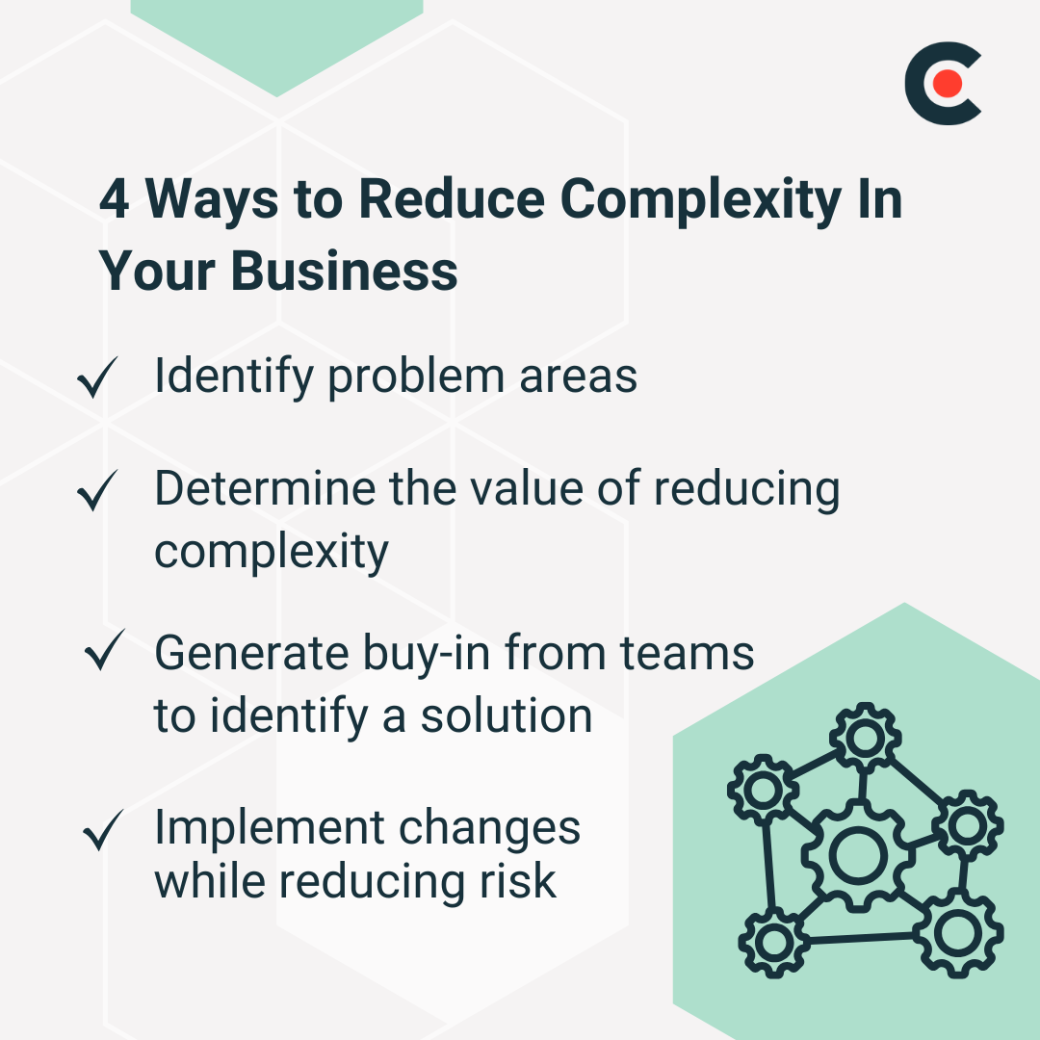
Once you identify that there is complexity in your business, you need to look for ways to simplify processes and operations. Coming up with an effective solution can be challenging, especially because it often requires cross-team collaboration and buy in.
Not sure where to look for complexity in your business? Start here, where complexity most commonly impacts the performance of your business.
Sometimes it isn't worth fixing complexity because the effort isn't worth the upside. Once you’ve determined where there is complexity in your business, you can weigh the benefits of reorganizing your business versus the risks associated with these changes.
In our situation, we had similar products that performed significantly better on most comparable metrics. Using our existing products as a baseline, we were able to assume the revenue upside of reducing complexity. Using this information, we were able to determine that there was significant upside to solving this problem.
If you don’t have internal benchmarks you can measure against, you can look at competitors or similar companies in other industries to assess the value of reducing complexity. This information can help you determine the value of reducing complexity and whether or not it is the right choice for your business.
Particularly because complexity is difficult to quantify, it can be difficult to get other team members on board.
Many people who built the system or developed the operation may not understand why something needs to be addressed again, and so you may experience some resistance. Still, you need to convince team members across the board to allocate resources to resolve the issue, even if it’s not obviously impacting business performance.
To successfully get other teammates on board with reevaluating operations, clear and effective communication is essential. Start by sharing evidence that highlights the negative impacts of current complexities. This could include specific cases where inefficiencies have led to lost opportunities or delays, making the problem tangible and relatable for your colleagues.
By clearly communicating existing challenges, more team members will understand the need to reevaluate operations and look for improvements. Not only is getting key stakeholders involved early in the process important for fostering a sense of ownership, their input and feedback are essential for reducing complexity.
The key to reducing complexity is finding a solution that works for all teams. When solutions are tailored to suit the needs of every team, it minimizes internal friction and prevents other forms of complexity from arising. A one-size-fits-all approach often leads to inefficiencies and challenges for people on other teams.
Often this means collaborating with team members that touch different aspects of your business. You will need to analyze the problem and talk through it with team members at different levels across your organization.
Once we were able to identify the issue surrounding Clutch’s product and how it was impacting the business, we had to brainstorm with several different teams to come up with a solution that worked for every team.
As we went through this discovery process, we coordinated with the product team to brainstorm ways to streamline this process and create a better product for our clients. Then, they made changes over several weeks to reduce the complexity of the product.
On top of that, we had to work closely with the marketing team so we could easily explain the changes to customers when it was rolled out.
Overall, finding a solution that worked for all teams was crucial for simplifying this process. It required open communication, a collaborative approach, and a commitment to addressing individual team needs in order to create a unified solution that benefited everyone.
Unfortunately, you take a risk when you start to reexamine products and operations. The truth is that you could be wrong and may, unintentionally, hurt your business’s performance.
In our case, we have identified unnecessary and potentially harmful complexity in our business, determined that it is meaningful to the business and developed a solution. However, there is still risk. Anything that has a potential upside also has the potential to be disruptive.
That doesn’t mean you should be afraid to make changes — instead, you need to do your best to minimize risk. Whenever you make a change, you need to anticipate consequences, like temporary decreases in sales and lower customer satisfaction rates, so you can address any potential issues before they arise. This could involve testing the changes with a limited group of clients or gathering feedback from team members. It's also important to have contingency plans in place in case the changes don’t have the impact you expect.
No matter how much you prepare, though, things may come up that you can’t expect. For this reason, we took a few precautions to ensure that this change was effective, and you should too.
For one, we stayed close with our biggest clients. Rather than risk our partnership, we communicated big changes and asked for feedback to ensure that we would retain them. Even with these precautions, we still had situations with important clients where we had to get on calls and make adjustments to overcome some unanticipated consequences.
We also phased in our changes. This allowed us to alleviate the impact it would have on existing customers and address any challenges that popped up in a timely manner.
As you think through complexity in your business, think about how the solutions can impact your customers as well as your internal operations. This can help you foresee any challenges so you can prevent them as well.
When we first started looking into this product, we weren’t totally sure that there was anything wrong with the product. But by addressing some of the issues we found, the product started to perform significantly better.
Our changes helped reps feel comfortable talking about the product, leading to more client interest. And, as a result, revenue skyrocketed.
So what’s the lesson here? Complexity in business is often an invisible drain on resources, creativity, and efficiency. By actively identifying and addressing areas where complexity lurks, you can streamline operations, enhance team performance, and ultimately boost your bottom line.