
How Executive Search Firms Help Fast-Growing Companies Build Leadership Teams That Scale
Avoid costly executive hiring mistakes. Learn how search firms help B2B companies hire leaders who deliver results.
Updated October 5, 2026

Choosing the right 3PL should not be like ticking boxes on a checklist. The best way to choose is to match the 3PL to your sales channels, check its full fee schedule, and make sure it can support your growth. It also plays a big role in how much margin you keep and how your customers experience your brand.
Getting it right may feel like a lot of work at first. But getting it wrong can slow your growth, and you often won't notice it until much later.
This blog covers where most brands go wrong when choosing a 3PL partner, as well as the questions you should ask before you sign anything.
Looking for a BPO agency?
Compare our list of top BPO companies near you
When your brand is doing around $1M in revenue, most 3PLs will work fine for you. Orders ship, customers receive them, and there are few complaints.
Things start to change once you cross $5M. You are sending a lot more inventory across more channels, and the timelines are getting tighter. If your fulfillment setup is not optimized, small issues start turning into real delays.
For example, your Amazon shipments may sit at the warehouse for weeks before check-in. This usually happens when shipping plans are still being created manually, and the team can't keep up with weekly replenishment. Some logistics teams now use AI logistics software to take this kind of repetitive work off their plate.
You may also start seeing placement fees on your invoices without knowing why. This happens when inventory is not being split across Amazon fulfillment centers.
Retail can bring its own problems, too. If Walmart and Costco compliance guides were not part of the original setup, your retail routing requests may get sent back.
So, having more volume does not always mean your brand is scaling well. The 3PL that worked for you at $1M may start slowing things down at $10M.
That is why choosing a 3PL needs more thought than most brands give it the first time around.
Here are the five most common mistakes brands make when choosing a 3PL:
Amazon has its own set of rules, and they are quite different from Shopify's. The labeling, case pack requirements, and inbound windows are different, too. Amazon also keeps updating these requirements.
Some 3PLs work mostly with DTC brands, so Amazon may not get as much of their attention. When that happens, your shipments can end up waiting 2 to 3 weeks before they get checked in. You may also see placement fees cutting into your margin, and a lot of back-and-forth emails just to get shipping plans sorted out.
AMZ Prep's Middle Mile program was created to solve this problem. It moves your inventory along freight lanes that already serve Amazon fulfillment centers every week.
With this, check-in time drops from 2 to 3 weeks to just 2 to 4 days. Placement fees go down to zero with 5-way split routing. Shipping plans are also created automatically and sent straight to the warehouse, so there is no need for back-and-forth emails.
If Amazon brings in more than 30% of your revenue, this is not a small operational issue. It can directly limit how fast your brand grows.
Many brands pick the 3PL with the lowest per-unit rate, thinking it will save them money. But the per-unit rate does not always show you the full cost.
Fees for receiving, unit handling, returns, and long-term storage are often not clear at the start. Once your inventory starts moving, these fees can add up quickly.
Communication is another cost that many brands overlook. If every issue has to go through a support ticket, even a small problem can take days to get fixed.
For example, a missing SKU on an inbound shipment can turn into a two-week delay if no one takes ownership of it.
Ask any operations lead what they'd rank higher next time, and communication usually lands near the top. The vendors offering Slack access, weekly execution calls, and named account owners tend to hold on to their clients longer for a reason.
Most 3PLs are good at one or two channels. Some are built for Shopify DTC, while others focus mainly on Amazon.
Very few 3PLs can handle Amazon, Shopify, TikTok Shop, Walmart, retail, and B2B from the same facility.
This becomes a problem when your brand starts selling on a new channel. For example, a new retail account may need EDI compliance that your current 3PL does not support.
In that case, you may need to bring in a second 3PL. Your inventory then gets split between two providers and two systems, and your finance team has to track the same SKU across two warehouses.
437, an apparel brand, runs its DTC omnichannel fulfillment with AMZ Prep from one setup. All its channels use the same inventory pool, integration, and operations team.
So when 437 wants to start selling on a new channel, it can plug it into the same setup without moving to a new warehouse.
Not every 3PL is equally good at every channel. Before you choose one, check how well they support the channels that bring in most of your revenue today.
When you look at a 3PL's rate card, the base pick fee is usually the one that stands out. But that is only one part of the cost.
You also need to consider the receiving fee, additional pick-up fees, return processing fees, and long-term storage charges. These fees are usually what make the biggest difference to your total cost.
Fulfillment costs have been going up as a share of order value over the last five years. Brands that check their invoices line by line are usually the ones that catch this early.
Before you sign, share your real SKU data, order volume, and channel mix with the 3PL and ask them to calculate your total cost. Also, ask what your cost will look like if your volume doubles.
A 3PL with flat-rate freight pricing or fixed per-case fees will make it easier for you to plan your budget. This matters most during peak season, when costs can fluctuate widely.
If your inventory is stored in just one warehouse, a lot of your US customers will end up in shipping zones 6, 7, or 8. That means orders take longer to arrive, and you pay more to ship them.
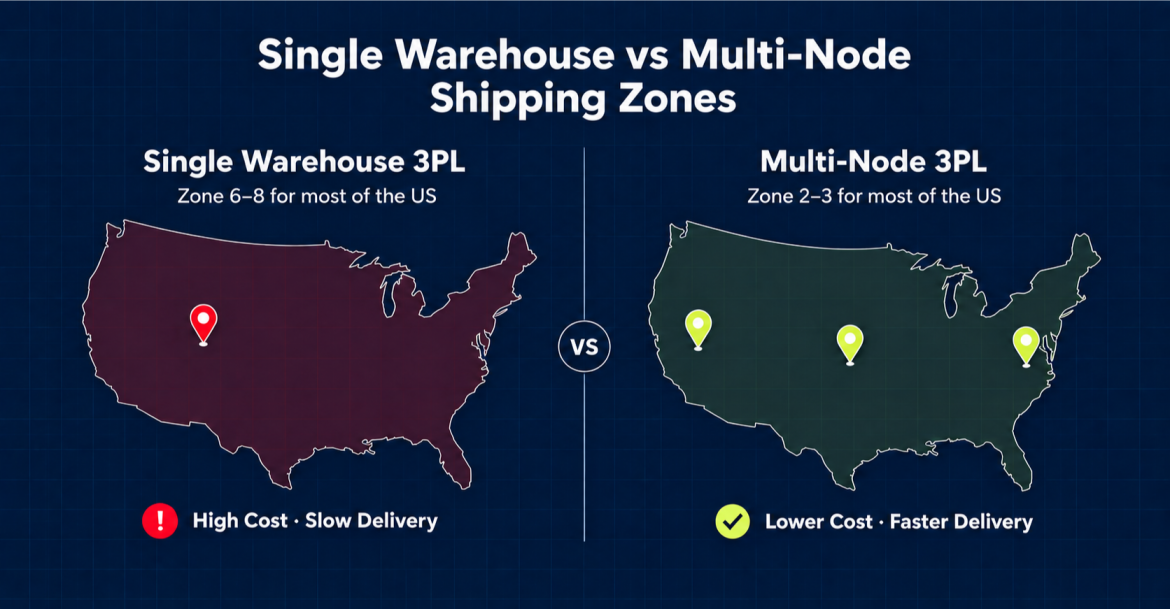
A 3PL with multiple warehouses and regional carrier partners can help with both. Many brands save 20-30% on parcel costs this way, which is a significant savings for a brand doing $10M a year.
Ask specifically which carriers the 3PL runs, how live rate shopping actually works in their system, and which regional carriers they can tap beyond UPS and FedEx.
Flip the mistakes into a positive checklist, and here's what to look for in a 3PL:
A sales call will usually show you the best side of a 3PL. To understand how they actually work day to day, it helps to ask more specific questions like these:
The answers separate 3PLs that will scale with you from those that quietly cap out around $10M.
Any real shortlist depends on your channel mix, order volume, and where fulfillment needs to physically sit. Six providers' e-commerce brands commonly evaluated are below, each with a different specialty. This isn't a ranking. It's a starting map for building your own comparison.
| 3PL Provider | Best For | Channel Strength | Network Footprint | Notable Capability |
| AMZ Prep | Multi-channel brands needs 2-day delivery | Amazon, Shopify, TikTok Shop, Walmart, B2B, retail | 50+ centers across US, Canada, UK, Germany, Netherlands, Dubai | Middle Mile freight consolidation into Amazon FCs |
| Flexport (formerly Deliverr and Shopify Logistics) | Shopify DTC brands wanting Shop Promise badges | Shopify, Walmart, eBay | US-focused multi-node network | Fast delivery badge integrations for Shopify and marketplaces |
| Flowspace | Mid-market DTC brands needing software-first visibility | Shopify, DTC, some Amazon | Distributed US warehouse network | Software-led inventory orchestration |
| Rakuten Super Logistics | US-focused brands needing 2-day ground coverage | DTC, Shopify, some Amazon | US-only regional network | SmartFreight parcel program |
| ShipBob | Early to mid-stage DTC brands under $10M | Shopify, DTC-first, limited Amazon | US, Canada, Europe, Australia | Distributed inventory management dashboard |
| Stord | Enterprise brands wanting cloud supply chain orchestration | Retail, DTC, B2B | US network with software layer | Full cloud supply chain platform |
Each of these providers serves a real segment of the market. The right pick depends on where your channel mix lives today and where you expect it to live in 24 months. A brand at 60% Amazon and 40% DTC evaluates this list differently than one running 90% Shopify DTC with a small retail account on the side.
The shortlist isn't about picking the biggest name. It's about finding the closest fit to your operational reality.
A clean 3PL selection process has 4 stages:
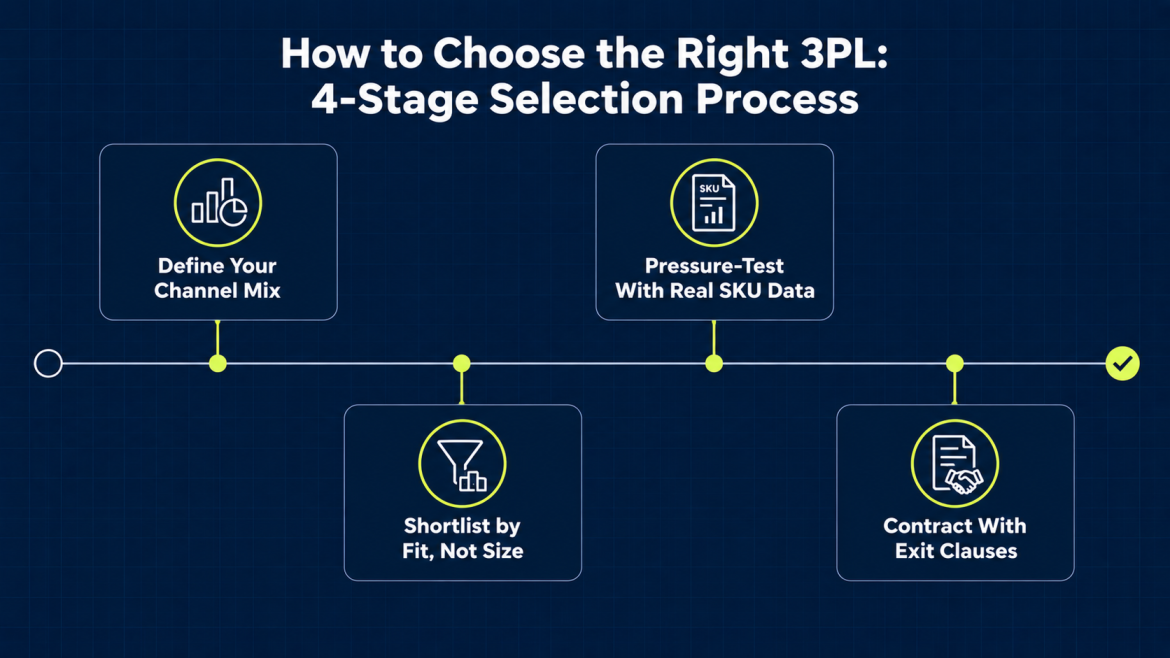
Start by writing down where your revenue comes from today and where you expect it to come from in the next 12 months. This will help you decide which factors matter most when you compare 3PLs.
The biggest 3PL is not always the best choice for your brand. Look for 3PLs with real experience in your top two sales channels and add them to your shortlist.
Share your actual order data with each 3PL on your shortlist and ask them to calculate your total landed cost. Comparing these numbers will give you a much clearer picture than comparing rate cards.
Before you sign, check that your contract has clear SLAs and a notice period. It should also explain how your inventory will be moved if you ever decide to switch 3PLs. Most experienced 3PLs are happy to include these terms, so ask for them early.
Most of the mistakes above happen for the same reason. Brands compare 3PLs only on features and pricing, forgetting that a 3PL also plays a big role in how quickly the brand can grow.
The right fulfillment partner can help you start selling on new channels and protect your margins during peak season. It also gives you more time to focus on growing sales for your brand.
The wrong one quietly caps everything your marketing team is trying to build.
Choose accordingly.
There's no single winner. The right e-commerce fulfillment provider depends on where your revenue lives, how many SKUs you carry, and where your customers ship to. Amazon-heavy brands and DTC-first brands almost never end up on the same shortlist.
Amazon mainly works as a 3PL. Through FBA, it stores and ships products for sellers on its marketplace. With Multi-Channel Fulfillment, it can also ship orders from other sales channels, such as your own website.
When you use a 3PL, you have less control over daily fulfillment. Costs can increase as your brand grows, and managing operations can become harder if the 3PL does not support all your sales channels.
Companies like C.H. Robinson and UPS Supply Chain Solutions are among the largest 3PLs in the US by revenue. For e-commerce fulfillment, brands typically compare providers such as ShipBob, AMZ Prep, and Flexport.
Yes, Costco uses both its own distribution centers and third-party providers. Brands that sell to Costco must follow strict routing and delivery scheduling rules, so many of them work with a 3PL that understands them.
There is no one cheapest 3PL. Pricing depends on your product size, order volume, storage time, and sales channels. A low base rate may still come with extra fees, so always check your total cost first.
Shopify Fulfillment Network was Shopify's owned 3PL until 2023, when it was sold to Flexport. Today, Shopify plugs into dozens of 3PLs through its app ecosystem. Brands pick their own fulfillment partner and connect it to Shopify for order sync.
Yes, Amazon works with third-party companies for some of its middle-mile and last-mile delivery. Amazon also has its own Warehousing and Distribution program for brands that need bulk storage before sending inventory to FBA.
A 3PL charges fees for receiving, storing, picking, packing, and shipping your products. It also charges for extra services like kitting, labeling, and returns. Some larger 3PLs also earn money from freight and shipping services.

![How to Create a Corporate Training Budget [With Template]](https://img.shgstatic.com/clutch-static-prod/image/resize/715x400/s3fs-public/article/f8cb0a8fb8e36a14ff257e02ce8b9475.jpg)