
Will AI Replace Graphic Designers? The Fear vs. The Facts
AI is revolutionizing graphic design, but is it replacing designers? Clutch research reveals what businesses actually think, and what designers need to...
Updated November 9, 2026

Graphic design mission statements are key to communicating core company values by answering an important question: Why are you providing these services in the first place?
A graphic design mission statement explains who you design for, what your work helps them do, and the principles behind your approach. Start with a clear sentence about the purpose of your design work, then support it with examples from your portfolio.
Use the template, drafting steps, and agency examples below to write a graphic design mission statement that reflects your work. You can also use a graphic design process book to show how that purpose informs your projects.
Looking for a Graphic Design agency?
Compare our list of top Graphic Design companies near you
A graphic design mission statement is a brief explanation of your purpose as a designer, studio, or agency: the people you serve, the design work you do, and the value you aim to create. It expresses your current purpose rather than a future ambition. UXPin’s design mission statement guide makes the same distinction between mission and vision.
| Element | Question it answers | Illustrative wording |
| Mission | Why do we do this work now? | We help local restaurants explain their offer through clear menus and visual identities |
| Vision | What future do we want to help create? | A city where independent restaurants are as visible as national chains |
| Values | What guides our choices? | Clarity, collaboration, and respect for each restaurant's character |
| Project goal | What should this assignment achieve? | Create a consistent menu system for three locations |
| Tagline | What short phrase expresses the brand? | Local flavor, clearly expressed |
Creating a strong design mission statement has two key benefits:
For a prospective client, the statement is a starting point for understanding your fit. Support it with relevant work, a clear process, and a conversation about project goals; a mission statement alone cannot establish whether a partnership will succeed.
Creating a strong graphic design mission statement is about clearly communicating who you are as a designer or agency, what you stand for, and what clients can expect when they work with you.
Build your draft around four decisions: who you serve, what you design, the outcome you work toward, and the approach that makes your work distinctive. Use these five steps to turn those decisions into a statement.
Choose the clients or communities your design work serves. “Independent restaurants opening a second location” gives you a clearer starting point than “all businesses.” Write down the communication problem you help them address, such as an inconsistent identity or hard-to-read information.
State the work you actually offer, such as brand identities, packaging, editorial layouts, or campaign graphics. Connect it to a client or user need. “Make product information easier to understand” is more useful than “deliver innovative solutions.” Avoid guaranteeing revenue or other results beyond your control.
Pick the approach that matters most to your work. For example, if your principle is clarity, identify a project where you improved visual hierarchy or simplified a layout.
Save that project as supporting evidence rather than trying to fit every value into the statement.
Use this template as a starting point, then adjust the wording so it sounds natural:
“We help [specific audience] [intended value] through [design services], guided by [distinctive approach or principle].”
For a solo designer, replace “we” with “I.” Aim for one clear sentence; add a second only if it supplies useful detail. This is a drafting recommendation, not a required format or word count.
Ask a colleague or client to read the statement without an explanation. Can they identify whom you serve and what your design work helps them do? Compare the wording with your portfolio and service list. Revise any claim you cannot support, and remove language that could describe almost any studio.
Generic draft: “We create innovative designs that help businesses succeed.”
More specific draft: “We help independent food brands make product choices clearer through packaging that pairs readable information with a distinctive visual identity.”
The revision names an audience, a design service, and an intended benefit. Before adopting it, the studio should be able to show packaging work that supports the promise.
The agency examples below show different ways to express purpose and approach. Use them for inspiration, then choose language that matches your own work.
When drafting a mission statement for your graphic design services, it’s important to feature your values as a brand through the statement.
Make values concrete. If collaboration matters to your studio, explain how clients participate in discovery or feedback. If clarity is central to your work, show how you simplify complex information. Keep the statement easy to find and place supporting evidence nearby.
Prospective customers will be looking for your values when considering your candidacy for a project. In fact, two-thirds of Americans prefer to work with brands and companies that reflect similar values, making transparency especially critical. Make sure your mission statement is easy to find, or else that customer might hire someone else, even if you are aligned.
Graphic design house ThompsonStenning showcases its values and mission clearly and transparently. The agency lists its mission, beliefs, and history together on the “About” page of its website.
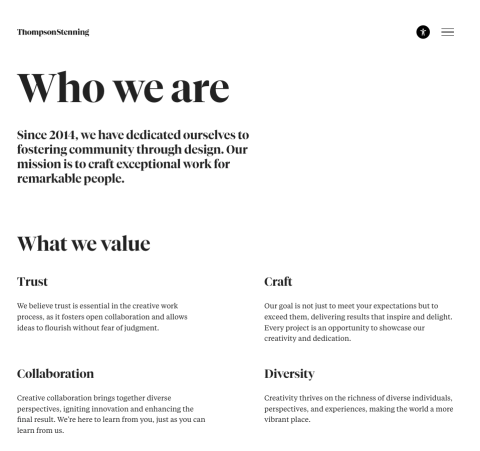
Their mission statement remains concise: “Our mission is to craft exceptional work for remarkable people.” Beyond this short statement, the agency clearly communicates its core values, giving clients insight into how they work and what they stand for. On their website, the “Who We Are” section emphasizes community-building through design, while the “What We Value” section breaks down principles that guide every project. Presenting the mission alongside detailed values not only reinforces the agency’s purpose but also helps prospective clients understand the approach, culture, and quality they can expect when working together.
Describe your current design approach in the mission statement. Keep your longer-term vision separate so readers can distinguish what you do today from what you hope to achieve.
By reading your mission statement, customers should be able to understand your value. They want to know what they will get from your partnership before hiring you, and a graphic design mission statement can paint a picture of what a successful collaboration with you will look like.
The Yard Creative handles sharing its mission effortlessly on its website. Listed prominently along with other helpful information on the company is a statement that clearly details what the company works to achieve through collaboration.
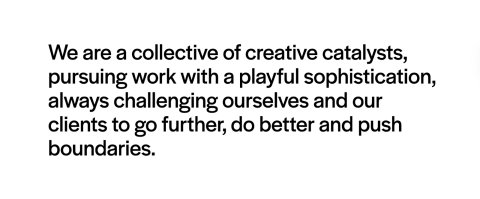
The page connects its approach to client outcomes and identifies values including curiosity, integrity, courage, and craft. The lesson for your mission statement is to connect a principle with how you work: what will a client experience when you put that principle into practice?
Name the value you work toward for clients, such as clearer communication or a more consistent brand identity. Keep short-term targets and project measures in your strategy or brief. Your mission should explain your purpose without promising results you cannot substantiate.
Graphic design agency Marquis Design effectively displays its goals within a mission statement on its website. The statement is only a sentence long, but it emphasizes core goals for customer service, collaboration, and results.
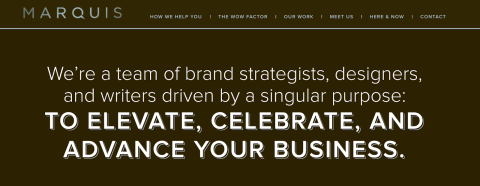
The statement reads: “We’re a team of brand strategists, designers, and writers driven by a singular purpose: to elevate, celebrate, and advance your business.” Not only are the collaborative goals listed out together, but they’re also in bold type and all capital letters to highlight the agency’s goals for its collaborations prominently. This way, prospective clients are clear on what the agency aims to achieve through its services.
Using Marquis Design as a source of inspiration, ensure that your graphic design mission statement showcases collaborative goals. This will drive prospective clients toward interest and alignment with your services.
These original sample statements illustrate different scopes. They are not quotations from real businesses. Replace the details with your own audience, services, and evidence.
Freelance designer: “I help local arts organizations make events easier to discover through expressive posters and clear digital graphics.”
Branding studio: “We help growing service businesses build a consistent identity through collaborative brand design and practical visual guidelines.”
In-house design team: “We help customers understand our products through clear, consistent visual communication across packaging, campaigns, and support materials.”
Once you’ve crafted a clear and compelling mission statement, the next step is making sure it’s visible and working for you. Here are the key places to showcase your graphic design mission statement:
Keep one approved version of your mission statement and use it consistently across these touchpoints. If you shorten it for a social profile, preserve the same purpose and audience.
A graphic design mission statement isn’t a one-and-done asset. As your skills, services, and client base evolve, your statement should evolve too. Regularly revisiting it ensures it remains relevant, accurate, and aligned with your current goals.
If you’ve undergone a major rebrand or added new design offerings, your mission statement should reflect these changes.
Similarly, when your ideal client shifts, whether in industry, project type, or size, update your statement to speak directly to them.
Growth or team changes, like adding collaborators, can also affect your values, vision, or approach.
Even without major changes, revisiting your mission annually can help ensure it still accurately represents your purpose and goals.
Begin by reviewing your current statement and noting any phrases that feel outdated or no longer reflect your work.
Next, gather feedback from colleagues, mentors, or trusted clients to ensure it accurately represents your brand and approach.
Then, refine your statement to make it concise, benefits-driven, and easy for prospective clients to understand.
Finally, update every place your statement appears, such as your website, portfolio, proposals, and social profiles. You can also consider highlighting any significant changes to show your growth and evolution.
A well-crafted graphic design mission statement is a tool that defines your brand, communicates your values, and sets expectations for clients before you even start a project. By clearly articulating your principles, vision, and goals, you make it easier for prospective clients to see why they should work with you and how your approach aligns with their needs.
Use the step-by-step framework in this article as a guide, and don’t forget to showcase your statement across your website, portfolio, proposals, and social profiles. Revisit it regularly to ensure it evolves with your business, your team, and the clients you want to attract.
Start with a draft, check it against your portfolio, and ask someone outside the team to explain it back to you. Publish the version that accurately describes your purpose and gives clients a clear starting point for a conversation.