
Task Automation: How to Cut Repetitive Work
Task automation saves time, gets work done faster, and reduces errors. Learn how to automate repetitive tasks step-by-step and how to decide what to automate.
Updated August 11, 2026

Artificial intelligence has fundamentally reshaped the relationship between consumers and the internet, making standard marketing playbooks increasingly outdated. Succeeding now means moving past top-of-page rankings to become the definitive answer.
While the rise of AI has led to uncertainty about its impact on business and debates about the future of search placement, the top performers in the field have already responded. Rather than abandoning established methods, they are integrating GEO — a supplemental strategy that uses cutting-edge SEO tools while prioritizing brand authority and user intent.
Winning that audience involves focusing on how buyers find solutions.
Looking for a Artificial Intelligence agency?
Compare our list of top Artificial Intelligence companies near you
Navigating the modern search environment requires building on legacy optimization rules to cultivate both human and algorithmic trust: with increasing AI adoption, businesses face a disconnect between visibility and customer acquisition.
As of early 2026, close to 40% of users start their inquiries directly in generative systems, representing a shift in consumer psychology. These platforms dominate because they are highly responsive, condensing and aggregating data upfront. Recent studies highlight a dual pattern: 60% of those surveyed prefer automated answers, and an equal percentage of searches never progress beyond the summary.
These new habits help explain why AI-driven discovery is projected to surpass conventional traffic volume by 2028.
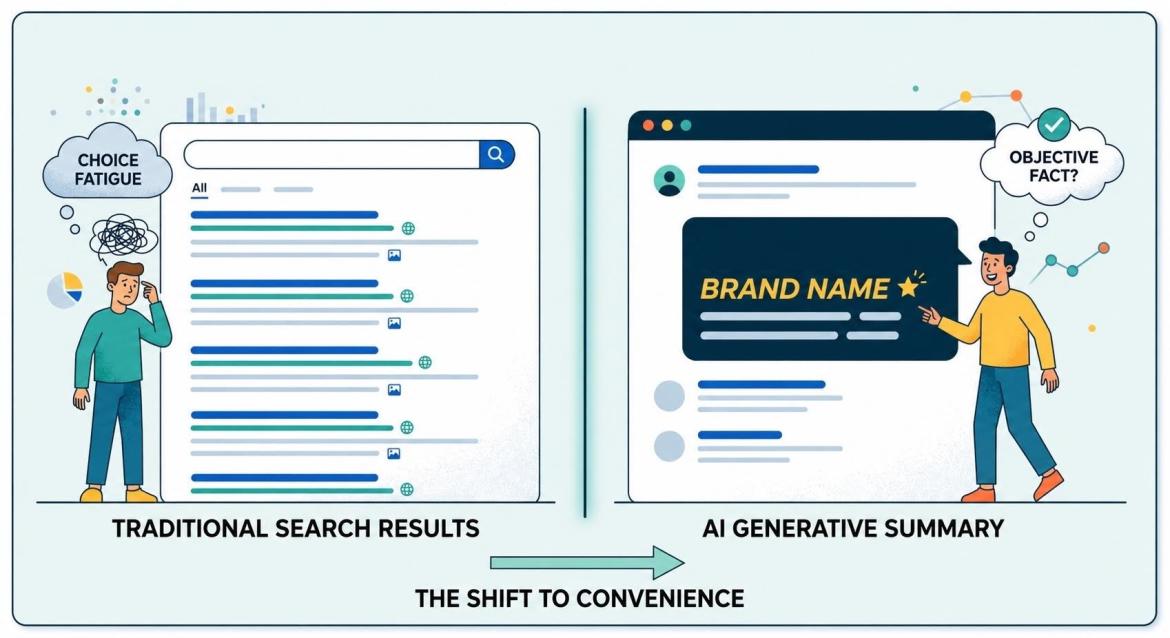
And while more than half of the market remains skeptical about AI outputs due to hallucinations and generic content, audiences also experience choice fatigue when confronted by pages of standard search results. In fact, if a business isn’t cited in a summary, it loses at least 92% of the people who conclude their journey there, since they perceive the engine’s endorsement as an objective fact rather than just a digital listing.
Classic SEO relies on a website talking to a crawler bot to build an index, but GEO enables machines that mimic humans to deliver direct recommendations. Since this format is changing how people find answers, showing up in these overviews is now more valuable to businesses than achieving a high ranking.
But can lower-ranking brands still win citations? Fortunately, LLMs prioritize semantic density over domain history, which means that high-quality, relevant content can displace legacy competitors.
This happens because these systems don’t just count keywords or look at the digital age. A Google query for a broad phrase like “best corporate law firm” favors large, established companies because they have been around for twenty years, but a user looking for something local will have a much more targeted question. When they ask ChatGPT, “What is the best corporate law firm in Austin, TX?” the platform will ignore an enterprise's age and instead scan the internet for the most detailed regional match. If a brand’s online presence includes clear validation of its work in a particular community, the summary will feature it prominently.
The proof must be front and center — no more vague marketing phrases such as “award-winning, full-service agency that delivers unmatched results” — while burying real-world success stories on a hard-to-access page. It’s the companies that share convincing examples, such as “specializing in attracting patients for multi-location dental clinics across Illinois,” that make it easy for a bot to find and present them to a potential buyer.
For businesses that are cited, the payoff is substantial: the average referred visitor who follows a recommendation is worth 4.4 times more than an organic lead. To engage these audiences, brands should ensure their cyber persona is fresh, as generative tools reward new data and often overlook it if it’s older than 3 months.
Entering a question, viewing a list of links, and going to a company’s site are familiar user behaviors of the past, but AI search has permanently reduced overall organic web traffic by up to 25%. Many sectors are experiencing very high zero-click rates, with specific news inquiries claiming over two-thirds of consumer attention and general how-to and factual requests capturing the vast majority.
However, industries that rely on interactive elements, such as maps in real estate and product carousels in e-commerce, are less exposed because generated overviews don’t show up on their results pages as often. In fact, under 3% of their total keywords trigger an automated response. This creates a divergence in outcomes: while informational intent is fully captured by AI summaries, transactional and localized searches remain tied to user action.
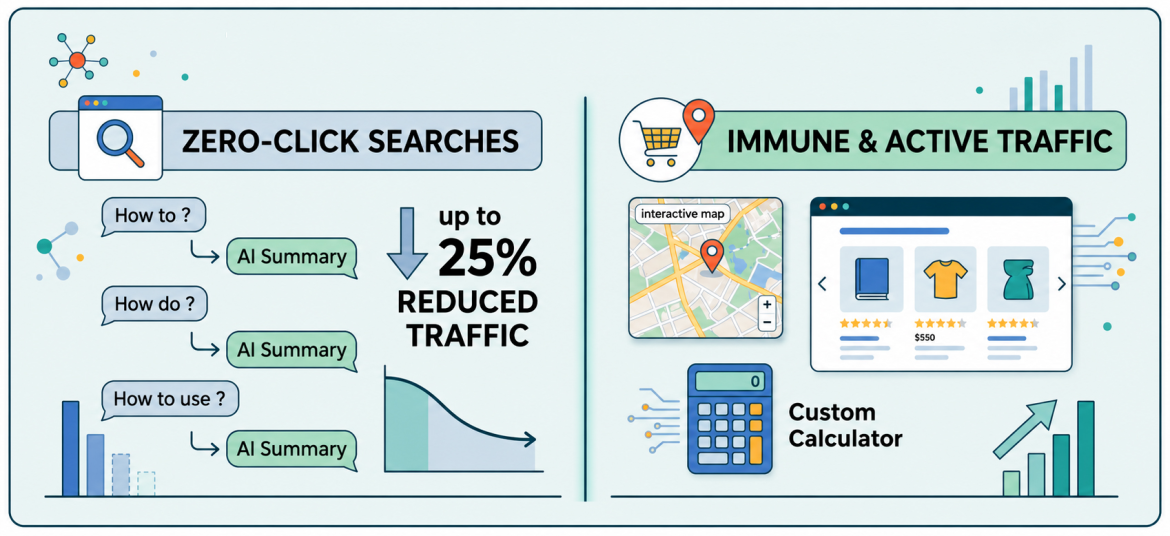
To achieve both passive AI visibility and active traffic, businesses must audit keywords strategically, separating educational lookups from commercial queries. Instead of fighting for maximum reach, they should optimize their content to provide basic definitions and simple how-tos, ensuring that algorithmic crawlers include them in summaries.
Brands also need to focus on dynamic features, such as checkout portals or custom pricing calculators, because motivated visitors must leave the chat interface to use these tools on their websites.
Imagine a high-intent buyer in Raleigh, NC, looking for artisanal sourdough bread. When they ask AI for baking inspiration, they might not click the links in the summary once they get their answer, but it doesn’t mean the journey is over. Instead, this user might go straight to a popular bakery they found. Along the way, they can conveniently pick up ingredients from a neighborhood deli, grab a coffee, and head to a nearby park for a picnic.
Modern search engines help consumers navigate these intricate hyperlocal relationships by moving beyond just matching isolated keywords. The algorithms are learning to prioritize cultural context, mapping proximity and travel times along with niche queries. This lets them recognize highly distinct regional signals, such as live bluegrass music at a downtown venue or a Diamond Award recognition, rather than returning generic, city-wide lists.
Securing a spot in these results allows companies to achieve the kind of authority that converts passive browsers into physical foot traffic. Newer enterprises can even outcompete legacy brands that rely on ads and long domain histories simply by prompting customers to leave detailed reviews that name specific products or services on platforms like Google, Yelp, and Reddit.
Evaluate your Internet reputation using this four-part framework to confirm that AI systems can easily verify your legitimacy.
To develop this online footprint, our team at Outpace SEO agency coordinates localized content with media interviews and case studies. Demonstrating active, real-world engagement builds a genuine community presence, ensuring that a business isn’t just found by an algorithm but endorsed by it.