
12 Years With Clutch: How Intuz Builds on a Partnership That Delivers
A Relationship That Has Stood the Test of Time Intuz is an AI consulting and development company established in 2008, with operations in Silicon Valley...
Updated December 5, 2024

Cybersecurity is a top concern for businesses today, and AI-driven tools are powerful allies in protecting against attacks. Cyber expert Jane Frankland cautions that although AI strengthens threat detection, issues like data biases and system vulnerabilities can limit its reliability. With the right precautions, however, AI can be a game-changer in securing your data and staying ahead of cyber threats.
As technology becomes more integrated into our everyday interactions, the risks and consequences of cyberattacks become more severe. 2023 set a new record for data breaches, blowing out the previous record (which was set in 2021) by 72%. Hackers have advanced along with technology and are using artificial intelligence (AI) to launch increasingly sophisticated attacks. The average cost of these data breaches has reached an all-time high of $4.88 million.
With such high stakes, businesses are turning to cybersecurity AI solutions to manage their risks.
Jane Frankland, CEO of KnewStart, believes that AI is more relevant than ever in cybersecurity and IT.
“In managing complex IT environments, AI not only handles large-scale data processing efficiently but also provides critical insights into potential vulnerabilities, making it an indispensable assistant in maintaining robust cybersecurity,” said Frankland.
Given that businesses that use AI and automation save an average of $2.2 million if they do experience a breach, this is a smart move. However, as with most AI software, cybersecurity isn’t a set-it-and-forget-it venture. If you want to leverage AI to mature your cybersecurity posture, you must understand where it excels and falls short.
All major cybersecurity frameworks, such as the National Institute of Standards and Technology’s Cybersecurity Framework, call for automated security tools as part of a well-developed cybersecurity defense. Effective cybersecurity requires a multilayered approach. There’s no one-size-fits-all solution for comprehensive data protection. Available options include the following:
SIEM solutions use AI to detect suspicious user behavior and other warning signs of an attack. Once they identify a threat, they automate many processes to respond to it. A SIEM monitors data from a range of sources across your IT infrastructure. It logs, collects, and analyzes this data in real time to identify any patterns or breaks in patterns that could indicate a threat.
Security analysts can use SIEM dashboards to follow data visualizations that highlight spikes and patterns in suspicious activity. The system can also be configured to automatically take action based on predefined parameters to mitigate security threats.
With remote work on the rise and bring-your-own-device (BYOD) policies allowing people to use their own phones, tablets, and computers while working, more endpoints are open to cyber attacks than ever.
“AI is hot, and it’s changing the game significantly when it comes to enhancing Endpoint Detection and Response (EDR) and transforming traditional security approaches,” said Frankland.
Endpoint detection and response (EDR) systems monitor and record activity at all endpoints to uncover suspicious behavior and block potentially malicious activity.
EDR systems can integrate with your other tools and provide a historical record of endpoint activity. They capture data such as when the host connected to an address, user accounts logged in and from where, network activity, and more. If an event isn’t detected in time, you can use this historical data to identify underlying causes in a security event post-mortem.
Your organization's threats will depend on factors such as how you use technology, the number of employees you have, and your work processes. Threat intelligence is a proactive plan that identifies and mitigates threats before they occur.
“In my experience, AI significantly enhances threat intelligence by rapidly analyzing vast amounts of data to detect anomalies and patterns indicative of cyber threats,” Frankland said. “This capability allows for real-time threat detection and response, which is crucial in today's fast-paced digital environment.”
Threat intelligence is specific to your company and includes details about what threats you face, from whom, the techniques they’re most likely to use, and the steps you should take to prioritize and mitigate those threats. Depending on the results of your threat intelligence, you can use a range of AI security tools to protect your data.
Today’s businesses are awash in data from the various systems, networks, and devices they use to perform business operations. This abundance of data can result in an unmanageable amount of minor security incidents and false positives. An automated incident response collects data from different sources to identify and prioritize incidents based on severity.
It then automatically performs tasks to speed up the incident response process and make your security teams more effective. Jobs that an automated incident response system might perform include dismissing false positives, opening an incident ticket, assigning team members to tickets, and tracking performance metrics.
Security vulnerabilities are known software defects that could allow a malicious actor to compromise your system. Unpatched vulnerabilities leave you open to hackers. The Equifax data breach in 2017 was one of the worst in history. It cost over $1.3 billion and took years to settle. An unpatched vulnerability was the root cause of the attack that exposed millions of customers’ sensitive data.
Vulnerability management identifies and remediates these vulnerabilities before they can be exploited. Because of the complexity of modern software systems, there are far too many vulnerabilities to be handled manually. AI tools can continuously scan for known vulnerabilities and, in many cases, automatically remediate them.
Your network traffic follows specific patterns depending on various factors. Network security monitoring inspects all traffic on your network for signs of unusual activity that may signal a threat. These tools notify you of any security incidents and provide reports with detailed information about them.
Network security monitoring tools integrate with the other software in your cybersecurity tech stack to help provide comprehensive coverage.
Although AI tools are an integral part of a comprehensive cybersecurity plan, you need to be aware of and have a plan to handle their risks.
“AI systems can be vulnerable to adversarial attacks, where malicious actors manipulate data to deceive the AI. Ethical concerns around data privacy and security also pose significant challenges,” said Frankland.
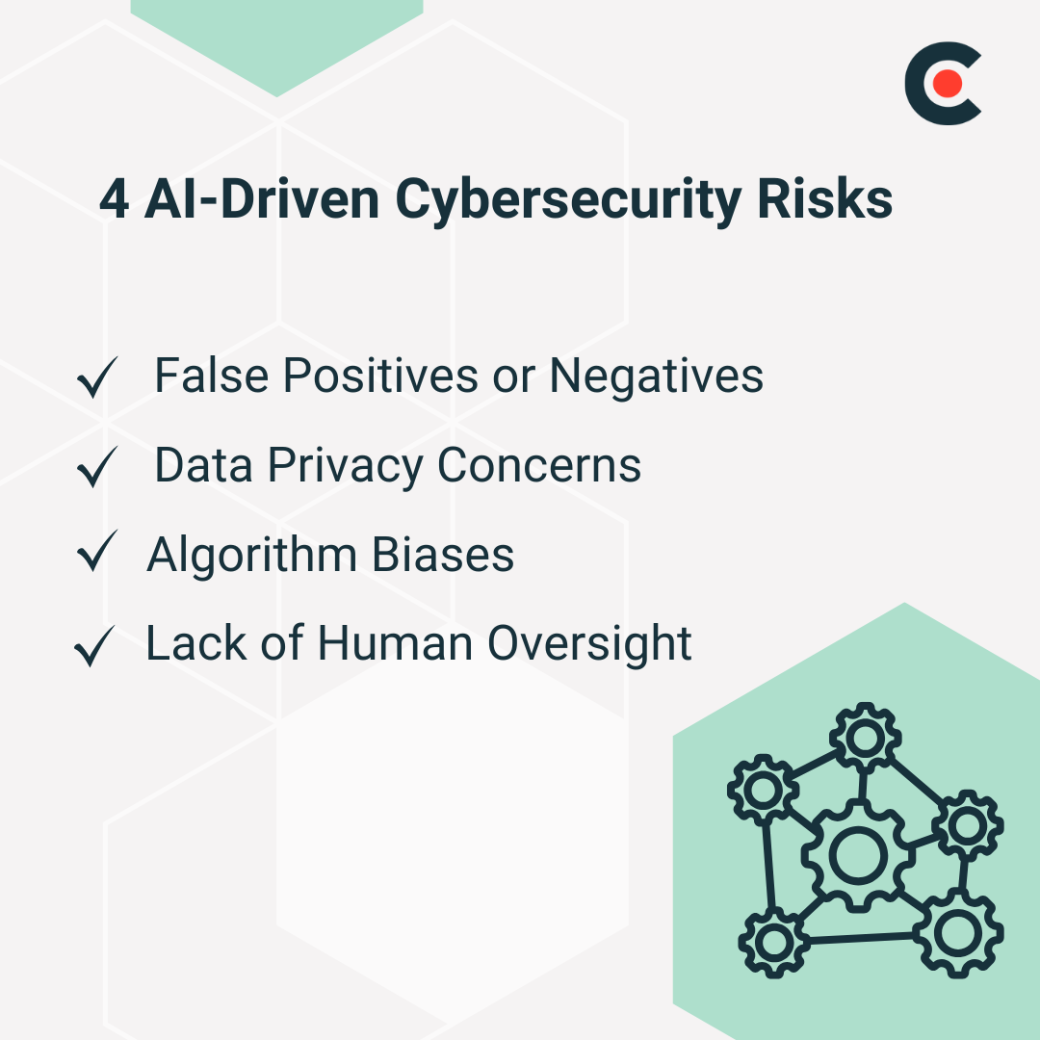
The biggest risks associated with AI-power tools include the following:
AI isn’t foolproof, so it can return false positives and negatives. Security tools can flag harmless activity as suspicious and block legitimate users from your network or system. They can also overlook serious threats that need to be investigated.
False positives can tie up your security team as they chase down non-existent threats, leaving you open to attack. The best way to avoid false positives is to correctly calibrate your software. Many AI-powered cybersecurity tools come with default settings that are too general to be useful.
Left as is, they’ll generate so many false positives that your security team won’t have time to do much else besides investigate them. Fine-tune your settings to work better for your use cases. Many tools also include machine learning features, so as you work with them, their accuracy rates will improve.
At the other end of the spectrum, you can keep threats from slipping through the cracks by using multiple tools. One will never be enough to catch all threats. You need a combination of tools, just as you need a combination of security measures, to prevent threats.
Training your staff on proper cybersecurity hygiene should be a top priority because 95% of breaches are caused by human error.
Because AI security tools work by monitoring and collecting such massive amounts of data, there’s a danger they may violate consumers' privacy. They can collect and analyze data that was never meant to be public, such as medical information, or collect so much data that they can identify patterns that could endanger someone if made public.
Implementing strong governance practices for how you collect data and what you do with it can help avoid these risks. Data minimization should be a primary focus. Set up your tools to collect and analyze only the data you need for them to be effective. You don’t have to protect data you don’t collect.
A data protection impact assessment (DPIA) can let you identify and mitigate risks associated with AI-based data processing. When you understand the risks, you can implement measures to protect sensitive data. Balancing data privacy and comprehensive cybersecurity requires diligence and intentionality.
AI tools reflect flaws, prejudice, and bias in their training data. This can impact how they interpret and analyze data and, as a result, their performance. Oversampling—the over or underrepresenting certain types of data—can interfere with the model's effectiveness.
Feature selection bias occurs when a model prioritizes inappropriate or irrelevant features for decision-making. This can lead to biased outcomes and errors in threat detection.
You can also introduce bias unintentionally by improperly tuning parameters. This may cause your software to weigh some inputs more heavily than others and return inaccurate results. You’ll need to continuously monitor and adjust your security tools to ensure they don’t have biases that make them less effective.
Although AI tools can be extremely useful in finding and heading off cyberattacks, they’re only effective if used under the guidance of human security specialists. If these tools are left without human oversight, you risk spending too much time responding to false positives and overlooking serious threats.
AI systems aren’t capable of performing the type of nuanced judgment human security analysts can. They can’t understand the underlying context in complex environments that can influence outcomes.
In some cases, automated decisions can violate regulations or policies if they aren’t adequately supervised. AI systems need accountability, particularly when making decisions that can have a significant impact on people’s lives.
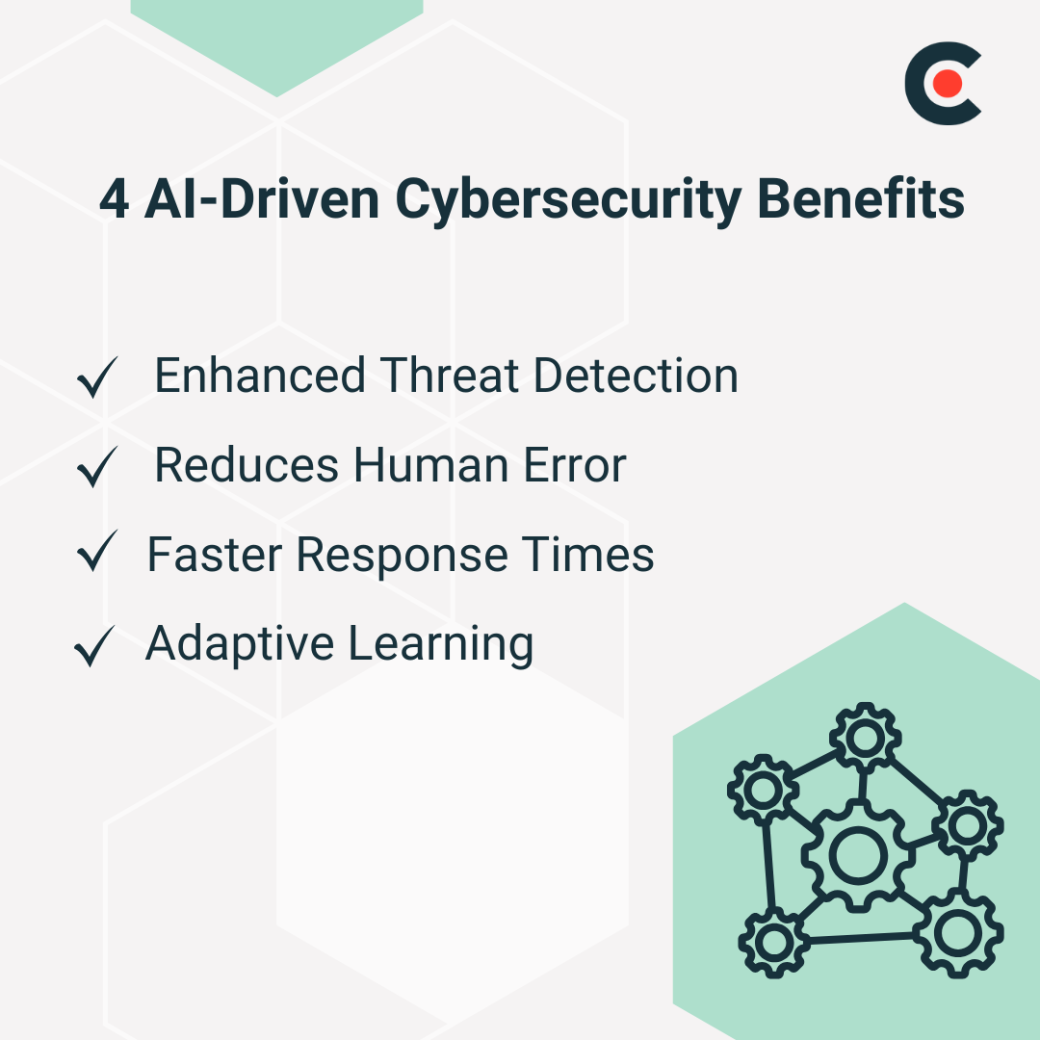
The benefits of AI-powered cybersecurity outweigh the risks if you handle them properly. The most significant benefits include:
It would be impossible to manually identify all threats an AI cybersecurity tool can find. In 2023, almost 30,000 software vulnerabilities were identified. Automated security tools can scan your systems constantly, working in the background and during off-hours. The expense of hiring human labor to perform such testing would be cost-prohibitive for even the largest corporation.
Layering your AI security tools can improve your threat detection rates. Including multiple tools reduces the risk that undetected threats will escape detection.
Cybersecurity AI tools are also very effective at catching and reducing threats related to human errors. Security misconfigurations caused Microsoft’s Bluebleed data breach. AI security solutions, such as static application security testing, check for these security misconfiguration.
There are many moving parts to keep track of in computer networks and systems. Some things are bound to be overlooked.
“By automating routine tasks, AI minimizes the chances of human error that can occur due to fatigue or oversight,” said Frankland. “It excels at processing vast amounts of data quickly and (hopefully – if it’s been designed and implemented correctly) accurately, identifying patterns and anomalies that might be missed by human analysts.”
AI cybersecurity tools function as a safety net to help you avoid expensive issues that result from human errors.
It takes around 277 days to find and contain a data breach. Since the longer private data is exposed, the more financial and reputational damage it can do, a faster response time is a strategic advantage.
Automated security software can help you discover breaches faster so they can be contained and remediated faster. Ideally, you want to prevent a data breach. However, if you do experience one, containing it quickly will help mitigate the damage. By continuously monitoring your systems, AI can speed up the process significantly.
Adaptive learning is how AI computer systems improve over time. They can modify their behavior and perform better as you use them more. They benefit from new inputs and experience to refine how they make decisions. Adaptive
AI can identify and respond to emerging threats, even if they haven’t been specifically trained.
“AI's ability to learn and adapt is a game-changer in cyber,” said Frankland.
The ability to continuously learn helps decrease the model’s propensity to return false results. Over time, it also gets better at recognizing subtle patterns that traditional systems could miss.
AI tools can also be customized to your specific environment with continued use. They can learn the network behavior and user patterns unique to your business that will allow them to better spot anomalies associated with potential attacks.
AI-driven cybersecurity platforms can help you identify, track, and contain attacks. However, as with all software, they’re much better servants than masters.
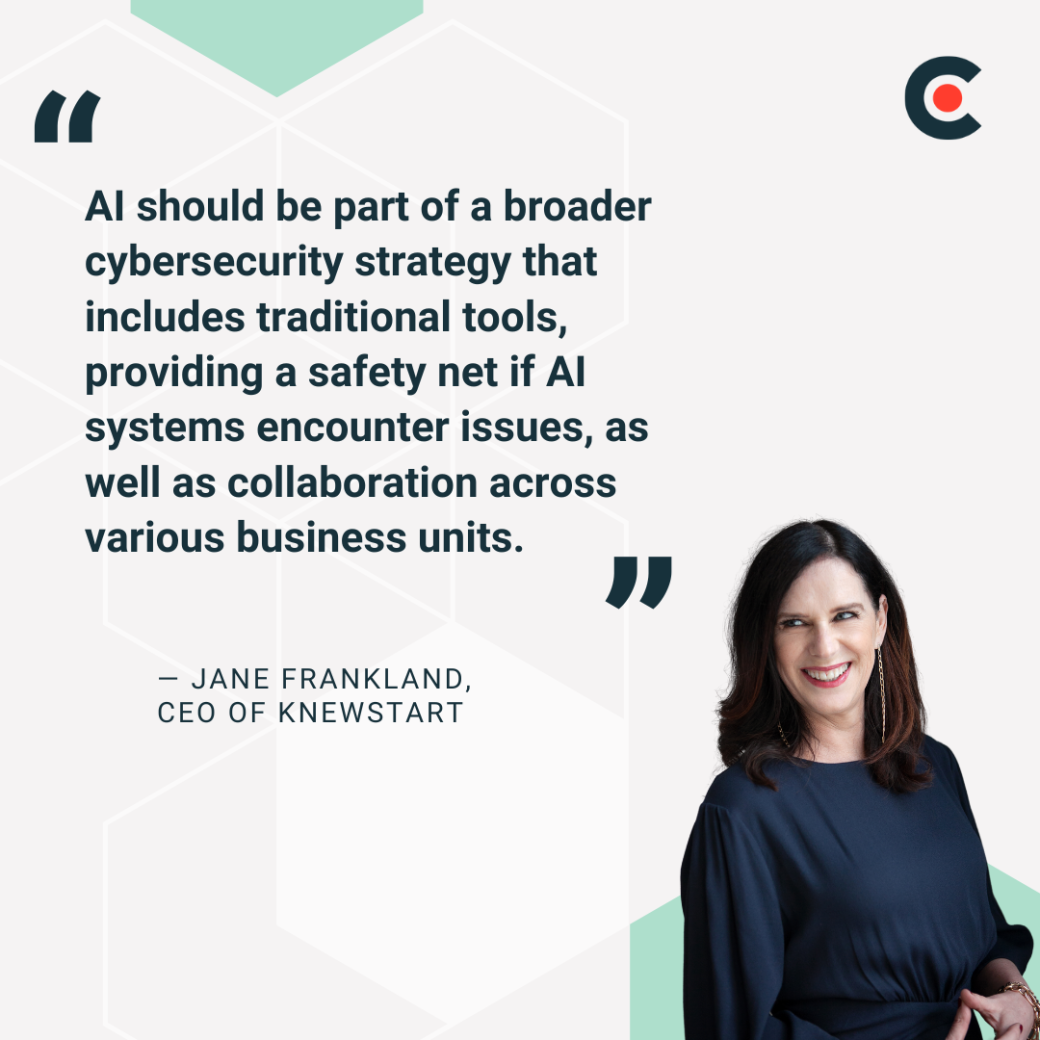
“AI should be part of a broader cybersecurity strategy that includes traditional tools, providing a safety net if AI systems encounter issues, as well as collaboration across various business units,” said Frankland. “Cybersecurity is after all a shared responsibility, and effective protection requires input and cooperation from multiple departments.”
Businesses are accountable for their software, so be wary of placing too much faith in unsupervised programs. You’ll get the best results if an experienced security analyst implements your security tools and verifies their results.