![How to Make a Budget for Print Design [With Template]](https://img.shgstatic.com/clutch-static-prod/image/resize/715x400/s3fs-public/article/d593c4d0f16292c1f26270424626b50f.png)
How to Make a Budget for Print Design [With Template]
Discover how to prepare an effective budget for your print design needs through this piece.
Updated March 24, 2026

What happens to your brand when someone outside the company is responsible for representing it? If the right systems aren’t in place, the answer is often brand misalignment and lost trust.
Have you ever looked at a brand and been confused about what it sells or even stands for? Being inconsistent in messaging doesn't just confuse your customers — it hurts your bottom line. Clutch’s data reveals 80% of consumers say consistent branding affects buying decisions, underscoring just how vital your branding strategy is. However, maintaining that consistency can become challenging when you're outsourcing your creative work.
Today, 90% of businesses work with graphic designers, often collaborating with freelancers and agencies. This expands creative output but can introduce new problems. 19% of companies reported brand misalignment as the primary frustration when working with graphic designers.
Looking for a Graphic Design agency?
Compare our list of top Graphic Design companies near you
Small inconsistencies in color, typography, and visual tone can add up across channels and quietly erode the trust you’re trying to build. This guide provides tangible steps to keep your branding consistent when hiring outside graphic designers.
Outsourcing design work introduces variables that are hard to control. Even when working with talented designers, small inconsistencies can slip through the cracks to cause real problems down the line.
For many companies, the problems start when they outsource design before fully defining and documenting their brand identity internally. Without clear guidelines, designers are left to interpret a brand on their own. This can lead to design issues that undermine credibility and recognizability. Inconsistent typography, color drift, and mixed visual tones are all issues that look fine in a vacuum but become clear issues when creatives are placed side by side.
Documenting your brand before outsourcing is critical for this reason. It eliminates guesswork and sets the stage for consistency.
Freelancers, agencies, and internal design teams are often isolated from one another. They can end up working in secret and without a shared framework, however unintentionally. This fragmentation results in frustrating final products that require revision, costing time, money, and effort. A website with a different tone from the company's social channels and email campaigns can leave a disjointed, less memorable impact on consumers.
The more teams and locations involved, the more opportunities there are for brand standards to quietly erode. Coordinating brand-consistent graphics across franchises or multi-location businesses requires intentional structure and systems. Many teams, especially growing startups, struggle with branding because they scale before building a design framework.
Consistency is everything, from social graphics to website pages and email templates. You want every brand asset to feel like part of a cohesive unit, each piece fitting together into a grand picture like a puzzle, regardless of who created it or when it was created.
Consistent brands pay close attention to:
When done well, customers will recognize your brand at a glance. This instant recognition is critical given the sheer amount of content most people see online daily.
Working with external graphic designers can still result in a strong brand identity. The key is to build a system that delivers consistent results, no matter who is creating content for your business. These five steps are a practical framework for consistency every time.
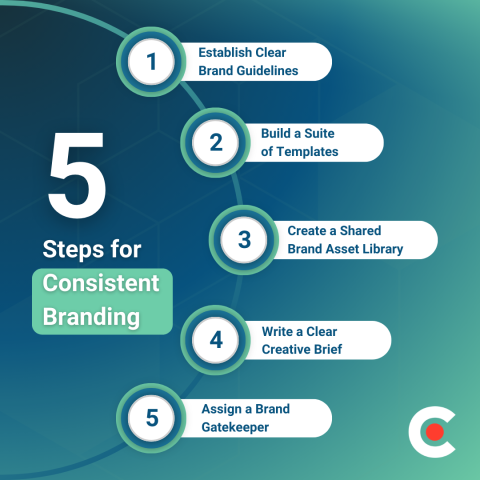
The first thing you need is a single set of guidelines to share with any graphic designers you hire. Without clear documentation, every new designer has to start from scratch. Even if they eventually learn your style, there's no reason to waste time teaching and re-teaching everyone you work with when a simple document can give them everything they need.
These guidelines need to be thorough enough that any designer can pick them up and immediately understand how to represent your brand correctly. That means including detailed instructions for visual elements such as:
It’s also important to provide higher-level guidance around brand communication. For example, define how your brand sounds across different contexts and channels. Many teams also share information about brand values, positioning, and messaging priorities with their graphic designers.
Finally, add several clear examples of correct vs. incorrect usage for each rule in your guidelines. Seeing a misaligned logo or off-brand color in context often helps designers internalize key takeaways faster than written rules alone.
Done well, a brand style guide allows multiple designers to contribute while maintaining brand identity consistency.
If guidelines give designers your brand's rules, templates show them how to apply those rules. They save time by removing guesswork and helping designers produce public-facing materials with fewer iteration cycles.
Consider building templates for any design work you produce regularly, including:
Templates are especially useful for companies managing design across multiple locations or teams. They help siloed groups produce visually consistent materials without ongoing management. The result is faster production, fewer revisions, and brand consistency that scales as the business grows rather than slowing it down.
Guidelines and templates save time and improve consistency. However, they may still leave designers sourcing assets like your logo and icons on their own. That can create inconsistencies when designers pull assets from different sources.
The solution is creating a shared brand asset library. With it, designers across locations and teams work using the same approved materials.
Your asset library should include everything covered in your brand guidelines and templates, including:
Tools such as Google Drive, Dropbox, and Figma libraries make it easy to centralize and share assets across locations, but this isn’t a one-time job. Keep the library up to date as your brand’s identity evolves. Otherwise, designers may pull from outdated materials, which can confuse your customers.
Every project has its own unique requirements, which will likely extend beyond the instructions you’ve provided in the previous steps. A strong creative brief bridges the gap.
As Miša Vučković, Head of Growth at Flow Ninja, puts it, "Designers often fall into the trap of creating work they personally enjoy or work they think the client will have the least feedback on, without deeply understanding the end user.” A well-written brief provides the strategic context designers need to make more informed creative decisions.
Vučković highlights three critical questions that brands often overlook while creating their briefs: “Why are we designing this? How will it actually be used/presented? What outcome are we aiming for?”
A strong creative brief should outline:
The more context a designer has upfront, the better. Clear instructions help them focus their creativity in the direction that’s most beneficial to your business.
Have a dedicated person or team to review design work before it goes live. This provides one last crucial layer of protection against inconsistency. When the same person or group has final say over which designs go into production, it’s easier to keep everything uniform.
Vučković warns, “Creativity and/or speed can sometimes overshadow function." He continues, "When aesthetics become the priority over strategy, that’s where the disconnect happens between what’s designed and what actually works.”

A brand gatekeeper catches disconnects before they go live. This role should be responsible for the full approval workflow, including:
Without a clear approval process in place, inconsistencies can still slip through. The gatekeeper closes the loop.
Outsourcing creative work helps brands create a consistent visual identity at scale and is often more affordable than internal hiring. However, maintaining consistency while outsourcing is a real challenge.
Companies can effectively keep outsourced brand elements aligned by investing in:
Ready to lock in your brand identity? Find a branding agency on Clutch to help you build a system that keeps your brand consistent across every touchpoint.