Answering Services: Professionalism in Customer Service
Professionalism in customer service is essential to retaining customers, building your brand image, and increasing sales.
Updated May 26, 2026

For many companies, contact centers are a core aspect of successful business operations. Handling everything from lead generation to customer support, outsourced call centers can add impressive value and meet business needs. However, going into a new partnership with a solid budget in mind will smooth out the collaboration from the beginning, promising success in the long run.
Call center companies are known to streamline business processes using dedicated agents to interface with prospects and existing customers. This frees up valuable time for companies to reinvest internally and positively impacts their bottom line.
While all types of call centers can be helpful in the right scenario, it’s important to understand the differences between their specializations to ensure you seek the right provider for your needs.
Looking for a Call Centers agency?
Compare our list of top Call Centers companies near you
Types of Call Centers:
While these centers likely sound similar, their differences may account for anomalies in call center pricing due to varying operating costs dependent on agency type.
When breaking down a call center budget, four main categories make up total costs that all companies should take into account.
By thinking about your budget using these categories, budgeting should start to feel a lot simpler — especially for small businesses. Mapping out your budget this way creates several opportunities for cost savings.
Before you do anything else, it’s important to have a lay of the land. Researching different types of call center service providers is a great first step to understanding what services and deliverables they actually provide.
Your budget will be dependent on the exact service provider you choose, so research will also help you learn about where there is potential wiggle room in your finances. Think through the ideal location, expertise, and types of services you’ll need to set the bar for your spending.
Oftentimes, BPO and call center services employ pricing models based on volume. For instance, companies may scale their pricing depending on the number of calls, emails, text responses, or other targeted customer interactions.
Knowing this, it can be helpful to do a ballpark estimate of how many engagements you want to occur on a weekly or monthly basis. Entering into interviews with this metric in mind will help potential call center partners understand the scope of your needs and staff against it.
At this stage, don’t worry about being too exact with your estimate. It’s still early in the process, so all you need is a general range to give most centers a good idea of your goals.
It may not be expected for companies to provide their team with any in-house equipment, but it’s absolutely essential to track these expenses if they’re necessary.
Technology expenses should include any hardware or software that is specifically purchased for call center activity and usage by call center agents.
Some of these tools may include:
Generally going hand in hand with volume-based charges, staffing is an important factor that can scale the costs of call centers significantly. The more agents staffed on your project, the more expensive operational costs will be.
If you plan on augmenting internal customer service or experience staff with outsourcing, be sure to factor in any salaries and benefits you’re extending to new teammates as well.
It’s highly unlikely that your new agents don’t need any training at all to start being effective for your business.
The cost of initial training and the writing and introduction of scripts can stall execution at the very beginning of a collaboration. However, it’s important to factor in the cost of regular skills development training sessions to be sure that the agents you hire are doing their jobs as effectively as possible.
This also keeps agents at the top of their game, well-prepared to address customer needs or concerns.
Budgets should be considered living documents — they should be employed to examine a service provider’s performance against ROI goals.
Looking back to ROI will not only let you know when your partner is performing well, but it may even help you justify additional spend for services. Improved customer service and faster-moving processes can have huge downstream impacts. Considering ROI in these cases is essential in keeping your budget up-to-date.
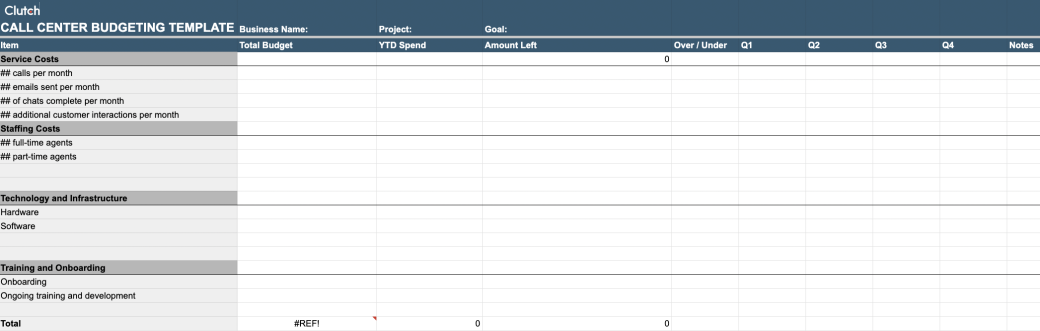
Download our free call center services budget template here.
The average salary of a call center agent is far from all that goes into determining the cost of working with a call center. These are the top four influencers of overall call center costs.
Call center services can be game-changers for those in need of a cost-effective customer satisfaction boost. While they can make big impacts, businesses must prepare to budget closely to make the situation work for them.
Keeping accuracy at the heart of call center outsourcing activity will ensure a smooth collaboration both in communication and in revenue.