7 Tips For Designing Web Forms
Clutch surveyed 502 web users about what they actually want from form design. Here are 7 data-backed UX principles that reduce abandonment and improve...
Updated May 29, 2026

Your website is your brand's most critical ambassador, and the statistics are sobering. Studies show that 88% of online consumers will dismiss a brand after a single bad web experience.
The quality of your site not only determines whether potential customers will give your brand a chance, but it also impacts your site's visibility in search engines, brand-building initiatives, and conversion rates.
That’s why more and more businesses are integrating marketing expertise into their web design process from the start. By getting input from SEO specialists, researchers, and marketers, these companies create websites that strategically attract customers and align with broader business objectives. Doing the same could help you build a site that’s optimized for search engines, user experience, and brand strategy — a strong foundation that will help you get more value from every visitor for years to come.
Looking for a Web Design agency?
Compare our list of top Web Design companies near you
This guide will get you started. It covers industry wisdom, best practices, and SEO strategies to improve the value of your site. Keep reading to learn how to develop and execute the ideal web strategy for your company’s goals.
The first step to getting more value out of your website is to do your research. Collecting and analyzing data from target users, competitors, and your broader industry will improve your decision-making process, guiding you to the optimal design.
Here are some research ideas to get you started.
Surveys from existing customers are a great place to begin. Ask your customers for direct feedback and offer a one-time discount as an incentive for their responses. This can help you understand how your target audience responds to different types of content, design attributes, and website features. You’ll end up with a better sense of what makes your website great, along with the pain points that you should try to fix.
But direct surveys are just one way to get this data. Companies also:
You can also learn a lot from competitors’ sites. Consider comparing them to yours to see where your site shines or falls flat. You can watch for design trends, functionality, SEO practices, and content.
It’s also worth completing a few tone analyses. Arham Khan, CEO of Pixated Agency, says that your goal should be, “to understand the industry and outline core messaging pillars, not copy.”
Once again, there are tools you can use to simplify this process. Conductor, SEMrush, and Ahrefs are some of the most popular tools for analyzing competitors’ SEO performance. You can also use AnswerThePublic and Ubersuggest to discover the top unanswered questions in your industry, so you can target them.
As you gather this data, it should provide clarity about what your website redesign needs to be competitive. For example, you may need an e-commerce site with certain features, a blog to reach your SEO goals, or the right forms to encourage new-customer sign-ups.
Thinking through this will help you understand which KPIs you’ll track to determine whether your website redesign is successful. For instance, an e-commerce site may look at increasing sales numbers, but a B2B brand may care more about driving consultation sign-ups. Other popular ways to measure ROI include changes in:
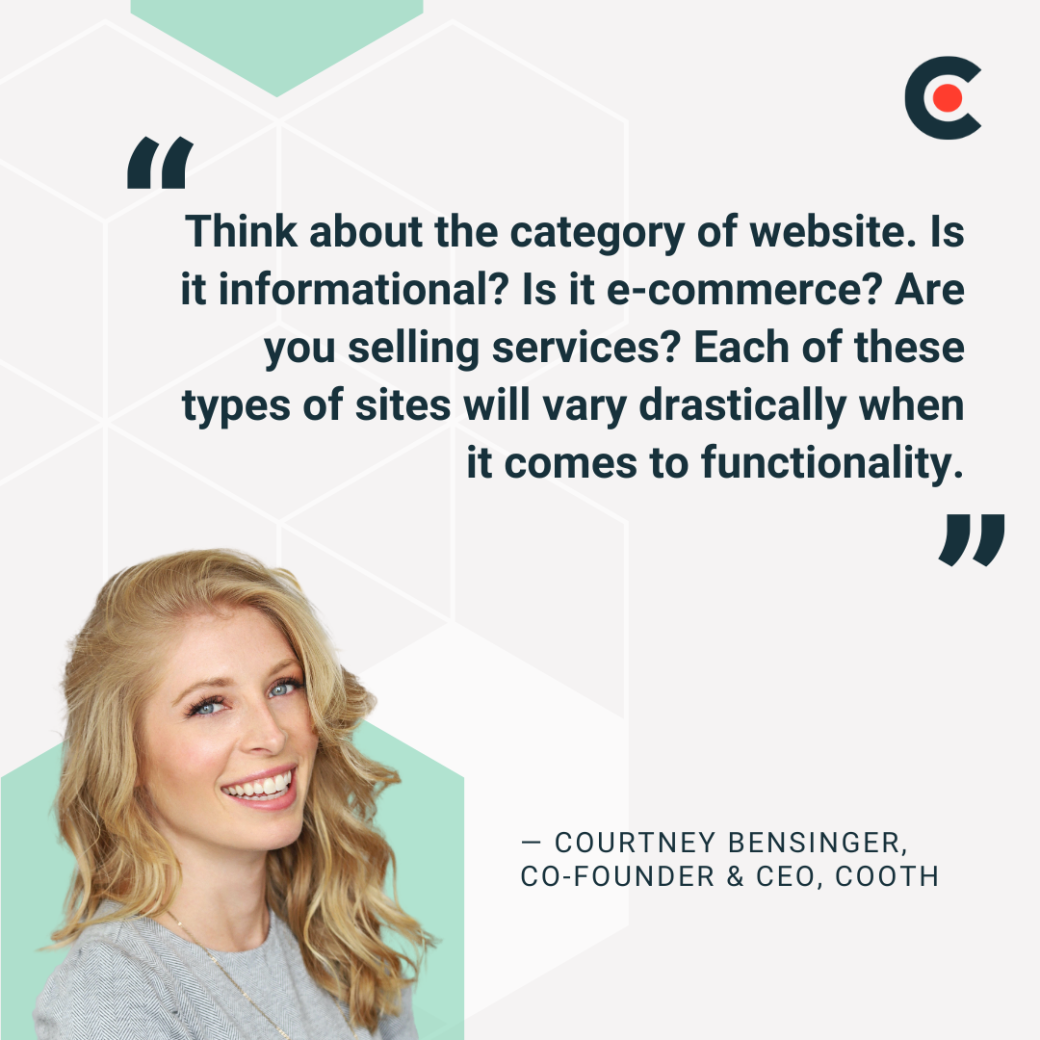
Courtney Bensinger, Co-Founder and CEO of Cooth, summarizes how business owners should think at this stage: “Think about the category of website. Is it informational? Is it e-commerce? Are you selling services? Each of these types of sites will vary drastically when it comes to functionality.”
Finally, your research phase should include some planning for SEO and ongoing user engagement. That means creating a long-term content strategy, which aligns with user intent and provides value at each stage of the buyer’s journey.
You might:
Research will help you design a better website, so you can get more value from the traffic that reaches it. But you’ll also want to take steps to attract additional traffic — like optimizing your site for search rankings and digital visibility.
Here are some strategies that can help you make it happen. If you need help with any of them, consider contacting a web design agency or SEO specialist for support.
The first step is figuring out which keywords you should be trying to rank for. You can use tools like SEMrush, Ahrefs, and Google Keyword Planner to figure this out. Look for high-volume keywords that are relevant to your industry, and consider how updating your website can help you target them. For instance, you might create a new product page to go after a high-volume search phrase.
You should also try to work the keywords you find into your content naturally, across:
Next, make sure your meta titles and descriptions are optimized for SEO performance. These are what users see when your page is featured in a Google search result. You can improve your click-through rate by crafting meta descriptions and titles that are compelling, concise, and accurately describe the content.
It’s also worth revamping your internal linking strategy. Doing so will help Google understand how your pages connect to one another, which can improve SEO results. It’s also a way to encourage visitors to stay on your site longer.
This doesn’t have to be complicated. The most important thing is that your major pages are easy to find and connected to other content in logical ways. You’ll also need a process for integrating new content into your internal linking strategy.
The speed at which your web pages load impacts their SEO performance. That’s why technical SEO should be part of any website redesign process. One of the most important elements of technical SEO is optimizing the images on your site.
Large, highly detailed images increase page load times. This can increase your bounce rate and make Google think that your site isn’t as valuable to users, hurting rankings. So, try to compress any images you add to your site. This will ensure fast load times without compromising quality. You should also add descriptive alt text with keywords to photos, as this can improve SEO results.
Mobile phones now account for 62.5% of global internet traffic. Google has responded to this by adding mobile-first indexing to its process. This means your site needs to be optimized for mobile users, or it could have poor SEO results for a significant percentage of the population.
You can make sure your website is ready with Google’s Mobile-Friendly Test.
Finally, speed matters when it comes to SEO, as both Google and end users favor faster sites. Taking a few simple steps can help your company keep pace with the competition:
Let’s wrap up by covering some key marketing tasks that can improve your site. These strategies can transform your digital home into a next-level tool for attracting and converting leads.
First, a marketer will make sure that your web design aligns with your broader brand strategy. For the best results, try to use consistent language, imagery, and messaging across the full site.
Rahul Aswal, a brand consultant at SimplePlan Media, puts it this way: “Branding isn’t just a set of visual assets — it’s a holistic system. Brands that think beyond logos and colors to focus on the entire brand experience create stronger emotional connections with their audience.”

You can learn more about how to craft content and design for a cohesive brand strategy here.
A marketing team can also leverage customer research and demographic data to help your site convert a higher percentage of visitors. They can anticipate user needs based on this information to remove friction points at each stage of your sales funnel.
For example, a marketer might analyze where people are dropping off most frequently and then redesign that page to better align with user expectations. This kind of optimization can substantially increase conversion rates over time, as new data reveals new opportunities.
You can also leverage your social media pages to increase web traffic and drive conversions. But you need a unified content and SEO strategy to be effective. Marketers can help with this, too.
For example, they can make sure that the content you share on your site formats well for social sharing. That could mean adding engaging graphics, blogs, share buttons, or adding the most-visited pages on your site.
You should also try to plan social content that supports your web pages. For example, if you post a blog on your site, share it across your socials, too. This can help you drive consistent traffic and build brand authority across the social media landscape.
Redesigning your website can be a highly effective strategy for improving SEO performance. But that process takes time, which is why you should also consider paid campaigns. These provide immediate results and are a great way to test new ideas before integrating them into your website.
Align your paid campaigns with your website goals. For example, if you want to get more leads, run ads at the top of your sales funnel, not the bottom. You can also create custom landing pages around paid ad campaigns. This can improve conversion rates by helping your site align with user expectations.
However you use PPC campaigns, make sure you’re tracking their performance over time with tools like Google Ads and Meta Pixel. Doing so is the only way to verify that you’re getting good value from the money you spend.
Redesigning your website is an opportunity to increase your brand's visibility and traction. You can take advantage of this by reintroducing your company on social media, promoting new content, and planning seasonal campaigns that sync marketing and sales through consistent messaging.
You might even want to outline your first 30, 60, and 90 days after launch. For example, what do you hope to achieve by day 30, 60, or 90? Do you need to revisit core KPIs at each phase to make sure you’re on the right track? Creating a rollout plan will help you respond optimally, regardless of what happens after your new site goes live.
Additional Reading: "How To Maximize Your Digital Marketing Campaign With Email and Social Media"
Bringing marketing, SEO, and research teams together is the most effective way to revamp your website. Doing so will help you make targeted changes that can increase traffic and conversions — but only with the proper web design strategy.
This page is the perfect resource for developing your company’s new website strategy. Once you start, take a look at our web design checklist to make sure you aren’t missing anything.