Cloud-Native Security Practices: How to Secure Modern Infrastructure at Scale
As the market for cloud infrastructure grows, cloud-native security is more important than ever .Follow these cloud-native security best practices to secure...
Updated December 5, 2024

Clutch surveyed small and medium businesses (SMB) in the U.S. to determine the popularity of cloud-based, online backup solutions compared to on-premise options.
The survey also addressed when SMBs began using online backup solutions, how much they spend on the service, and which data they store online versus on-premises.
The study consisted of 304 employees who use a cloud-based, online backup service for work.
We define SMB as a business with 1-500 employees. In the case of this survey, 74 percent of respondents represented companies with 11-500 employees.
Online, or cloud-based backup, allows users to store, back up, and recover data.
Users share a copy of their data with a server located off-site. A third party provider, such as Apple, Google, or Microsoft, manages the server and ensures data security. On-premise backup options, such as a secondary hard drive or server, are the alternative to cloud-based services.
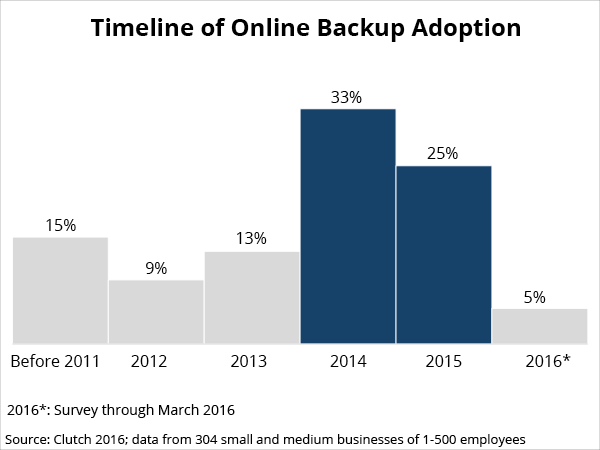
SMBs have been slow to adopt this new technology. Only 37 percent were using cloud backup as of 2013. However, there has been a surge in use in the past two years. In 2014 alone, 33 percent integrated cloud-based backup services into their business plan.
Businesses need a reason to trust new technology before accepting it fully.
“It’s natural for business owners to take a cautious approach to adopting technology, especially when it comes to securing their critical business data.”
— Mark Anderson, Co-founder and IT Strategist, Anderson Technologies
As the platforms progress — address lingering concerns about not being in control of critical data, security, and regulations — more SMBs see online backup solutions as beneficial for business.
“As popular cloud backup and storage services address security questions, display their business capabilities, and prove that they can save you money, it is not surprising that more and more SMBs feel comfortable embracing cloud backup services.”
— Steve Woodward, Chief Technology Officer, SkySync
As the benefits of online backup become apparent, other businesses are more likely to adopt the solution.
Some benefits include online backup’s automation and lower cost of data storage.
“We are at the point where most of the early adopters have seen some level of success. Now, others are saying, ‘Hey, this is the right place and time.’ People are moving to the Cloud.”
— Steve Woodward, SkySync
SMBs look to both online and on-premise solutions to back up their data. Only 16 percent use cloud-based services exclusively. The same trend holds true for data that is critical to daily business operations. More than half of SMBs, 56 percent, back up mission critical data both online and on-premise.
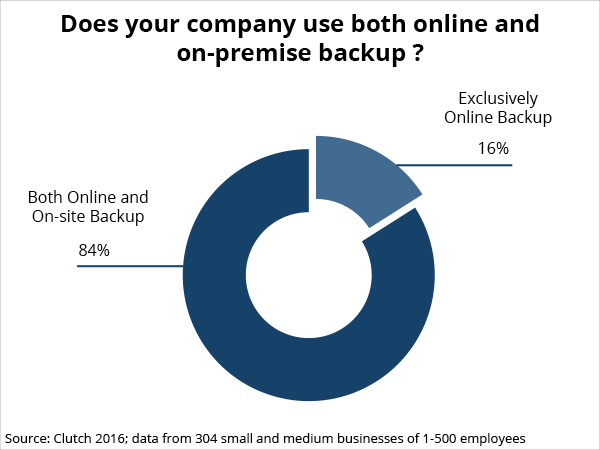
Backing up data in two places is a common practice. It gives users two ways of recovering data, with cloud-based recovery providing a vital role in the case of complete office loss due to fire, flood, or other, according to Mark Anderson of Anderson Technologies.
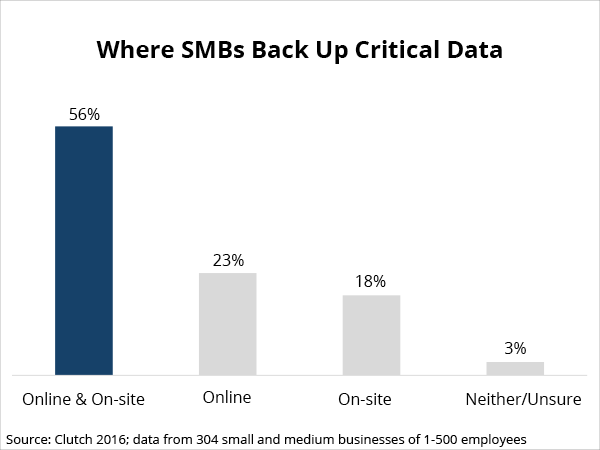
Additionally, it makes sense to store certain types of data on-site to ensure it remains accessible at all times.
“A small business will want to save file data or collaborative data on-premise because it will be more accessible to a lot of people. But, other types of data, like operational files or operating system backups, may not need to be as accessible, so they can be backed up in the Cloud.”
— Steve Woodward, SkySync
Which data is stored on-premise and which is stored in the Cloud depends on the business — its goals and needs.
Therefore, it’s important to understand the type and amount of data you need to store and back up before selecting a solution.
“What I see the most when I work with people is that they often don’t understand their data. They don’t know what they have or what they need. This information is necessary though. It can determine what data goes to the Cloud and what stays on-site.”
— Steve Woodward, SkySync
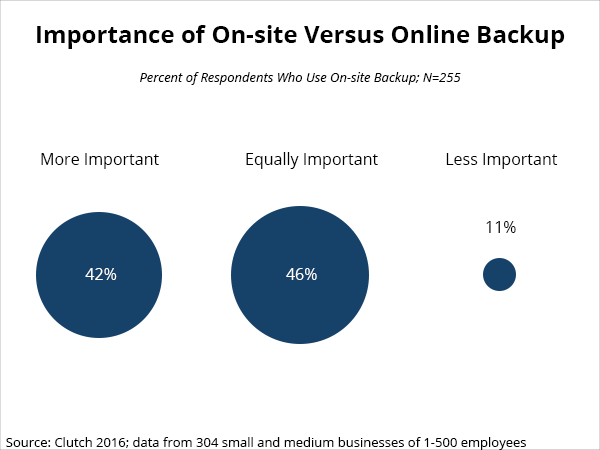
SMBs remain wary of online backup services. Nearly half say on-premise backup is more important.
A change of heart is apparent though. 46 percent say both online and on-premise options are equally important. The findings make sense in the context of where SMBs back up their data the most: both online and on-premise.
The sentiment makes sense, say thought leaders in the cloud backup industry who reviewed the survey findings.
“You trust what you know. For years and years, on-premise was the only option available for businesses. This history is ingrained in IT departments the world over.”
— Mark Anderson, Anderson Technologies
Businesses appreciate the ability to control important data when they use on-premise backup.
Conversely, fear remains closely associated with storing data outside the business. Will it be compromised? Who can access the data? What security features protect critical business information?
“The Cloud can be a double-edged sword. Some small business IT teams will be familiar with it and others may be afraid of the unknown, especially if they are more traditional – have stored data on-premises in the past.”
— Steve Woodward, SkySync
Other factors include the length of time to restore and access data in case of a total loss and the costs associated with migrating to a new platform.
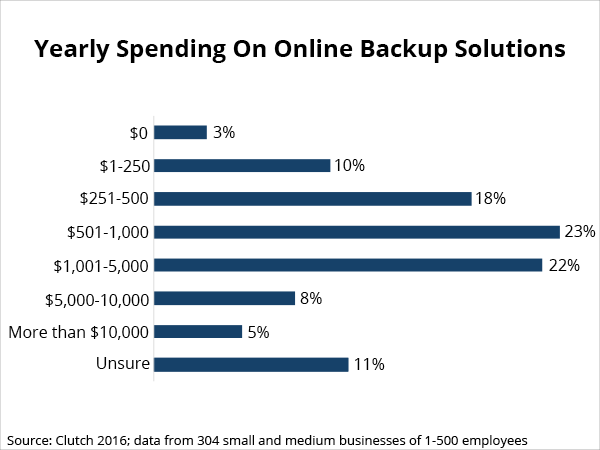
Most SMBs (63%) spend between $250 and $5,000 on online backup each year.
What affects the cost of online backup services?
Thought leaders shared six key factors that affect cost:
“The more intolerant you are of data loss, the costlier it will be to use online backup services. You will have to spend more time designing the infrastructure for you backup solution to limit the amount of time without access to your data in case of a failure.”
— Tim Fox, Head of Managed Services, CorpInfo
Spending on cloud backup services is a tradeoff. Spend more for faster data recovery. Spend less for slower data recovery. It depends on how often you need the data and when.
Consumer-facing solutions top the list of popular online backup services for SMBs.
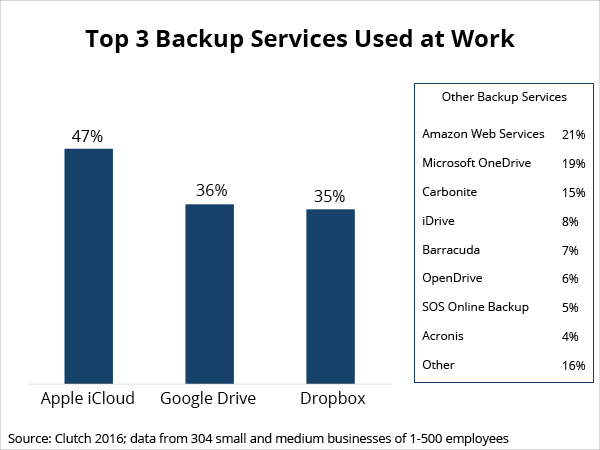
In fact, SMBs look to the same cloud services for online backup as cloud storage, according to a previous Clutch survey that found Google Drive (53%), Dropbox (45%), and Apple iCloud (34%) the most popular cloud storage solutions.
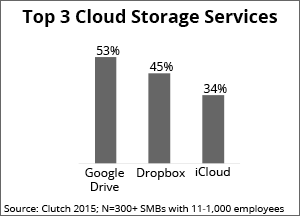
“People have been using iCloud, Google Drive, and Dropbox on their personal devices and accounts for several years. Then, they started using those same services at work. When there’s enough use, the IT team may decide to apply the services across the entire company.”
— Steve Woodward, SkySync
The top three online backup solutions favor simpler forms of backup, such as backing up files. None of these options allow bare-metal backup, which entails completely reinstalling an operating system and restoring data and settings.
“The prevalence of these three services indicates that companies are focused on performing more file-level backups versus ‘bare-metal’ backups. Companies would not be able to quickly and efficiently recover an entire server this way and depending on their tolerance for downtime should investigate augmenting these offerings with other more robust options.”
— Mark Anderson, Anderson Technologies
The study consisted of 304 respondents who use cloud-based, online backup solutions at companies with 1-500 employees.
About half come from companies with 50-500 employees.
81% of respondents are manager level or higher.
The data was collected throughout March 2016.