
How to Use Claude Code if You're Not a Developer
Learn how to use Claude Code to build your own AI agents without a coding background, including setup, first steps, and safety tips backed by Clutch data.
Updated July 9, 2026

To develop an AI application, follow six core phases: business analysis, data analysis, data preparation, model development, model testing, and operationalization. Skipping or rushing any of these steps is the primary reason AI projects fail — and failure rates remain stubbornly high across the industry.
AI projects often fail because businesses underestimate the complexity of developing and implementing AI solutions. Unlike traditional software development, AI requires careful planning around data, model performance, and operational requirements to deliver meaningful results.
Research shows that many AI initiatives fail to achieve their intended outcomes due to challenges such as poor data quality, unrealistic expectations, insufficient training data, and limited AI expertise. However, businesses can improve their chances of success by following a structured development process tailored to AI applications.
Looking for a Artificial Intelligence agency?
Compare our list of top Artificial Intelligence companies near you
This guide outlines six core phases for developing successful AI solutions. Whether you’re building a machine learning model or integrating a large language model (LLM) into a business workflow, these steps provide a framework for moving an AI project from concept to implementation.
Before starting, establish which type of AI application you're building — because the development approach differs significantly.
Traditional ML applications are trained on your proprietary data from scratch or fine-tuned from a base model. Examples include fraud detection systems, demand forecasting engines, and custom image classifiers. These builds require significant investment in Steps 2–4 (data analysis, preparation, and model development).
Generative AI / LLM applications use pre-trained foundation models — such as GPT-4o, Claude, or Gemini — via API, customized through prompt engineering, retrieval-augmented generation (RAG), or fine-tuning. Examples include AI copilots, document summarization tools, and customer-facing chatbots. For these projects, Steps 2–4 are lighter, but defining what the model should and shouldn't do becomes more important.
This is an analysis of the business that centers around AI.
The key elements of AI-focused business analysis comprise the following set of questions that need to be answered:
The AI-focused business analysis needs to begin with a focus on the core requirements and objectives of the business.
Although your business will have many needs and objectives, your focus needs to be on only those that make AI essential. This is the ‘success criteria’ defined for the project.
To arrive at the ‘success criteria’ for the AI project, you need to assess the current situation of your business and understand the cognitive requirement.
Once you’ve established the success criteria, the next step will be determining how AI can help you meet it.
At this point, the AI Go/No-Go Assessment needs to take place. This is a quality control measure that will help you determine whether to proceed with the project or abandon it.
In case there are enough factors to proceed with AI implementation, it is critical to pick the proper AI pattern which will drive the execution technology stack, approach, and machine learning models selection.
The industry recognizes 7 distinct patterns:
Ultimately, all these activities help perform an analysis of the business centered around the AI project as well as determine its success chances.
The second phase of the AI application development process is all about analyzing data in relevance to the AI application being developed.
The key questions that need to be answered as part of this phase are:
This analysis needs to begin with an understanding of the core objectives and data requirements. Once these requirements are understood, the next step would be to filter out the data sources that are relevant to the AI project.
Additionally, determine the type and quality of data available to meet the business objectives established in Step 1.
Before using data for AI training, establish:
Also consider pre-trained models and whether they can be used to speed up project delivery.
Note for LLM-based builds: This phase focuses on the documents, knowledge bases, or structured data your application needs to access — not raw training data. Evaluate the quality, volume, and retrieval architecture (chunking strategy, embedding model, vector database) for your RAG pipeline.
The purpose of this phase is to prepare data in accordance with the requirements and scope of the AI project. The key elements are:
The data used for the AI project must be able to address the needs of the business. Therefore, data not only needs to be prepared, cleaned, and labeled, but it also needs to be properly formatted and augmented.
The latter is especially important and can be achieved with engineering and enhancement of data. However, before you do this, make sure that pruning and optimizing data will make modeling more effective and accurate.
Once the initial data set is prepared, the process for future data set iterations needs to be established.
By ensuring the above, you will have enough data to move to the next phase.
This phase looks to establish the important processes that help create the ML data model for the project.
The key elements of this phase are:
Some important considerations for ML data model development include:
For LLM-based applications: Model development in this context means prompt engineering, retrieval pipeline construction, and evaluating whether fine-tuning on domain-specific data improves task performance. The algorithm selection step is replaced by model selection — GPT-4o, Claude 3.5 Sonnet, Gemini 1.5 Pro, and Llama 3 are the most commonly evaluated foundation models in 2026, each with different cost, latency, and capability profiles. Orchestration frameworks like LangChain and LlamaIndex are widely used to build the retrieval and agent logic around the base model.
As the name suggests, this phase involves the testing of the AI model that has been developed.
The key questions to consider are:
In AI model testing, the first thing to know is if the learning takes place for the trained model. Learning curves — which track training vs. validation performance over iterations — are a standard diagnostic tool for identifying underfitting, overfitting, and convergence issues. MLflow and Weights & Biases both provide built-in curve logging and experiment comparison across model iterations.
Once testing results are available, review the model for accuracy, performance, and alignment with business KPIs. If the model does not meet the criteria, it goes through another iteration to achieve an improved outcome.
For LLM-based applications: Testing expands beyond accuracy metrics to include evaluation of factuality, hallucination rate, and task completion. Tools like Promptfoo, Braintrust, and LangSmith are widely used to run automated eval suites against representative prompt sets before any deployment decision.
Ultimately, this phase produces an AI model ready for operationalization.
Now that your ML model has been tested and fine-tuned, it’s time to integrate it with other web or mobile application components and roll out to the production environment.
The process typically begins with a comparison of model operationalization requirements. You need to select the target deployment approach for your ML model:
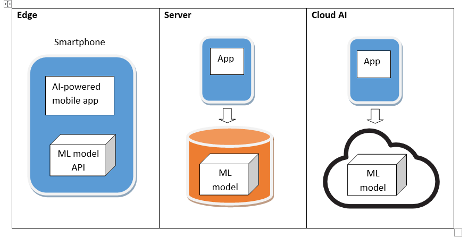
Based on the selected approach, the target environment needs to be configured and end-to-end integration with the rest of the application must be properly verified.
The final — and often underestimated — step is model governance and monitoring. Production AI models drift over time as the input data they receive diverges from what they were trained on. A monitoring plan should track:
MLOps platforms like MLflow, Arize AI, and Evidently AI provide production monitoring dashboards for these metrics. Define retraining trigger conditions and assign governance ownership before launch — not after.
Building an AI application in-house requires specialized skills — data scientists, ML engineers, and AI architects — that most businesses don't have on staff. Working with an external AI development partner is common for businesses that have the business problem and the data but not the technical team to execute.
When evaluating AI development firms, look for demonstrated experience in your specific AI pattern (predictive analytics vs. conversational AI vs. computer vision), a structured development process, and verified client reviews from similar industries.
Clutch's directory of top AI development companies lists verified providers with client reviews, so you can compare firms by specialty, company size, and location.
The AI-focused software development process outlined in this article addresses a majority of the issues that lead to AI project failures.
This process has been battle-tested on multiple projects that Achievion has successfully delivered for its clients of various sizes and industries.
A simple AI feature or MVP typically takes 6–8 weeks. A production-ready AI application with multiple integrated models takes 12–16 weeks, depending on data complexity and integration scope. LLM-based applications often ship faster at the MVP stage because the core model is pre-trained.
Python is the default for AI development due to its extensive ML ecosystem — TensorFlow, PyTorch, scikit-learn, and Hugging Face Transformers. For latency-sensitive serving infrastructure, Go and Rust are increasingly used alongside Python.
For traditional ML models, yes — quality training data is the primary input. For LLM-based applications, you can leverage pre-trained models via API and supplement them with proprietary data through retrieval-augmented generation (RAG), which avoids the cost and complexity of full model training.
It's a structured evaluation conducted during Step 1 that determines whether AI is the right solution for a given business problem. It evaluates data availability, technical feasibility, cost-benefit alignment, and risk factors before committing to development resources.
What is the difference between a machine learning application and a generative AI application?
Traditional ML models are trained to make predictions or classifications on structured tasks (fraud detection, demand forecasting, churn prediction). Generative AI applications use large language or image models to produce new content — text, code, images, audio — and are typically built on pre-trained foundation models rather than custom-trained models.