
Your Brand Strategy Problem Probably Isn't a Messaging Problem
AI made brand execution cheap, but not brand strategy. Here's why agencies must shift from logos to diagnosing the gap between what companies say and do.
Updated March 25, 2026

Looking to hire a PR agency? First, create a budget with Clutch’s downloadable PR budgeting template.
Many small businesses may think that public relations is only for large corporations with big budgets, but PR can also be a great investment for small businesses.
PR helps build trust and credibility for small businesses. Through positive media coverage, press releases, and thought leadership pieces, small businesses can showcase their expertise and build a reputable image in the eyes of potential customers.
Looking for a Public Relations agency?
Compare our list of top Public Relations companies near you
If you’re looking to build out your PR efforts, it can be difficult to know how much the project will cost and how to budget for it.
This article will dive into what goes into a PR budget and everything else you need to know to prevent overspending.
Table of Contents
Need help enhancing your business's public image? Search top PR agencies on Clutch.
Maintaining and managing your business’s reputation can be complex. PR agencies offer a variety of services with the goal of building positive relationships with various stakeholders.
These services include:
While the cost of the PR services aren’t dependent on the type of PR services you need, this may impact how much work is being put into your project. For instance, companies that need support with investor relations and crisis management in addition to standard corporate communications will spend more than a small business looking to improve their visibility with reputation management.
Just as importantly, knowing what PR services your business needs may impact whether you want to hire internal PR efforts or need the support of an agency.
Some business leaders may not realize that when they invest in public relations, they need to set clear objectives in order for the project to be successful. These goals will drive your PR strategy and can greatly impact your project's cost.
These goals include enhancing brand visibility, growing thought leadership, increasing media coverage, strategic communications planning, and more.
Just like any project, these goals should be clear and measurable to make sure that all stakeholders are on the same page. Once you outline broader PR goals, you should be able to identify key results and performance metrics to help track your project.
With these goals in mind, companies can dive deeper into what resources they would need and how much it would cost to accomplish these objectives.
Once you’ve established goals for your PR project, you will want to identify deliverables. Consider this as ‘how’ your business will meet its goals.
For example, a key result for a business looking to invest in crisis communication would be by solidifying a crisis communication plan with predefined protocols and messaging. However, Those looking to strengthen media relationships should set a goal such as increasing the number of media mentions by 25% in a given period.
Other deliverables can include
The more deliverables your business requires, the more expensive it will be. By outlining the deliverables for your project, you can gain a better understanding of how much you will need to spend on the project.
The most important part of creating a branding budget is making sure you don’t overspend, but knowing how much to set aside is a challenge.
How much your business should spend depends on how big your business is and what PR services you plan to invest in. Larger businesses are likely to need more support for than smaller businesses
PR agencies offer a variety of pricing models for their clients, but the most popular is by hourly rate. Usually, PR companies charge between $100–$150 per hour for their services. So, the more PR work your business requires, the more expensive your project will be.
Companies spending more than a fair amount on PR should consider hiring an in-house team or keeping a PR agency on retainer. Companies that have a lot of PR needs may be able to save money this way, but only if their work warrants it.
Learn more about how much it costs to hire a PR agency in Clutch’s ‘PR Pricing Guide.’
Hiring an internal PR team can be expensive. Once companies consider salary, benefits, hiring costs, and training costs, the price may be too much for some businesses. Instead, companies can save money and gain access to top-notch PR professionals by hiring a PR agency or consultant.
In addition to being experts in their field, external PR agencies bring an impartial viewpoint and fresh perspective to a company's communication strategies.
They can offer valuable insights and creative ideas that may be overlooked by those within the organization. This objectivity can help in crafting effective messaging and positioning that resonates with the target audience.
Many PR agencies also have vast networks that can help them secure media placements that can improve your brand’s perceptions.
Whether you hire a PR team internally or externally, you may need to supply data, images, brand assets, and content to your PR team.
While most PR agencies will create assets they plan to release themselves, they will still need certain assets from your internal team.
They will use these assets to promote your business for various purposes. They may use them to create social media posts, write press releases and whitepapers, schedule interviews, and release statements using your brand assets.
To provide this information, companies require a team of writers, graphic designers, brand managers, and more.
Additionally, you may also need to account for additional costs like those associated with media placements or the cost to conduct surveys.
When you start your project, be sure to discuss the deliverables you expect and what is needed to get there so you can properly plan.
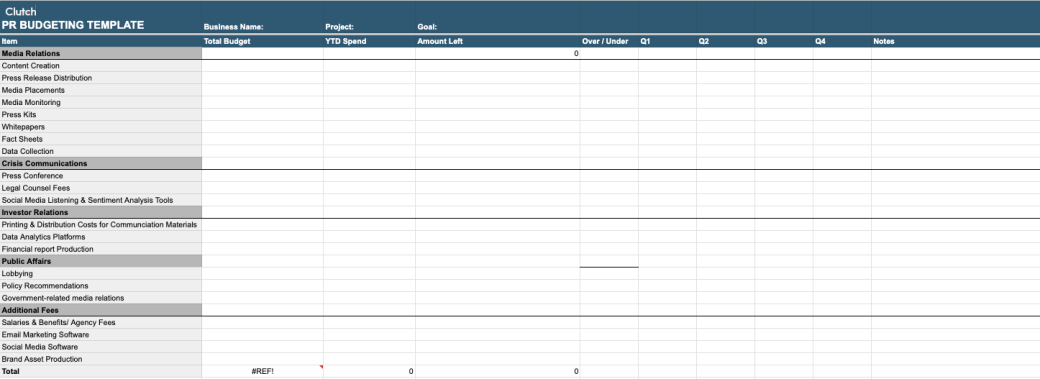
Download the branding budget template.
When hiring a PR agency, you may spend anywhere from a few thousand dollars to tens of thousands of dollars. Whether your project is on the high or low end of that scale depends largely on the scope of the project and how involved the PR team is in your promotional efforts.
To accurately estimate the cost of your project consider these factors:
Be sure to include all of these factors in your PR budget.
Public relations professionals — whether they’re in-house or outsourced partners — have experience building their client’s brand image and improving perception.
If your company is interested in investing in PR, you must first create a budget for your project. Though costs may vary, understanding your project goals and how you will accomplish them will help you estimate how much you need to spend on PR to be successful.
To accurately estimate your project costs, consider everything your PR team will need. From providing assets your partners need to the cost of media placements and more, be sure to include them in the budget.
Also consider the size of the team you need and where they’re located to get a better understanding of the total cost of your project.