
Why Salesforce Staff Augmentation Is Becoming a Strategic Choice
Salesforce staff augmentation is no longer a stop-gap. Learn why more businesses now use external specialists to access expertise, move faster, and scale...
Updated February 19, 2026

Having an impactful center of excellence (CoE) can be a huge benefit to growing software companies. Not only do they serve as specialized expertise hubs, but they also offer opportunities for internal growth and can support product development.
As more companies invest in IT, some of them choose to invest in centers of excellence (CoEs) to stay ahead of the game. They use these centers to win the battle for IT talent, capturing emerging tech trends and growing their own capacity to partner with big companies.
Let’s take a closer look at what a CoE is, whether you need it or not, and how to set it up in your software development company.
Looking for a IT Services agency?
Compare our list of top IT Services companies near you
Looking for IT professional? Check out Clutch’s directory of top IT companies and filter by location, budget, and specialty to find the perfect partner for your project.
A Center of Excellence (CoE) is also referred to as a competency center or capability center, and it serves as a centralized group designed to strengthen expertise in a specific area of the business. A CoE is a team of specialists that provides thought leadership, researches trends, and supports training for a certain focus area.They can be internal or external hires with expertise in a specific area.
CoEs can be established as either temporary initiatives or permanent organizational structures, depending on the company’s goals. They are most often created to address a specific skills gap, knowledge deficit, or operational challenge, while also driving innovation and long-term improvement.
They collaborate to capture new knowledge and practices from inside and outside of the organization and enhance expertise in a specific focus area/areas to help the business grow.
At its core, a CoE acts as the organization’s single source of truth for its area of focus, ensuring that best practices, standards, and processes are applied consistently across teams. By centralizing expertise, CoEs help optimize resource allocation, reduce duplication of effort, and improve overall efficiency. They also play a critical role in risk management and regulatory compliance, particularly in highly regulated industries.
For a CoE to be effective, it must have clear executive sponsorship, sufficient funding, and the authority to influence or make decisions. Its objectives should align closely with the organization’s broader strategy and long-term vision, and it should be positioned as the governing authority with the deciding vote on significant decisions within its domain. Mature CoEs typically operate using an iterative, feedback-driven model, continuously refining their approach based on outcomes and stakeholder input. To maintain objectivity and scale impact, CoEs are usually structured separately from the business units they support.
For IT companies, a CoE is a cross-company team that adopts and shares industry best practices to attract qualified professionals. They also nurture internal talent and deliver software solutions that people like.
The focus area of a CoE within a software development company might be a technology (Cloud, Scala), a skill (negotiations, providing feedback), a business concept (RPA, digital transformation), or a broad area of study (DevOps, Software quality management).
Keep in mind that the focus area(s) should be defined and organized as a way to reach a specific, measurable goal.
An IT company may target its CoEs by meeting two critical needs:
If you choose these as your core goals, you should consider two paramount things:
For example, this visual shows how N-iX organizes their CoEs’ work and structured their focus areas.
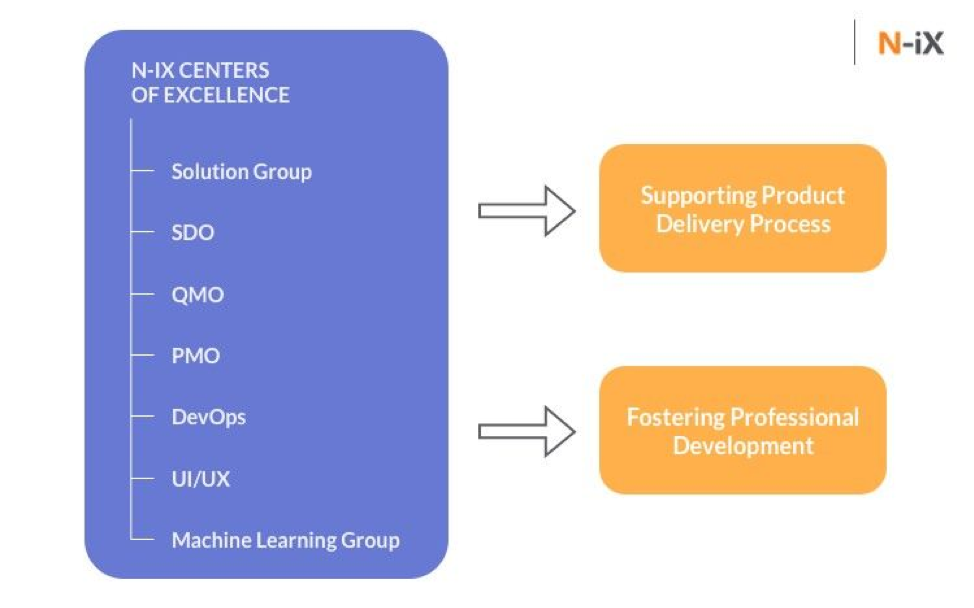
N-iX CoEs include teams such as:
All of them support the product delivery process and assist in the professional development of employees.
Let’s break down how CoEs support the product delivery process even further with this flow chart.
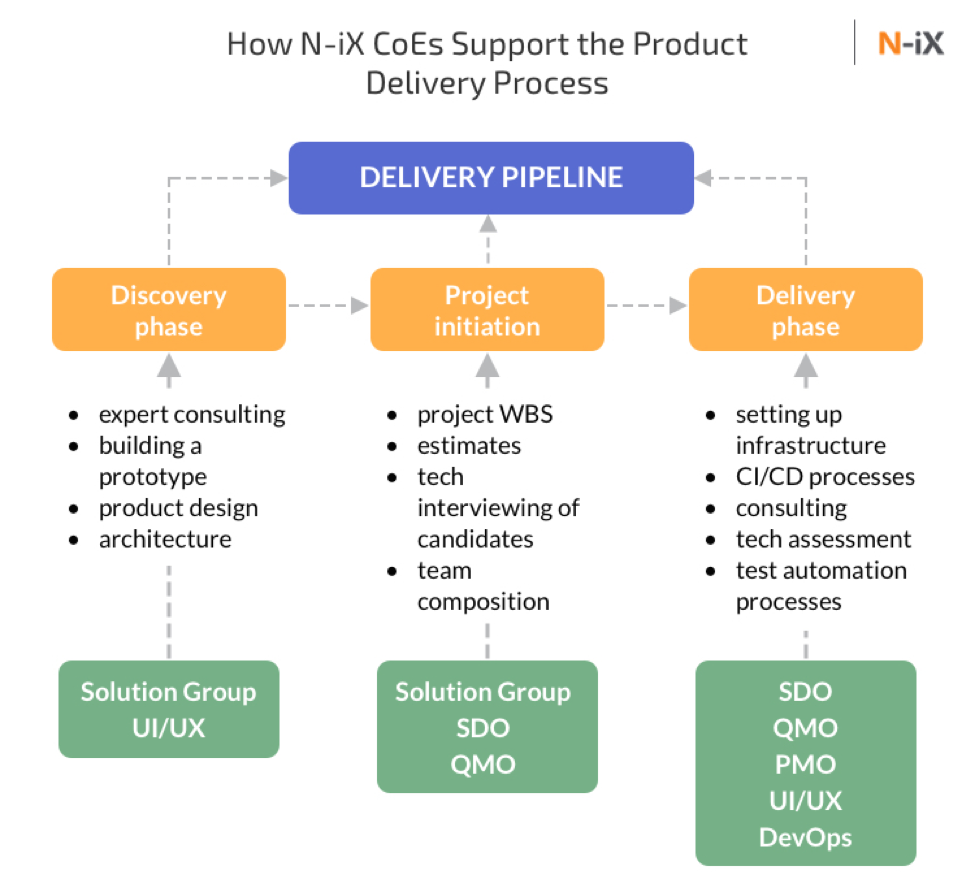
To make the focus areas more business-oriented, we organized our CoE teams not around a specific technology or a domain, but rather around different parts of the product delivery pipeline. CoEs then provide expert consulting during each stage.
For example, the solution group and UI/UX team can help build a product’s prototype and design the architecture in addition to offering expert knowledge.
A well-designed CoE relies on a clearly defined team structure that balances strategic oversight with hands-on execution. While the exact makeup may vary by organization and focus area, effective CoEs typically include the following core roles. Together, these roles form a cross-functional team that enables the CoE to operate as both a strategic authority and an execution engine.
The steering committee provides executive-level oversight and direction for the CoE. Made up of senior leaders and key stakeholders, this group ensures the CoE’s initiatives align with broader business objectives, approves major investments, and resolves cross-functional conflicts. The committee also plays a critical role in securing ongoing funding, authority, and organizational support.
The CoE lead is responsible for day-to-day leadership and overall performance. This role translates strategic goals into actionable plans, sets priorities, and serves as the primary point of accountability for outcomes. The CoE lead also acts as a bridge between executive leadership and delivery teams, ensuring alignment, visibility, and momentum.
Subject matter experts bring deep domain knowledge to the CoE’s area of focus, whether that’s cloud infrastructure, data analytics, security, or application development. They define best practices, establish standards, and provide guidance to business units. SMEs also help evaluate new tools and approaches, ensuring decisions are grounded in expertise rather than trends.
Technical architects design the overarching systems, platforms, and integrations supported by the CoE. They ensure solutions are scalable, secure, and aligned with enterprise architecture principles. By setting technical guardrails, architects help teams innovate without creating long-term complexity or technical debt.
Process Analysts
Process analysts focus on how work gets done across the organization. They document current workflows, identify inefficiencies, and design standardized processes that improve consistency and performance. Their work ensures the CoE’s recommendations are practical, repeatable, and measurable.
Engineers are responsible for implementation and execution. They build, configure, and maintain solutions in accordance with CoE standards, often supporting pilot programs or high-impact initiatives. Their hands-on experience also feeds valuable feedback back into the CoE’s continuous improvement cycle.
Compliance leads ensure that CoE initiatives meet regulatory, security, and internal governance requirements. They assess risk, define controls, and work closely with legal and security teams to prevent issues before they arise. This role is especially critical in regulated industries, where consistency and oversight are essential.
Establishing a CoE calls for time, effort, and money. So how do you know if building a CoE is right for you?
To answer the question, let’s take a look at what it takes to set up a CoE and the potential returns.
Setting up a CoE is the best strategy for a mid-level IT company that’s looking to grow (large companies are defined as over 1,000 employees). These companies already have a considerable amount of expertise — not to mention, their people are willing and qualified enough to coordinate these centers and provide training.
They also have enough resources to invest in the professional development of employees.
CoEs provide companies with a strong playing card in the highly competitive IT talent market. Having a bigger talent pool and a better employer image provides an IT company with the capacity to build teams faster. They can then work with big companies that need large development teams and rare expertise, such as embedded engineers or blockchain developers.
By having your CoEs research the latest tech and business trends, you can align them with your business needs. This allows you to keep up with fast-paced changes by always being ready for implementation.
CoEs can encourage key talent to join the team and organizes them in effective ways.
Roles will have set competencies, allowing you to have a clear and objective view of available expertise within your IT company.
CoEs can help attract talent because they promote growth opportunities (both for junior and senior developers) and a chance to work with new, trendy technologies.
Developing a culture of both formal and informal mentorships, training, and knowledge sharing.
You now have experts who can help evaluate a candidate’s technical skills for a specific project. They can also provide consulting in case of bottlenecks, change in requirements, and more.
CoE team members can assist in tenders that are relevant to CoE focus areas.
There are several steps you need to follow to organize a successful Center of Excellence.
By having specific, tangible goals you can measure the effectiveness of the center and the invested resources. This also makes it easier to organize the center’s scope of work and identify core skill sets to meet these goals.
How many focus areas will it cover? What budget and how many employees will you need to support its operation?
By defining the scope of the center, you place restrictions on projects your CoE team undertakes. This helps to ensure that the CoE focuses on the most strategic areas.
Having an operational center means understanding how to best leverage your resources’ skills. Here is a list of tips to consider that will encourage a positive working environment for your CoEs.
CoEs are first and foremost about people with expert knowledge who can share it, both in formal and learn-at-lunch mode. Therefore, it’s important to organize tech meetups, a cross-company mentorship program and other professional development services.
Also, it’s crucial to establish a culture of providing feedback and create a favorable environment for informal training and mentorship.
To increase your employees’ motivation, you’ll need to provide them with growth opportunities and relevant professional development services.
Opportunities can range from a traineeship program that nurtures junior and middle software engineers to an architecture associate program that provides senior software engineers with ways to transition into tech lead and architect roles.
It’s also a good idea to reimburse employees for earned certifications.
A Competency Model provides employees with a more transparent career path so that they understand what they need to do to grow and get promoted. Also, it allows you to get an objective view of available expertise within a company when allocating experts for a project.
Standardizing professional levels and competencies help with core performance evaluations while enforcing professional goals.
It’s important for employees to have a chance to do interesting jobs that help them grow, improve their skills, and spark motivation. Involving CoE members in discovery projects allows your company to be more oriented on solution development.
You can re-enforce your company’s expertise to clients and address any uncertainty they may have by publicizing your CoE findings. For employees, it’s another opportunity to polish their soft skills such as presentation and negotiation.
Finally, if you’ve invested effort, time, and money in setting up and maintaining a CoE, don’t keep quiet about it. CoEs improve your employer brand image and motivate external professionals to learn more about the company.
Some might decide to join your company just to enter the CoE. Also, marketing your CoEs can help you raise financing to extend their activity.
Setting up a CoE in your software development company allows you to grow expertise, create a sustainable internal talent pool, and engage external employees more easily.
Additionally, you can increase your internal employees’ motivation and deliver quality software solutions that people like and use.
Additional Resources: