Updated September 21, 2026
Your customers may expect to be able to consult an expert with any questions they have about your product or their setup, while your employees need their equipment to function smoothly. Partnering with the help desk support services makes their experience better without taking away from your business’s operations.
If your current help desk support services are holding your business back, it's time to outsource.
According to Deloitte, 68% of companies are already doing just that. Outsourcing help desk services frees up your team to focus on coming up with innovations and refinements to your products and services that help make a name for your organization. Meanwhile, specialists are able to devote their time to customer support, improving your clients’ experience and making their impression of your brand more positive while making sure your employees aren’t slowed down by any tech issues.
Because outsourcing is an increasingly popular solution, there are a lot of help desk support services looking to be hired, and choosing the right one for your business can be challenging. Our guide will show you exactly how to hire help desk support companies, from where to look to the key questions to ask.
Browse Related IT Services
What Are Help Desk Support Services?
Help Desk Support Services: These services, also known as IT support, provide real-time technical assistance to an organization’s user base, employees, or both.
A help desk support team serves as a technical assistant for your customers. They're the ones who troubleshoot software glitches, resolve hardware issues, and guide them through the digital user journey. These teams are responsible for:
- Troubleshooting all relevant issues
- Diagnosing and fixing issues remotely
- Software installation and updates
- User training on new software or processes
- Hardware support (laptop repairs, server maintenance, etc.)
Outsourcing your help desk support creates several benefits for your business. It allows your in-house support team to focus on core tasks and boost productivity. Outsourcing is also much more cost-effective than hiring and training in-house IT staff.
Help desk providers have specialized knowledge, experience, and equipment. They’ll handle everything, from training your in-house staff to scaling their services as needed.
5 Benefits of Help Desk Support Services
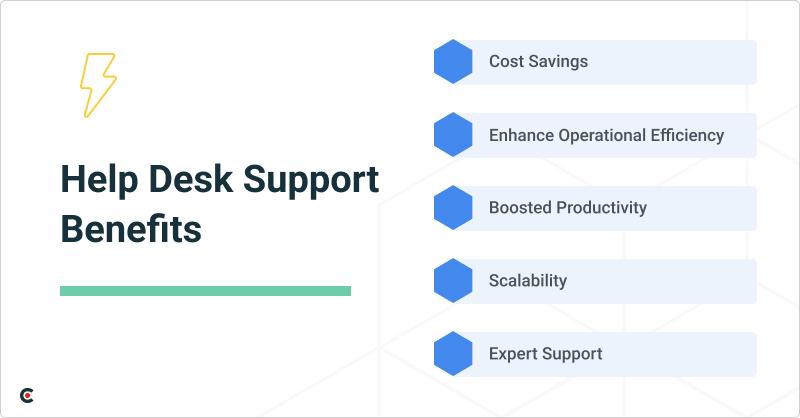
If your current tech support system is draining your resources, outsourcing can be the right solution. Hiring help desk services offers many benefits, including:
- Cost savings
- Enhanced operational efficiency
- Boosted productivity
- Scalability
- Expert support
Cost Savings
The main reason companies choose to outsource help desk services is to cut costs, according to Deloitte. With outsourcing, you'll have a clear monthly budget for tech support, so you don’t have to worry about unexpected costs. There's no need for in-house IT infrastructure, equipment, or training.
Enhanced Operational Efficiency
Help desk providers have standardized processes and tools, which allows for quicker problem-solving. A recent report released by Mordor Intelligence shows that outsourced help desks can increase operational efficiency by 45–65%.
Their proactive monitoring and maintenance help minimize downtime so your operations can remain uninterrupted. Help desk support can also streamline your IT processes, reducing inefficiencies and errors.
Boost Productivity
Being able to maintain a staff that isn’t required to provide troubleshooting for your clients allows your employees to focus on what they do best.
Whether you have an in-house help desk to support your staff or are turning to a help desk service for that as well, you can achieve faster, smoother help for the people in your organization. Departments with access to efficient tech support have shown a boost in productivity when their issues are solved quickly and efficiently. Minimized downtime means less lost productivity and fewer missed opportunities.
Scalability
Help desk providers can easily adjust their staffing to meet your changing needs. Deloitte found that many organizations turn to outsourcing due to changes in their talent landscape (29%), employee expectations (24%), regulatory requirements (22%), and cybersecurity threats (18%).
Whether you're expanding or experiencing a surge in demand, outsourced help desk teams can easily accommodate your growth. You’ll also avoid the overhead of hiring and training additional in-house staff.
Expert Support
Help desk providers have deep knowledge of all kinds of technologies and platforms. Many of them offer round-the-clock support to address issues whenever they arise. Such preventative measures can help you avoid problems from the outset and reduce downtime and costs.
What Services Do Help Desk Support Companies Provide?
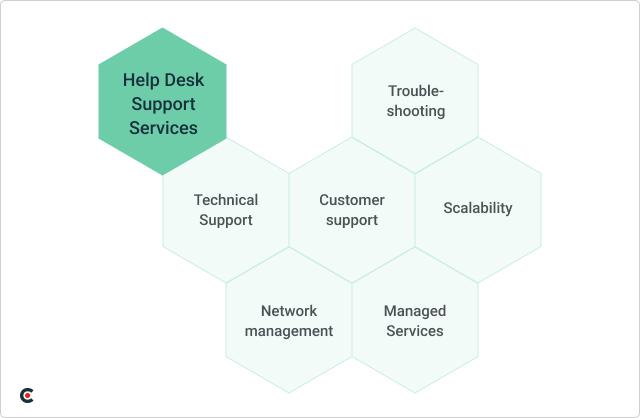
When you outsource your technical support responsibilities, what can you expect them to cover? Help desk service providers typically offer:
- Technical support
- Troubleshooting
- Customer support
- Scalability
- Network management
- Managed services
Technical Support
Your help desk team is there to help with everything from software installations to hardware troubleshooting. The goal is to make sure your team can work efficiently and effectively.
For instance, if your employees are struggling to install a new software application, your help desk team can provide step-by-step guidance or even remotely install the software for them. This way, you can drastically reduce downtime that would otherwise be spent navigating a tricky new software.
Troubleshooting
Help desk teams are also responsible for troubleshooting, which means diagnosing and resolving IT issues. Whether it's a slow computer, a network outage, or a software glitch, they’ll be on hand to identify the root cause and provide a quick solution.
Suppose your network is experiencing intermittent connectivity issues. You’ll turn to your help desk team to pinpoint and fix the problem, whether it's a faulty cable, a hardware malfunction, or a network error.
Customer Support
Nearly half of all customers in this Salesforce survey are willing to pay more for better customer service. Your help desk team can provide technical assistance to your customers, making sure they leave with a positive impression.
For example, if a customer has trouble using your software, your help desk team can provide remote assistance. Some also create instructional videos to guide them through the process.
Proactive IT Management
Proactive IT management is all about preventing problems before it’s too late. Your help desk team will be responsible for these preventative measures, such as regular updates and backups. The goal is to keep your IT infrastructure secure, reliable, and efficient.
Network Management
Your network is the backbone of your operations. Your help desk team can manage your network infrastructure with regular troubleshooting and security updates.
Most importantly, they can keep an eye on your network for signs of intrusion or unauthorized access. They’ll keep up with the required security measures, such as firewalls and intrusion detection systems, and alert you to any issues they notice.
Managed Services
Managed services take a comprehensive approach to IT support. Your help desk provider can manage your entire IT infrastructure, including hardware, software, and network. This will free up your internal support resources and let you count on a more predictable monthly cost.
How to Assess Help Desk Support Services
With so many options available, how can you know whether your help desk service is working well for you? Tracking certain metrics and key performance indicators (KPIs) will tell you how they impact your business performance.
Here are some important metrics to measure:
- Response time: The average time it takes for a help desk support agent to respond to a customer's initial inquiry. A quick response time shows that the team is alert and professional, improving your customer satisfaction rate in the long run.
- Resolution rate: The percentage of tickets resolved successfully within a specified time frame. A higher rate points to effective problem-solving and lower customer frustration.
- Churn rate: The rate at which your users stop using the help desk service. A low churn rate means customers are satisfied and loyal. That means you can cut costs associated with acquiring new customers.
- Customer retention rate: The percentage of your users who continue to use the help desk service over time. A high retention rate means the team is contributing to long-term business success.
- Cost per ticket: The average cost associated with resolving each ticket. This metric will help you optimize your resource allocation and identify areas where you can improve your customer service efficiency.
What Is a Help Desk Support Team?
Help desk teams offer the talent and experience of multiple different professionals. When you outsource your technical support services, you’re paying for the expertise of:
- Help Desk Agents: They interact directly with users, fielding incoming calls, emails, and chat requests. Overall, they’re responsible for technical assistance and troubleshooting common issues.
- Network Specialists: They are responsible for maintaining and optimizing your company's network infrastructure. They keep an eye on the network performance, fix any connectivity issues, and implement security measures to protect your network from threats. Even if you already have a cybersecurity professional, network specialists are an important part of your support team.
- Customer Service Teams: They work closely with the help desk team to resolve customer issues and create a more positive experience.
- Queue Managers: They oversee the workflow and efficiency of the help desk team. They manage incoming requests, assign tickets to agents, and study the performance metrics to make sure their service delivery is as expected. They also serve as the point of contact for your in-house team.
What Is a Help Desk Support Team?
When you’re looking for a help desk team, there are three things you should look for: experience, service level agreements (SLA), and security.
First, look for a help desk provider with a proven track record of handling similar-sized businesses or organizations in the same industry. This way, you can guarantee that they’ll understand your specific challenges and can tailor their services accordingly. For instance, if you're a healthcare organization, the provider should have experience supporting HIPAA-compliant systems.
Second, ask about their service level agreement. It should outline their response times, resolution rates, and other performance metrics. A reputable provider may guarantee a response time of around 15 minutes for critical issues and a resolution time of 24 hours for most tickets.
Lastly, take a closer look at their security measures. They should have robust security practices, such as regular vulnerability assessments, encryption, and compliance with local regulations.
Criteria for Hiring a Help Desk Support Company
Consider these factors when hiring a help desk service provider:
- Scalability: Make sure the help desk provider can accommodate your future growth and handle changes in workload.
- Integration Capabilities: Check if the provider's tools can integrate with your existing systems and software, leading to savings in implementation.
- Knowledge Base: An all-inclusive knowledge base can help users find answers to common questions without requiring human intervention. Most modern customers prefer independently solving their issues.
- Analytics and Reporting: Look for a help desk provider that offers detailed analytics and reporting. It’ll help you measure performance and identify areas for improvement.
- Support Availability: Consider the provider's hours of operation and availability of support channels (phone, email, chat). Ideally, the provider’s team should be available 24/7.
- Business Continuity Planning: Most importantly, the provider should have a plan in place to address outages and disruptions, including disaster recovery solutions.
Lastly, don’t forget to read honest reviews about the provider provided by previous clients. Clutch maintains a directory of verified user reviews that will let you evaluate the unique strengths of each service and figure out whether they’re a good match for your business.
10 Questions to Ask When Hiring Help Desk Support Services
Before you hire a help desk service provider, don’t forget to ask them these questions:
- What is your average response time for critical and non-critical issues?
- How do you handle peak workloads or unexpected surges in ticket volume?
- What security measures do you have in place to protect customer data?
- Can you provide any references from existing customers?
- What is your process for knowledge base management and self-service options?
- How do you ensure the quality and consistency of your help desk agents' performance?
- What is your current approach to disaster recovery and business continuity planning?
- What KPIs do you consider essential, and how do you measure and report on them?
- What is your pricing model, and how do you handle additional charges or fees?
- Can you provide any examples of your work with similar organizations?
Search for Help Desk Support Services Based on Project Requirements
Once you’ve decided what you want from a help desk support service, it’s time to find the right one for your business. The Clutch database offers company profiles and ratings, as well as an extensive filtering system that lets you narrow down services by location, areas of specialty, pricing, and more.
Clutch also offers detailed and honest reviews on over 35,000 vetted providers, which means you can learn all about previous clients’ experiences before you even contact the service provider. Help desk support hiring has never been easier. Visit Clutch today to explore top-rated providers and read honest reviews from their clients.