
Why Salesforce Staff Augmentation Is Becoming a Strategic Choice
Salesforce staff augmentation is no longer a stop-gap. Learn why more businesses now use external specialists to access expertise, move faster, and scale...
Updated April 30, 2026

Businesses are increasingly relying on business intelligence (BI) and analytics services to gain valuable insights and make informed decisions. Creating a budget for BI and analytics services will ensure that your business can seamlessly integrate these processes.
Data-driven decision-making has become essential for staying competitive. Business intelligence (BI) — the tools and practices that help organizations collect, analyze, and act on data — can help companies identify trends, streamline operations, and better understand their customers. But building BI capabilities on a tight budget can feel daunting.
Whether you're just getting started or working with limited resources, this article will walk you through building a BI and analytics budget that works.
Looking for a IT Services agency?
Compare our list of top IT Services companies near you
Use our free template to plan your BI & data analytics goals. Each company that chooses to invest in this service needs to have its own decision-making process to determine its goals and what they need.
Plan your BI & data analytics budget according to your priorities.
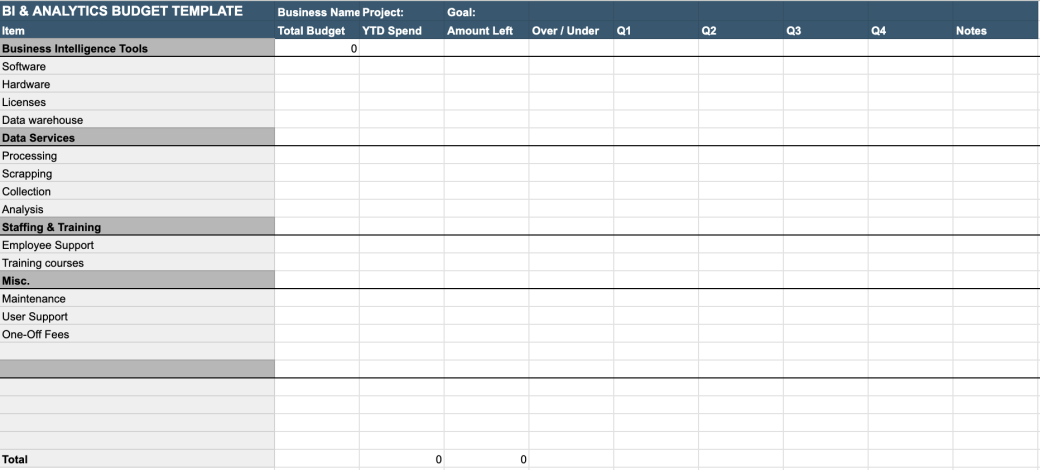
Download our BI & data analytics template.
A comprehensive BI budget incorporates diverse components to ensure efficient resource allocation across your entire data infrastructure. Some key elements to include in your BI budget:
To ensure balanced spending, many organizations apply the 50/30/20 rule: allocate 50% of your BI budget to 'needs' like core infrastructure and software licenses, 30% to 'wants' like advanced visualization tools, and 20% to 'savings' or maintenance reserves and training.
Before creating a budget for business intelligence & data analytics services, your company must lay out their goals to ensure seamless business operations.
These goals might depend on their industry, size, and other specific data-driven decisions.
Some common goals for companies might be:
All of these goals can become reality for companies that invest in BI & data analytics. Data can help businesses monitor performance for goals, improve their services for end-users, and give a competitive advantage.
With your goals in place, you can plan your budget with benchmarks and solutions that fit getting to that end goal.
Defining the scope of work establishes a clear understanding of the project by outlining the exact objectives, deliverables, and expected outcomes of the BI initiative. This ensures that all stakeholders, from IT to executive leadership, are perfectly aligned on what the budget covers.
Without a defined scope, projects often suffer from 'feature bloat,' which can inflate costs and delay projects by 20%-40%. A well-documented scope prevents this by setting realistic milestones and strict boundaries around data sources and dashboard requirements.
Overall, having a clear scope of work provides the financial clarity needed when communicating cost expectations to stakeholders. It allows teams to accurately forecast whether they need to invest in additional cloud storage or specialized predictive analytics tools before the project begins.
Allocating resources when creating a budget for BI & analytics is key for effective implementation. By allocating resources appropriately, organizations can maximize their potential.
It also helps with planning projects effectively by assessing each project requirement and assigning the right resources.
Business intelligence and data analytics often rely on specialized software and tools. These can include data visualization software, predictive analytics tools, data modeling platforms, and data management systems. Ensure that resources in terms of BI software and people are looped in on any planning.
If the right resources are dedicated to a project, all aspects should receive the right amount of attention and support.
As your business grows, the volume of data and the complexity of analytics requirements may increase. It's important to consider the scalability of your business intelligence and data analytics solutions and the associated costs of scaling up.
Flexibility helps accommodate changing business needs, adoption of new technologies, updating KPIs & other metrics, and more. With a flexible budget, your business can have room for experimentation, which will impact your overall BI strategy.
Consider budgeting for ROI analysis to measure the impact of your BI and analytics initiatives. This will help you evaluate the effectiveness of your investments and make informed decisions for future budget allocations.
Outsourcing a business intelligence provider is the best bet for business owners.
When looking to hire, it is important to define your requirements for project management, scope of work, and communication to help your team select the right fit for your specific project.
Vet companies based on their experience, knowledge of BI tools, and other factors that could make or break a successful collaboration.
Consider the following factors when creating a budget for business intelligence and data analytics services:
It's worth noting that the costs of business intelligence and data analytics can vary significantly depending on the size and complexity of your organization, the specific requirements of your industry, and the level of sophistication needed in your analytics capabilities.
See what companies are charging for business intelligence solutions with our pricing guide.
Managing the budget for business intelligence and data analytics initiatives is crucial for organizations seeking to gain insights from their data.
By considering various factors such as infrastructure, software and tools, data storage and management, data integration, expertise, scalability, maintenance and support, and data security and compliance, businesses can make informed decisions about budget allocation.
It is important to note that the costs associated with business intelligence and data analytics can vary depending on the size and complexity of the organization, industry requirements, and analytics capabilities needed.
Hire a BI analytics company that works well with your company’s budget.