
Why Hiring Fast Is Costing You More: The Case for Pre-Vetted Remote Talent
Speed-to-hire may feel like a competitive advantage, but replacement costs, productivity gaps, and re-hiring cycles show up on the balance sheet. Here's why...
Updated February 17, 2026

Personas made a huge difference in the marketing world, and now they're doing the same in HR departments around the world. Companies looking to maintain employee engagement and retention in this challenging market should consider segmenting their audience using employee personas.
Updated 05/12/2022
Is your brand’s marketing strategy as effective as it could be? User personas are a valuable tool to tailor your outreach to a specific audience base.
Looking for a Human Resources agency?
Compare our list of top Human Resources companies near you
Effects of the COVID-19 pandemic have made it a challenging market for employee engagement and retention. However, employee personas can assist HR teams in stabilizing employee attrition and fostering top talent.
Leveraging semi-fictional characters called “personas” is a technique agencies use to enhance marketing campaigns.
When the time comes to launch a new product or penetrate a new market, personas can to be very useful as you identify your target market.

Lately, personas have made their way to many human resources (HR) departments. After reading this article about personas in HR, you will understand that this welcome shift could decrease employee turnover and improve staff engagement to help facilitate a workforce where everyone feels respected and understood.
Looking for help building personas? Hire an HR company on Clutch.
There are plenty of benefits to using personas in the HR field. Here are three of them to help you brainstorm.
Once you've selected your desired use cases for HR personas, you can move on to the creation phase.
Employee personas are the product of an HR department segmenting their staff members into groups based on their background and work at your company. Here are some steps you can take to get you to segmentation:
These three tips should set you up on a good path for creating accurate employee personas.
A persona is a semi-fictional representation of real buyers within a particular segment of a brand’s market.
Today, personas drive the market of personalization – a trend that half the companies in the world consider profitable and worth investing in.
In most cases, personas pull information from:
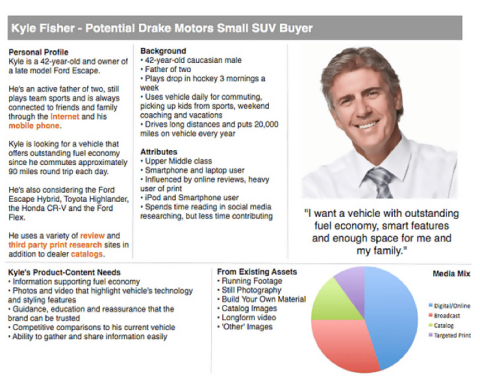
In short, a persona is a deliberate generalization of a group within your target customer base. The image below depicts an example of a male customer named “Kyle Fisher” who might be interested in buying a small SUV from Drake Motors.
This persona includes a personal profile of what this fictional buyer’s personal life might be like. In narrative form, it describes his background, socioeconomic information, family life, career, and current interest in buying a car. A graph lays out how he allocates his existing assets, paired with a list of his current product-content needs.
The persona carefully balances detailed information and generalized traits. It's specific enough to create helpful content and campaigns that resonate with target audiences, yet sufficiently general to cast a wide net when it comes to using an advertising budget.
A persona lets a marketing professional walk in the shoes of potential buyers they wish to understand, support, and influence.
The sophisticated use of personas has enabled the personalization software industry to turn relevance into a fine art.
Without personalization from personas, savvy customers in the current market will get bored with generic content and bounce from landing pages that don’t specifically engage them. They will ignore messages that fail to address their unique needs and pain points.
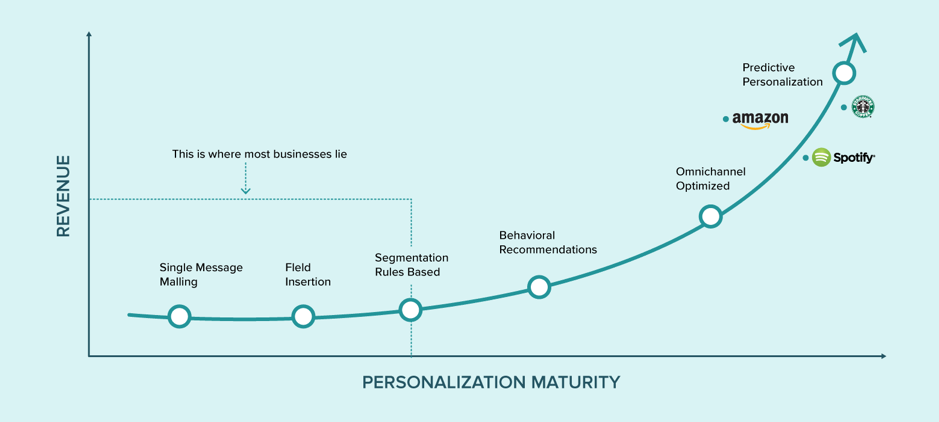
The graph below shows the correlation between personalization maturity and revenue. The spectrum ranges from the basic factors most businesses use, like single message mailing, field insertion, and rules-based segmentation.
Higher-level tactics leveraged by leading companies like Amazon and Spotify are behavioral recommendations, optimized omnichannel, and predictive personalization.
Personalization is forecasted to be a $3000 million industry by 2024. On average, customization improves email click-through rates by 14% and makes websites 2 to 5 times more engaging.
Considering how demonstrably well personas work, it’s no wonder they have been adopted by software developers, the banking industry, and fortunately HR departments as well.
Harvard Business Review has been vocal in its support of personas. It has zeroed in on why personas are such an intrinsic part of today’s agile businesses.
As the world shifts online and customer-brand interactions become almost exclusively digital, a void has developed within companies. It is extremely easy for the people powering a brand to consider their buyers and browsers as nothing more than numbers in an analytics engine.
How can you combat this trend?
Personas generate and propagate empathy by making buyers seem human, rather than just a set of metrics. They help brands tap into the hopes, fears, and aspirations of their customers.
Of any department in a given business, human resources teams need to be empathetic and focused on the human aspect of its stakeholders the most.
HR had the first brush with personas when the war for talent peaked.
As organizations started losing star performers to better pay, a two-fold need was born.
Personas have helped HR departments think outside the box. CEOs started delivering talks at universities where their ideal candidates were already enrolled, which brought brand awareness while internship programs cemented loyalty early.
Today, simply hiring the right talent is no longer enough. The “product” which HR needs to sell to its customers (namely, employees) is retention.
This realization has spurred forward-thinking organizations into action. Personas are rapidly moving from the talent acquisition department to retention and pathfinding, extending empathy from the realm of customers to the workforce.
It makes little sense to borrow personas from other brands. Use your own audience to create personas.
Instead, here are some rules of thumb that will help you identify your personas and then compile documents that let you understand workers better, guide them on their path of personal development and in the process even nurture the leaders of tomorrow.
5 Tips for Solid Employee Personas
Use each of these five tips to embrace your brand and audience together in creating employee personas to guide HR practices.
Before embarking on this journey, it’s critical to understand that the HR personas you craft won’t fully represent your ideal employees. You can always draw up a wishlist of competencies and characteristics, but a persona belongs with your talent acquisition department.
When it comes to retention, the work has to be grounded in reality.
It's important to invest in the right tools when recruiting the best talent. Prepare to dive deep into your people analytics tool, and consider objective metrics based on quantitative research.
Your timesheet tool should give you an accurate idea of your employees’ average workweek. You can easily separate staff members into cohorts. Some groups will naturally emerge that spend more time immersed in “work,” while others will be less connected to the office system.
Complement this information with the output from your performance management system. Performance reviews serve a valuable purpose by telling HR about the goals met and failed expectations.
Tap your 360-feedback management tool to assess qualitative data. This type of system is essential to have in place. While legacy information, such as the sentiments of employees on an ongoing basis, is useful, a 360-feedback polling feature can capture anonymous insights into your workforce’s goals and aspirations.
Choose your queries carefully. Asking open-ended questions lets you analyze the "lingo" of your organization. What words are your talent using to describe themselves and the company culture?
As a follow-up, re-affirm key assumptions with multiple-choice questions that are less ambiguous.
Use these principles to categorize personas rather than actually filling in the gaps. As suggested, anything aspirational from the HR perspective about hiring needs to be communicated to recruitment.
You find that some of your employees feel these ways:
Company values will give you a clear indication of:
What you decide to “name” these personas is of little importance as long as you’re not supporting biases or promoting stereotypical thinking. Don’t label the persona discussed above something like “Gen X Gerald," because some of the individuals in that cohort might actually be millennials.
Based on the size of your company, you may end up with 2 to 6 personas. Look at the characteristics of the groups you’ve identified.
Add these factors to create an employee persona:
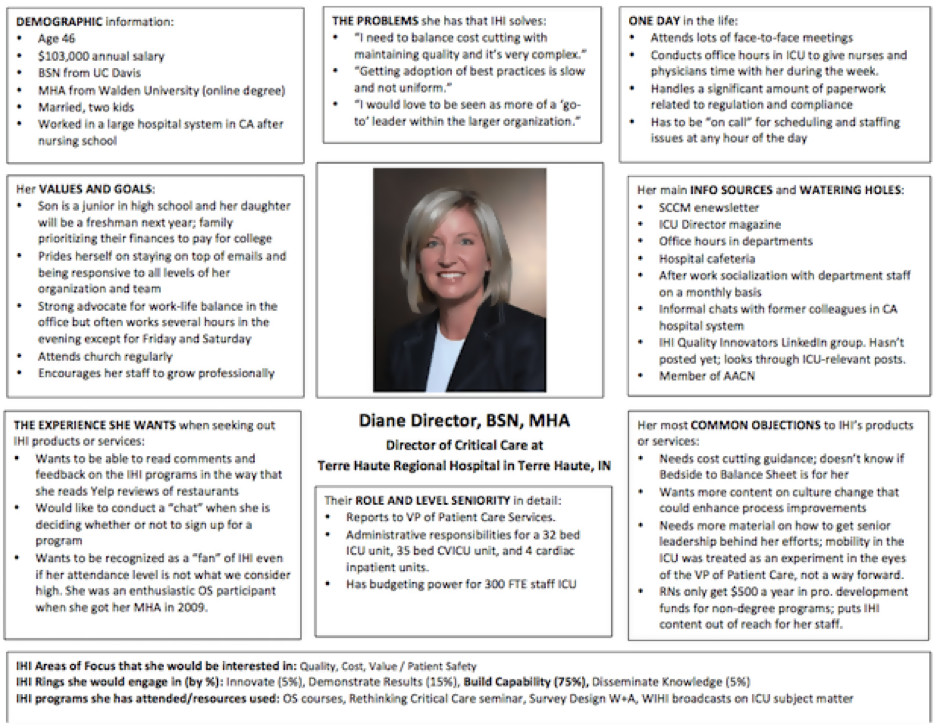
When you complete the overview, a persona should look like the example below.
This sample persona contains much more concrete data and actionable insights than the initial version presented in this article.
Do your due diligence by holding focus-group interviews with employees who can comment on your personas and answer lingering questions. Feedback sessions can test how effective your suppositions turn out to be.
Compiling your HR personas is a fascinating exercise, but your work doesn’t end when they’re complete. In fact, creating personas is just the first step.
HR personas have arrived right when they’re needed the most. In light of the internet revolution, people are connecting with others around the globe and expanding their worldviews.
The added flexibility of online work is also giving rise to distributed teams where employees share the responsibility of moving a company forward, but don’t work in the same office space.
If HR teams remain incapable of satisfying employees who prioritize how they feel through intangible indications like “quality of life” more than a base amount on a paycheck, then retention numbers will continue to plummet.
Remote work requires its own set of practices to ensure that all workers, including HR professionals, view their peers as people and not AI bots who know how to get work done.
When used consistently, HR personas can:
For example, if most personas don’t respond to email nurturing, consider removing email sequences from the onboarding process. Instead, try a more personal approach with less intensive follow-up. Deploying the AI-powered Donut solution is just one potential method to explore.
The classic HR structure has remained rigid and static for decades. It’s time to replace outdated practices with paradigms that demonstrably work better.
HR companies encourage businesses to embrace personas as a valuable tool to usher in a new age of personalized, need-based support, training, onboarding, and recruiting for both potential and current employees.
Co-founder of HR software company CakeHR that streamlines attendance and performance management for customers worldwide. Keeping a sharp eye on HR, marketing, business, finance, science, technology and the connections between them.
See full profile