
Why Hiring Fast Is Costing You More: The Case for Pre-Vetted Remote Talent
Speed-to-hire may feel like a competitive advantage, but replacement costs, productivity gaps, and re-hiring cycles show up on the balance sheet. Here's why...
Updated March 31, 2026

Did you know that employee disengagement costs businesses between $483 and $605 billion per year in the U.S. alone?
Companies that fail to monitor employee engagement are missing out on higher productivity, increased profits, and happier employees.
So, how do you gather data on the best ways to improve employee engagement? You ask the employees themselves.
Looking for a Human Resources agency?
Compare our list of top Human Resources companies near you
If you’re not sure where to begin, here are 12 tips for how HR professionals can collect and analyze employee engagement surveys.
Employee engagement surveys measure how motivated employees are to perform their best every day.
These anonymous surveys offer honest insights into employees’ attitudes toward the company’s culture, overarching goals, and work environment. They can also help identify any areas that might be holding employees back from dedicating themselves to their work.
Measuring employee engagement goes far beyond checking to see if employees enjoy their jobs. An engaged employee isn’t only satisfied with what they do but is also motivated to work hard because they care about the company. For example, the top workplace values employees consider important are companies that:
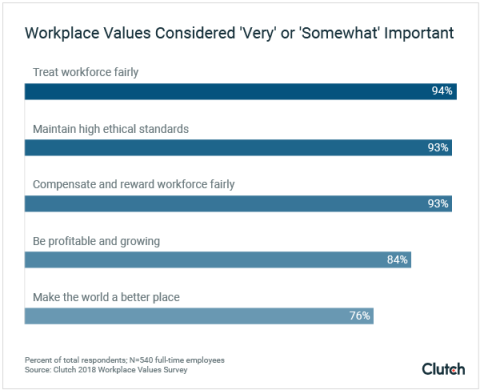
Companies with high workplace values have employees who also understand how their roles tie in with overall company objectives and strive to enforce company values through their responsibilities.
In this survey of more than 600,000 staff members from various industries, companies with high levels of employee engagement improved 19.2% in terms of operating income, while companies with low levels of employee engagement declined a whopping 32.7%.
Essentially, as employee engagement increases, so does company profitability.
When companies take action to improve engagement, they can reap the following benefits:
Once you recognize how useful employee engagement surveys are, you can begin implementing them in your company.
Check out these 12 tips for collecting and analyzing survey data quickly and efficiently.
It’s important to ask the right questions when constructing a questionnaire. Here are the top 10 questions to include:
These 10 questions all require employees to respond to a statement using a range (example: strongly disagree, disagree, neither agree nor disagree, agree, strongly agree). This spectrum of responses is known as a Likert scale. Using a Likert scale allows HR teams to gain broad insights about the team without requiring written responses.
The cost of an employee engagement survey depends on several factors, including which survey tool you choose to use for the activity and the size of your company.
However, it’s estimated that conducting an employee satisfaction survey costs between $3,000–$10,000. On the higher end, surveys of this nature cost up to $15,000.
It’s up to the human resources team to measure employee engagement to collect honest employee feedback. These 12 steps to conducting employee engagement data analysis will help team members and respondents communicate openly with human resources professionals to create a better workplace environment together. The ultimate goal of this process is to establish improved action planning and employee morale.
Whether you’re aiming to qualify overall satisfaction with leadership or measure the performance of a new company initiative, getting the answers you need begins with defining your focus area.
Home in on specific aspects of the company as opposed to a hodge-podge of all the above, and you’ll be able to collect actionable insights.
If this is your first employee engagement survey, consider it a rough draft that you can add to as you gather data continually.
If this isn’t your first survey, consider whether the information you garnered in the past was actionable. For instance, if you only received a simple “yes” or “no” response for whether employees felt motivated day-to-day, ask yourself how you can add detail to gain the information you need.
Some focus areas for effective employee engagement surveys include:
Determine what you want the employee engagement survey to focus on to collect the best insights possible.
The goal is to gather actionable feedback, not to confuse or exhaust your employees. For that reason, aim to keep survey questions as simple as possible.
For example, if you’re surveying for company culture, don’t ask the question: “Do you feel there is a good level of energy shown by positive staff members who show that the organization cares about delivering a quality outcome to customers?” These are two separate questions.
Instead, break this longer question apart by asking
Breaking these thoughts into two questions allows employees to provide clearer answers and helps you analyze data quicker. Additionally, simple questions will decrease any perceived barriers to entry surrounding the survey. This will encourage more employees to fill it out, increasing the response rate.
Hand-in-hand with keeping questions simple is not over-explaining why they’re there in the first place.
If you’re asking a question about an employee’s intention to stay with the company, there’s no reason to include information about turnover rates or potential for career growth. This could influence the integrity of responses and limit the amount of honest feedback you receive.
Instead, keep fluff to a minimum. Although you might run into questions that require a bit of context, it’s best to keep questions as straightforward as possible. This will ensure that employees remain focused on the question at hand and gives them a chance to explain their point of view.
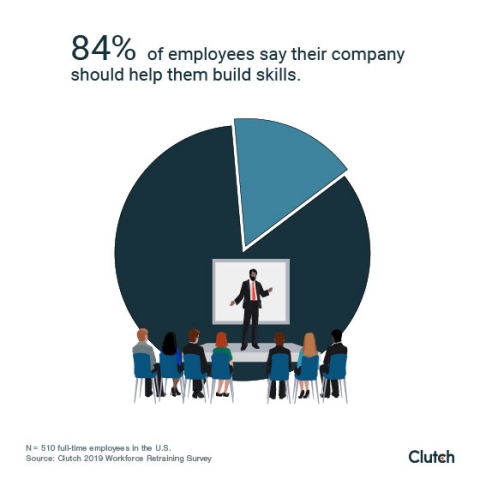
For example, 84% of employees say their company should help them build skills. If you ask about skill-building in your survey, let employees explain what skills they want to build on the job — rather than just guessing for them.
Remember, the purpose of an employee engagement survey is to learn what employees have to say, so do your best to leave your two cents out of it.
Though using a cohesive five-point scale makes it easier for you and your employees, you should include at least one open-ended question about where improvements can be made.
This provides an opportunity for your employees to express their full opinions about their work environment and overall motivation.
For example, if you’re asking how satisfied employees are with the company culture, an average grade of “neutral” or “satisfied” instead of “very satisfied” will result in several unanswered questions.
Follow these types of questions with an open-ended inquiry asking what improvements employees want to see or what they feel is distracting from company culture.
Many employee engagement surveys use a five-point grading scale for responses, such as “Strongly Agree to Strongly Disagree” or “Very Satisfied to Very Dissatisfied.”
Pro tip: If you choose to incorporate a scale into your survey, be sure to keep it consistent. Switching between different scales can confuse employees and runs the risk of inaccurate answers.
Additionally, using a cohesive grading scale improves survey function and allows for easier data analysis. You can directly compare ratings for each response as opposed to sifting through varying response types, saving a considerable amount of time per question.
How employees perceive their role depends on multiple factors. To gauge employee engagement levels, you must consider how multifaceted the employee experience is.
Remember that no answer is black and white, regardless of your focus area. Identify this gray area by considering a wide range of variables.
If you’re surveying for employee satisfaction, remember all that goes into their day-to-day routine:
Employees’ satisfaction goes hand-in-hand with their experience at your company.
A driver’s analysis dives deep into what motivates your employees on a personal level. This will identify which survey items have the greatest impact on overall engagement.
Consider these possible drivers:
By analyzing the responses to these drivers, you can discover what your employees view as an incentive to work hard. You might discover that those who view growth as a driver are more inclined to be highly engaged. Alternatively, you might find that there’s a lower correlation between recognition and overall engagement.
Either way, you can use this feedback to understand what motivates your employees and implement programs that target this motivation.
Managers intimately understand the challenges their teams face. Turn to them when composing questions about their work environment and duties to identify areas that need improvement.
Once surveys have been collected, encourage managers to review the results themselves and discuss them with their teams. Not only does this encourage transparency within departments, but it also promotes cross-team brainstorming to develop new ways to improve engagement.
Once you’ve analyzed initial employee engagement results, create opportunities for employees to suggest and implement changes.
Including employees in the process shows them that their opinions matter to you and the company. Providing a safe space for them to voice their concerns and gather feedback from peers goes a long way toward driving engagement.
Try introducing town halls or listening sessions about areas that could use improvement. Listen to what workers have to say, then aim to implement solutions.
One great way to handle this is to conduct pulse surveys. A pulse survey is a frequent, short engagement survey that measures worker impressions of a company in real-time. This type of survey indicates to employees that you’re taking their responses seriously and are actively trying to improve in the immediate term.
By the time you’re crafting your next survey, you’ll have a better idea of what to focus on and where to improve.
You know firsthand that your company differs from department to department, from leadership to management, and from location to location.
Several different factors can determine employee well-being and work-life balance, including:
These factors are drivers of employee engagement. This is why we recommend segmenting your results to make collection and analysis easier.
Once you separate results by department, you might discover trends in engagement or notice that some teams are more engaged than others. Not only can you analyze this data much quicker on a team-by-team basis, but you can also get a glimpse of what’s making certain departments tick.
What’s the finance department doing that’s driving engagement? What incentives do they offer, or how do they optimize their work environment? Determine if you can leverage these tactics in other departments to increase engagement company-wide.
Your baseline data serves as a benchmark for quantifying the effectiveness of new initiatives. It identifies where you currently stand in terms of engagement.
Compare the results of each new employee engagement initiative, such as focus groups or committees, to this benchmark.
The more frequently you administer surveys, the easier it will be to identify areas of improvement.
There’s no point in keeping survey results a secret, especially if you’ve found awesome metrics for engagement or positive sentiments about the company.
If you make the positive results of your engagement survey a topic of ongoing conversation, you’ll foster the belief that this is a sustainable part of your culture.
On the other hand, if you’ve discovered some less-than-desired metrics, it’s still worthwhile to bring them to everyone’s attention. (One of the best ways to package this data is in a PDF. Here’s a PDF editor that can help you do this.)
That way, you can begin to make improvements. After you start to make improvements based on the survey responses, it’s important to follow up regarding your changes as part of your engagement strategy.
Conducting an employee engagement survey is one of the most straightforward ways to gather feedback from your employees.
To speed up the process and efficiently analyze results, incorporate these tips into your next survey.
Need support with running an effective employee satisfaction survey? Hire a top-rated HR agency.