
The Real Cost of Your MVP in 2027
AI made code cheap, but not software that holds up. See how MVP cost drivers have shifted and why human validation and taste are now what you’re really...
Updated March 19, 2026

AR and VR technology is growing in popularity and usage. Companies that leverage immersive technology are positioning themselves for future growth. Here’s what you need to know to budget for your own AR/VR development project.
According to a recent Clutch survey, 58% of consumers have used either augmented reality (AR) or virtual reality (VR) before making a purchase, making AR/VR a worthwhile investment for brands looking to boost engagement, grow brand awareness, and increase conversions.
However, some business leaders are hesitant to develop immersive experiences because they’re unsure how much it costs or what should really go into their AR/VR development budget.
Looking for a Software Development agency?
Compare our list of top Software Development companies near you
The virtual reality app development process is highly technical, and companies aren’t likely to have VR software development knowledge in-house to take on the project themselves.
From this perspective, working with a virtual reality development company is often the more cost-effective, stress-free solution to a daunting project. However, hiring development services isn’t necessarily a walk in the park. When it comes to managing VR app development costs, a thought-through budget is a must-have.
Whether you’re a startup looking to create a VR game or a healthcare company aiming to enhance education with a virtual environment, this guide will walk you through creating a VR development budget step by step.
According to data from Clutch, most AR/VR development companies charge between $25-$49 per hour for their work, with total project costs typically ranging from $10,000 to $49,999. However, those prices can range depending on your industry, the scope of the project, and the platform the experience will be launched on.
To get a better understanding of how much it costs to hire an AR/VR development company, check out Clutch’s AR/VR Pricing Guide.
When setting up a VR application development project, there can be seemingly countless expenses. However, the costs shouldn’t overwhelm you if you know what to expect. Keep the following categories in mind when building your budget to get a high-quality end product.
The purpose of VR technology is to provide immersive experiences that mimic and enhance those of the real world. While VR is especially popular in the gaming industry, video games are far from the only useful place for VR within a business.
Companies undertaking a VR development project may not be familiar with the process, which can make budgeting stressful. However, there are easy steps you can follow to achieve an accurate budget.
Having goals early on in the project will not only help you guide your service provider in the right direction, but it will also set you on a clear path forward internally. This is essential to your budget.
At this point, sit down with relevant stakeholders and determine VR projects objectives. A project with the goal of employee training will need different tools and approaches than a solution for architectural visualization.
Having project goals like these in mind will guide the project and, therefore, the budget.
The technical needs of a VR project are a huge driver of end cost. They play a role in determining the complexity of the work and expertise needed to complete it.
While it’s not expected that you know everything about VR software and associated platforms going into the project, it’s good to have a general idea of how different tools will work together to yield the product you’re looking to create.
The main types of tools that you’ll likely need to account for in your dev budget include the following:
Each type of technical requirement is critical in figuring out an ideal budget for prototyping, development, and deployment.
Now that you’re familiar with the tools and technologies needed to produce VR solutions, now it’s time to begin accounting for the cost of the development work that your outsourced business service provider will carry out.
Costs that will come up when you’re evaluating the cost of the development process will include:
Content creation is where backend development and architecture become front-end design, graphics, and animation.
Technical expertise is needed to create 3D models, animations, and photorealistic graphic rendering. Understand how extensive your animation and graphics work will be to get a good idea of how much support you’ll need for it.
3D interactive animations are a hallmark of VR products and must be budgeted for as such.
Testing is incredibly important in ensuring your product is safe, engaging, and otherwise works as it should.
Your testing team can save your credibility for high-quality solutions down the line by ridding work of bugs and errors.
Testing occurs across the solution but can be broken down into the following areas for the sake of proper budgeting:
Remember, VR development doesn’t terminate once a product launches. Following the release of a new app, companies are expected to maintain engagement and relevance by updating the app.
Updates over time cost additional money, but regular bug fixes and optimizations will keep the VR application functional and current over time. This makes your solution more sustainable.
Generally, companies are able to work with the same service provider via retainer to handle ongoing needs for a monthly fixed price.
No one expects their project to hit bumps in the road that delay production. However, unforeseen circumstances and scope creep are very common, even for businesses that plan and budget well.
When a project starts to get a little out of control, a contingency fund ensures your budget stays within your control. Allocating a fund of about 15% of the cost of the VR project will give you just the amount of buffer and wiggle room you need to remain confident in the face of issues.
A well-planned budget is a major player in the success of your project, and this preparation includes expecting the unexpected.
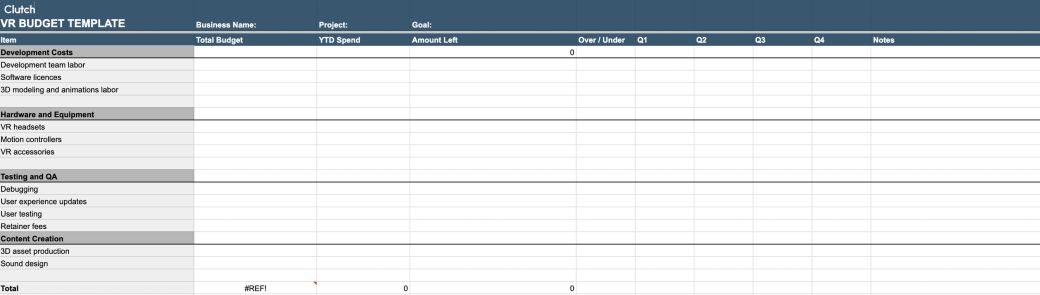
Download our VR Development Budget Template.
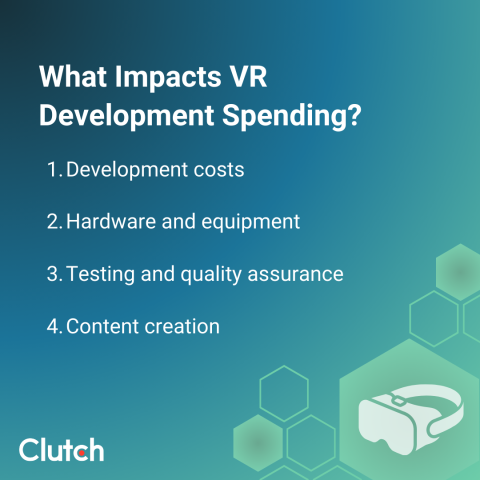
VR development costs can vary significantly from project to project, but there are a few key main factors that drive changes in budget.
While there are many things that will sway costs, important repeat offenders include the following:
While VR can come across as very expensive, budgeting correctly can make this technology accessible to businesses of all types and sizes. A healthy budget will include the expected spending for development, hardware, software, and testing.