
12 Years With Clutch: How Intuz Builds on a Partnership That Delivers
A Relationship That Has Stood the Test of Time Intuz is an AI consulting and development company established in 2008, with operations in Silicon Valley...
Updated March 24, 2026

Growing your SaaS business goes far beyond structuring a strategic plan. Success in business growth is based on applying specific strategies for each element planned to ensure the desired growth - or even exceed the goal.
SaaS companies have many business peculiarities, so it is common to consider some guiding pillars of the business, which we will address in this article, sharing some important conclusions that can drive SaaS growth through strategic technological development.
Measuring the growth of Software as a Service is critical to evaluating progress and ensuring continued business success. One technique that yields good results is to segment the process into five basic stages: acquisition, activation, retention, referral, and revenue.
The performance of each stage and its impact on the overall expansion of the SaaS business requires specific evaluation tools. Key performance indicators include:
I've created a list of 4 SaaS growth strategies to help you improve these metrics in your next planning.
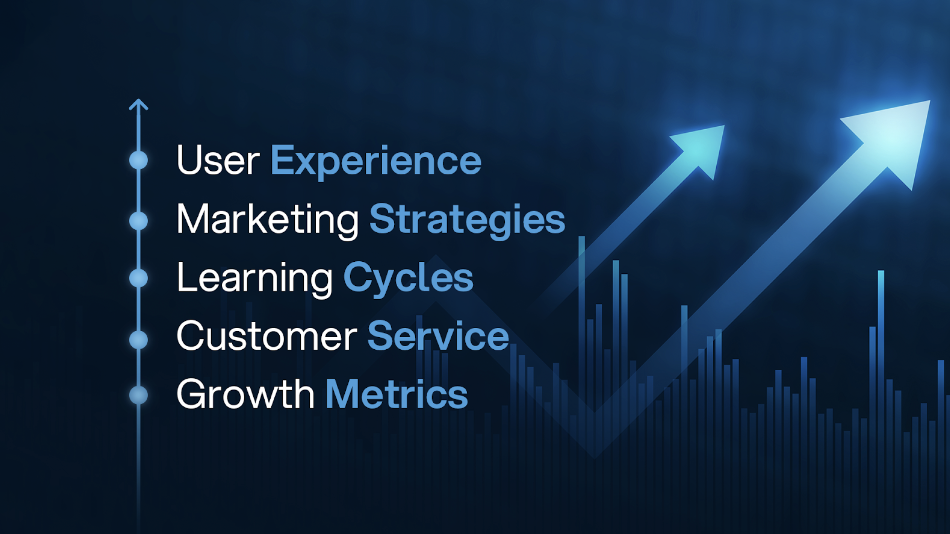
The user experience is a key strategy that should always be improved. Customer satisfaction is especially important when it comes to SaaS. By actively refining products based on user feedback and leveraging data-driven insights, you can deliver solutions that largely meet user expectations.
By understanding and addressing the needs and pain points of the audience, companies can build strong relationships that drive loyalty and sustainable business growth.
Lead generation and customer transformation is a process that requires the use of marketing strategies, the most important of which are:
To achieve this growth, you need specialized professionals in the sales field, and your product's promotion is no different. You can create a detailed marketing plan, set goals and OKRs, and allocate the optimal capital to each strategy. Keep operations and resources on track.
An agile marketplace requires agile skills. In the SaaS landscape, constant change is part of innovative solutions. Therefore, the business process must be innovative, agile, and adaptable to new features and functionalities.
The best way to achieve this is to collaborate with customers through intelligent communication. Agile methodology, such as the famous Scrum, is widely used to achieve this goal. This technique implements constant customer interaction, organized in sprints, which are periods limited to about a month, in which an incremental version of the product is developed. Scrum is an excellent way to gather customer feedback and validate your project.
In addition, this methodology allows all professionals to be involved in all stages of the idealization and development of the project so that the project requirements can be met in full alignment with the customer.
"It costs 5 to 7 times less to retain a customer than it does to acquire a new one," says Philip Kotler, a renowned marketing expert. This vision is even more definitive when discussing B2B companies because it makes business growth and revenue more sustainable.
Long-term revenue stability is ensured by customer loyalty, as loyal customers tend to boost their CLTV (customer lifetime value), make their customers happier, and generate recommendations for your business.
Some of the key retention strategies for your SaaS are:
To ensure that your company remains relevant to customers and investors in the marketplace, you must demonstrate that your business is growing. Tracking and reporting on relevant business metrics means tracking and reporting. Retention rates, monthly number of customers interested in the product, activation rate, number of active users, customer acquisition cost, customer lifetime value, and a brief summary should be included in the list.

These techniques will help you create a high-performance product. It is important to remember that there is no secret formula or recipe; you need to analyze your scenario and understand how these strategies can be adapted to the needs of your business.
The path to SaaS growth is built with innovative and collaborative teams that can leverage data analytics and adopt agile development methodologies.
By investing in scalable infrastructure and prioritizing a seamless user experience, companies can position themselves for sustainable success in the competitive SaaS environment.