Lead Quality vs. Lead Quantity: Why B2B Teams Are Rethinking Their Funnel in 2026
Bigger buying committees and tighter budgets are forcing B2B teams to rethink lead quality vs. quantity. Here's how top teams rebalance the tradeoff in 2026.
Updated September 17, 2026

Several factors should be taken into account when pricing your agency’s content services such as offering content as part of other services, pricing according to your client’s requirements and budget, and delivering content according to a schedule.
To price content services, agencies choose a pricing model — per word, hourly, per project, monthly retainer, value-based, or a credit/subscription system — and set rates based on their cost of delivery, the client's budget, and the value the content creates. The most important decision isn't what to charge but how to charge, because the model shapes your margins, your client relationships, and your ability to scale. This guide covers the main pricing models, current 2026 benchmarks, and the cost factors that determine whether content is profitable — plus how AI has reshaped the whole conversation.
Getting pricing wrong carries real risk for a content marketing agency. Charge too much, and clients won't have enough budget left to succeed. Charge too little, and you devalue your work and set unsustainable expectations. The key question isn't what you should charge (though this guide covers benchmarks) but how you should structure pricing — there's a big difference.
Looking for a Digital Marketing agency?
Compare our list of top Digital Marketing companies near you
The most important principle: content is not a commodity.

Behind every blog post, whitepaper, or case study is a system of people and processes — strategy, interviews, ideation, edits, distribution, and measurement — all of which belong in your pricing model because they're part of your cost structure.
| Model | How it works | Best for | Watch out for |
| Per word | Flat rate per word (e.g., $0.20–$1.00+) | Simple, high-volume writing | Rewards length over value; ignores strategy |
| Hourly | Bill for the time spent | Audits, one-off or unscoped work | Penalizes efficiency; caps upside |
| Per project | Fixed fee for a defined scope | Discrete deliverables (a site rewrite, an ebook) | Scope creep erodes margins |
| Monthly retainer | Set fee for ongoing deliverables | Consistent, long-term programs | Undefined scope; "always-on" overuse |
| Value-based | Priced to the outcome/ROI not the hours | Strategic, high-impact content | Requires trust and proof of results |
| Credit / subscription | Clients buy credits redeemed against deliverables | Flexible retainers with variable outputs | Credit values must reflect true cost |
Rates vary widely by scope, seniority, and content type, but current benchmarks give agencies a reference point:
For buyers comparing vendors directly, Clutch's content writing services pricing guide breaks these ranges down further.
Having worked with agencies at nDash — which began as a content agency before becoming a content community platform — I've watched pricing mistakes cost real business. The biggest fall into three buckets:
The agencies that grow take the opposite approach: a content-first model with a regular cadence and value-based pricing built into structured, ongoing retainers.
How does this look in reality? Let’s focus on one example of an agency that used a credit-based system.
In this system, as part of the retainer agreements, clients purchased a set number of “credits” per month, with credit values assigned to different deliverables. For instance:
This approach set up both the client and the agency for long-term success in several ways:
Perhaps the key advantage for the agency was that the price per credit factored in all the other services that come with content creation.
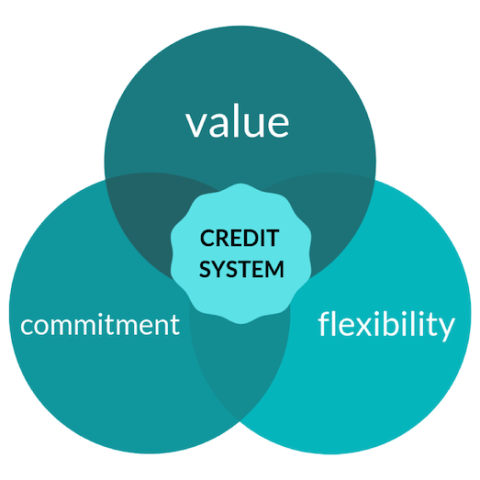
Instead of pricing credits equal to the deliverable, they were priced according to their overall value provided by the agency.
This is only one example of a system that works, but any approach that meets these key criteria will end up mutually beneficial for both your agency and your client base.
Now comes the tricky part: In order to provide content in a profitable, scalable, and sustainable way, you need to have a firm grasp on the factors that affect the cost of delivery. This includes:
Although you’ll eventually have to settle on a dollar amount (both with your costs and the client’s), it’s far more important to understand these factors before you begin selling content services.
Generative AI has reshaped content pricing from both ends. Raw drafting is faster and cheaper, which puts downward pressure on per-word and per-hour models — the exact models that price the commodity part of the work. That's precisely why the "content isn't a commodity" argument matters more now than in 2019: when anyone can generate a passable draft, the value shifts to the parts AI can't replicate — strategy, original research, expert interviews, editorial judgment, brand voice, and measurable results.
The practical takeaway for agencies: lean into value-based and outcome-based pricing, and price your process and expertise, not your keystrokes. Agencies that still bill purely by the word or the hour are competing directly with AI on cost — a race to the bottom. Those that price to outcomes are selling the thing AI can't: judgment and results.
Ultimately, the price of content comes down to how well clients understand its value. If they see content as words on a page, the price reflects that. If they see it as core to how they grow as a brand, prices are higher — and everyone is better off. Choose the pricing model that matches the value you deliver, ground it in your real cost of delivery, and revisit it as AI keeps reshaping what the market will pay for.
Start by choosing a pricing model — per word, hourly, per project, retainer, value-based, or credit/subscription — that matches how you deliver value. Base rates on your real cost of delivery (workload, expertise, volume, process) and the client's budget, and favor value-based pricing for strategic work.
Per-word, hourly, per-project, monthly retainer, value-based, and credit/subscription. Per-word and hourly are simplest but cap upside; value-based and credit systems reward strategy and scale better. See the comparison table above.
Agency hourly rates typically run $100–$250 (averaging ~$125), monthly retainers commonly fall between $1,001 and $15,000 depending on scope, and blog posts often range $150–$600 each. For a buyer-side breakdown, see Clutch's content writing services pricing guide.
Value-based pricing sets the price according to the outcome the content produces — leads, rankings, pipeline — rather than the hours or word count. It requires trust and proof of results, but it aligns the agency's incentives with the client's growth.
AI has driven down the cost of raw drafting, pressuring per-word and per-hour models. It's pushed agencies toward value- and outcome-based pricing, where the value lies in strategy, expertise, and results — the parts AI can't replicate.
Stephanie Roulic is the co-founder and head of customer success at nDash.co, the world’s first open content community platform. When she's not growing nDash, you can find her planning events for Boston's startup community.
See full profile