How Brands Make Decisions With Less Attribution Data in 2026
Brands in 2026 are making smarter marketing decisions with 40-60% less attribution data. Discover how leading teams use incrementality, MMM, first-party...
Updated January 3, 2025

After analyzing over 1,000 emails and voicemails from the sales cadences of the top 281 SaaS companies, the Process Street team identified five key factors to use when contacting your own leads.
Our team at Process Street takes inspiration from other products and marketing teams in order to improve our own. So, using the data of a fictional Vodafone employee, we signed up for the top 281 software as a service (SaaS) companies and then recorded how their sales teams contacted us.
Over 1,000 emails and voicemails later, we decided to publish everything we found (including copies of every email and transcripts of every voicemail) on Inside SaaS Sales so that everyone can benefit from the project.
Looking for a Digital Marketing agency?
Compare our list of top Digital Marketing companies near you
To give you a taste of what we found, I’ll summarize five of the key points we discovered.
It’s often hard to know just how long to keep in contact with a potential lead. Even with marketing automation software, it’s a delicate balance between the value of a potential deal and the time and effort you invest in nurturing that opportunity.
Between sales emails, voicemails, and marketing automation, the average amount of time before a company stopped contacting us (after signing up, we didn’t reply to any emails or voicemails) was 9 days.
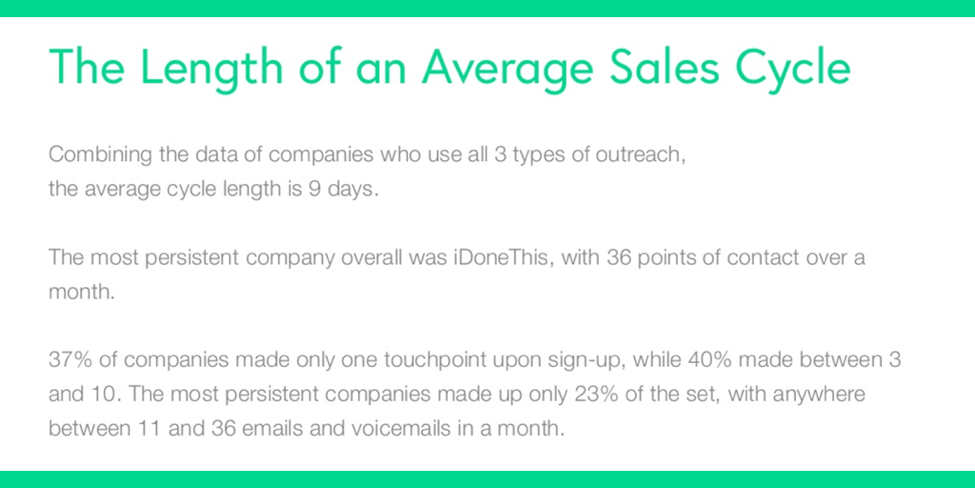
The most persistent company we found was iDoneThis, which contacted us 36 times in a month-long span.
A significant portion (37%) of companies only had one touch point upon sign-up. In other words, although staying in contact for at least a week is the industry standard to maximize your sales opportunities, you don’t necessarily have to drown your contacts in constant communication.
On average, the SaaS companies we signed up for sent one sales email every two days. This is often enough to keep you in the mind of your leads but avoids sending them too many emails and messages.
It is good to follow up, but being too eager can make a customer uninterested in your services.
Although the most common method was to send a sales emails once every two days, a significant portion (41%) of companies sent an email every day.
More than half of all emails we received were marketing emails. So, rather than sending constant sales emails designed to entice a sale, mixing in general marketing material will help get potential customers more interested in your product or brand as a whole.
This is especially true if your company owns a blog. Getting your leads to stay subscribed (or to subscribe to) your blog’s mailing list will both generate consistent traffic for your site and make leads more likely to convert in the future.
Our study showed that using MailChimp is the most common marketing automation software.
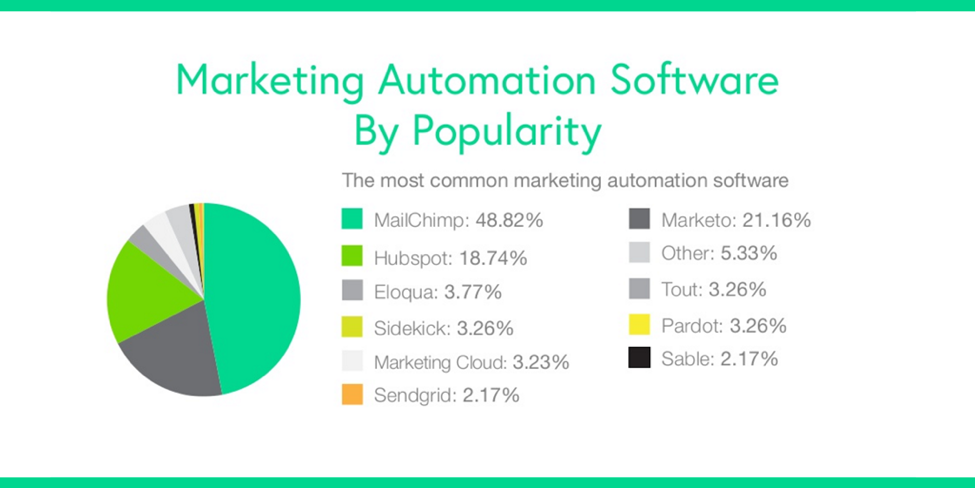
MailChimp was the software used by almost 50% of the 281 SaaS companies. Until recently, we used it ourselves at Process Street.
It’s easy to use (even if you’ve never sent a marketing email before) and has everything you need to cover and analyze a basic campaign. Setting up an automated campaign is just as simple, saving you time that can be better spent following up with your leads or creating more content.
If you’re getting started, remember that the software and approach you use is only as important as knowing when to automate email campaigns.
Subject lines are one of the most important aspects to get right in your sales emails. If they aren’t enticing, nobody will want to open your email to read the rest of your copy.
The subject needs to interest readers enough to open the email. The email copy can get the reader to click through to the blog post, product, demo, or whatever else you’re trying to promote.
So, when crafting your email subject lines, consider using one of these top five most common words we found in the emails we received:
One important thing to note is that, despite being one of these top five words, all “Re:s” we received were false because we didn’t reply to any communication beyond the initial sign-up.
This can be a good tactic; a false “Re:” implies that communication has already occurred and that the recipient is just receiving a follow-up to something they’ve already interacted with. In other words, the initial awkward interaction has seemingly passed
Email marketing (and sales emails) is a difficult practice to get right — you have to sell the audience on a particular idea without losing their interest.
If your email is too short, you likely did not feature enough information to drum up enough interest to get leads to click your call-to-action (CTA). Too long, and the lead will lose interest long before they convert (or they won’t read everything before clicking through, which can lead to false expectations).
From the data we gathered, we found that the best number of words a sales or marketing email should have is around 130:
Using about 130 words gives you enough room to concisely summarize the value that your audience will get, but there’s very little wiggle room for jargon to sneak in.
Although it’s possible that you might need to overshoot this average to convey all the necessary information to sell your offer, anything above this should make you consider editing and shortening your copy.
If anything doesn’t serve the specific purpose of the email (e.g., making them want to click your CTA), cut it. If a sentence feels long-winded or an idea takes an entire paragraph to summarize, cut it down and keep your language as simple as possible.
If you’re really struggling, try looking for jargon and filler words to eliminate.
Not every tip will work for your audience, so make sure that you’re managing your processes and tracking your results so that you can find out what works and what doesn’t.
If you want to see exactly what each of these companies sent us after we signed up, check out Inside SaaS Sales for a free SlideShare presentation, copies of every email, and transcripts of every voicemail.
Benjamin Brandall is a content marketer at Process Street, where he writes on startups, SaaS, and workflows. His work has been featured on TechCrunch, The Next Web, and Fast Company.
Benjamin Brandall is a content marketer at Process Street, where he writes on startups, SaaS, and workflows. His work has been featured on TechCrunch, The Next Web, and Fast Company.
See full profile