
How to Measure SEO Success When Traffic Declines
Organic traffic is down, but is your SEO failing? Learn which metrics show real SEO success when AI Overviews and zero-click searches are reducing clicks.
Updated May 29, 2026

Search engine algorithms are changing quickly, and so is user behavior. These practical SEO optimization strategies will help you adapt and stay visible.
SERPs have gone through drastic changes over the last five years or so. Sure, Google still has its signature white background, and Yahoo keeps mixing in ads and images. But the rise of AI and a stronger focus on user intent have reshaped the behind-the-scenes search algorithms.
Google has embraced these changes the most with AI overviews.
Looking for a SEO agency?
Compare our list of top SEO companies near you

This AI-generated content is great for users who want instant results, but many businesses are struggling to adapt and stay relevant. Instead of focusing on traditional keywords, marketers need to think about how to make content more snippet-worthy and AI-friendly. Old-school SEO just doesn’t cut it.
Plus, now that anyone can churn out hundreds of blog posts with ChatGPT, search engine results are more crowded than ever.
Sydney Wess, SEO Manager at Clutch, observes, “AI is raising expectations for velocity but also creating tons of bad content and noise.”

But that doesn’t mean your content is doomed to obscurity on page 12 of the results. Our practical SEO optimization tips will help you boost your site’s rankings and work with the AI algorithms, not against them.
While search engine algorithms are definitely changing, their major priorities remain the same. They still want to connect users with the most accessible, authoritative, and—above all—highest-quality content.
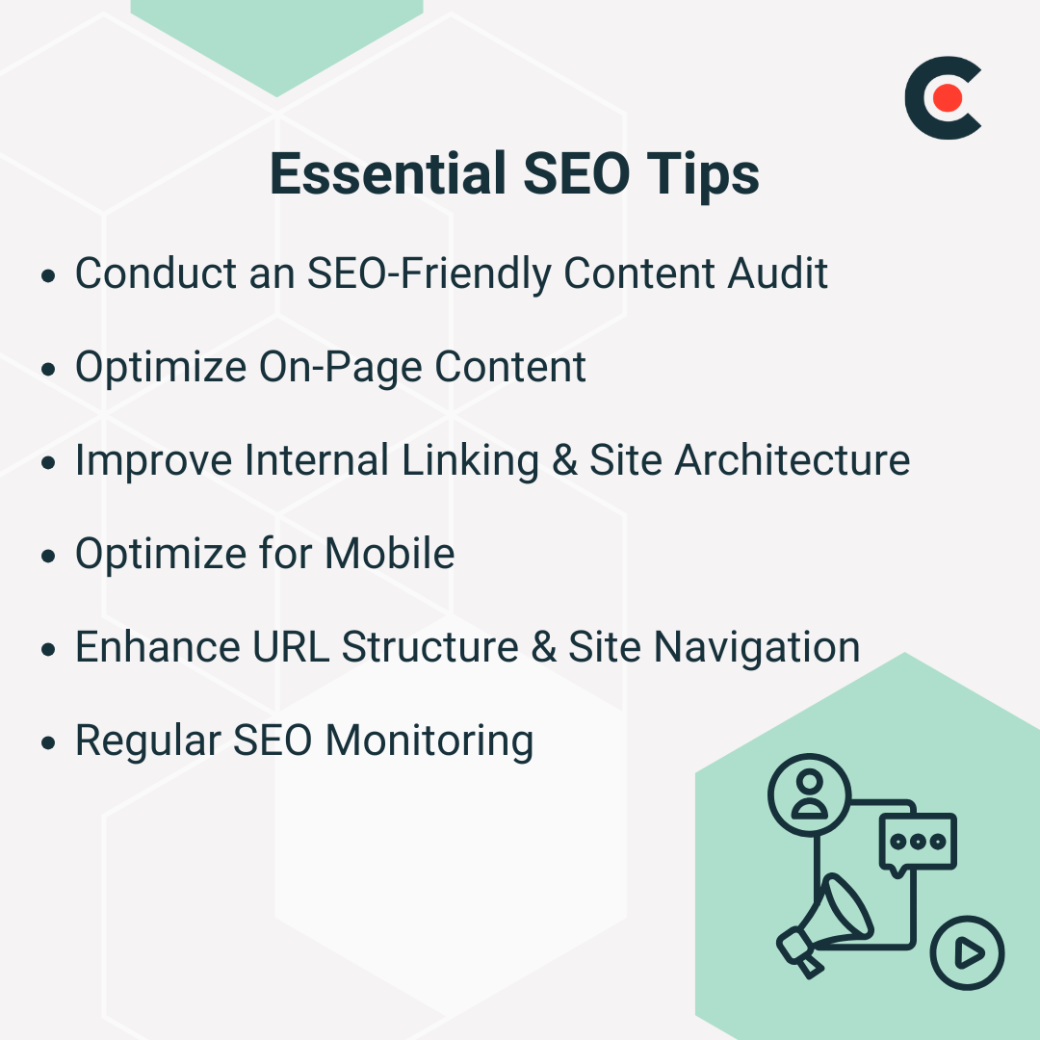
That means you don’t need to completely reinvent your SEO strategy, just modernize it. Get started with these simple but effective strategies.
Ten years ago, search engine optimization was pretty straightforward. You’d research what your audience searched for online and sprinkle relevant keywords into your content.
A few terms like “best mechanic in Jacksonville” and “affordable brake repair” were often enough to rank — maybe not #1, but in the first few pages at least.
Not anymore. “The days of simply optimizing for keywords are long over,” Wess explains. “It’s about defensibility and credibility now.”
Take an objective look at your content’s credibility and performance with an SEO audit. Here’s how:
Comb through all your content and identify anything that’s outdated, incorrect, or just not up to your quality standards. Note any gaps you find, too. For example, your blog might be missing discussions of a major industry trend from the past year.
Gathering hard data is the only way to truly understand how your content is doing. Tools like Google Analytics allow you to track web traffic, conversion rates, and other key metrics. You can also use SEO platforms — such as Ahrefs and Backlinko — to monitor keyword rankings.
With your performance data in hand, go back to your inventory and sort content into three categories:
Be honest with yourself about each piece's value. There’s no reason to keep an outdated white paper that no one downloaded since 2016 or a blog post that gets two clicks a year. By decluttering your site, you’ll make it easier for visitors to find genuinely valuable content.
The best content is actionable, well-researched, and tailored to your audience. Spruce up your site by adding updated sources and clear calls-to-action. You should also tweak or delete anything that’s not relevant to your customers.
These steps will give you a solid foundation for optimizing your site for 2025 and beyond.
Once you’ve got the right content, it’s time to dive into the nitty-gritty of SEO optimization. Warning: This process can be complex, so be patient.
Search engines consider dozens of factors when ranking content. As Wess puts it, “Everything matters, from how quickly a page loads to how well your content matches a user's intent factors into how well your content will rank and be found through different channels.”
And, of course, search engines also care about the quality of your content. Wess continues, “Google is prioritizing experience and depth, so things like internal linking, topical relevance, and trust signals (like author bios or transparent sourcing) carry more weight than ever.”
These best practices will increase your chances of getting ranked by search engine algorithms:
Start with the easiest steps first. For example, writing compelling meta descriptions and title tags only takes a few minutes per article (especially after some practice).
You can also use AI SEO tools — such as SEO.AI and On-Page.AI — to automatically optimize your site. But always carefully double-check the software’s work. Otherwise, you might end up with nonsensical meta descriptions or wonky formatting.
Organizing each individual page’s layout is only the beginning. You should also structure your entire site consistently and logically.
Create a diagram to map out your site’s layout and spot connections between pages. Group related content into topic clusters, and think about which content matters most. For example, a construction company’s website might look something like this:
Use internal links strategically to help visitors move around your site. Your services page, for instance, should link to your contact page so leads can get in touch easily. Similarly, a tutorial on painting walls might link to the main how-to guides page. That way, DIY lovers can find more articles with practical tips.
Building out your site’s architecture has many benefits. For humans, it makes your content more accessible and user-friendly. It also helps search engines to crawl and index your content. Otherwise, the algorithms might not understand the connections between your pages and choose not to display them in the results.
Plus, this process will help you spot “orphan” pages. This content isn’t linked from anywhere else on your site, so they’re basically invisible islands. Search engine crawlers typically can’t find these isolated pages, so they don’t index them, and all your content creation efforts are wasted.
Over 62% of web traffic came from mobile devices in the first part of 2025. As a result, Google uses a mobile-first indexing approach. That means it mostly crawls and indexes the mobile version of your site instead of the desktop one.
Follow these SEO optimization tips to create a mobile-friendly site:
Feeling a bit out of your depth? Consider outsourcing more technical tasks to a web developer.
Search engines factor URLs into their rankings, so don’t treat them as an afterthought. Take the time to write descriptive URLs instead of using random characters.
For instance, https://awesomesoftwarefirm.com/pricing will perform better than https://awesomesoftwarefirm.com/2u4t80u0uushohaoghoaotua.
Create a clear menu structure, too. The main menu should include all your cornerstone pages, such as “About,” “Services,” and “Blog.” You may also have drop-down menus with subpages for easy navigation.
Breadcrumbs can also greatly impact the user experience.
When you browse REI, for example, you might see a breadcrumb like this: “Patagonia / Men’s Clothing / Men’s Jackets.”

Breadcrumbs are internal links that help users understand where they are within the site and let them quickly move between levels.
Even if you follow all the tips in this guide exactly, your content probably won’t rocket to the top of the search results overnight. SEO is a long game, often taking many months to produce noticeable results.
But that doesn't mean nothing's happening. Monitor SEO key metrics at least once a month to see your progress and spot subtle changes. Here are a few areas to measure:
These indicators can help you make adjustments as needed. For example, you might notice that an article on hiking gear has high traffic, but most users spend only a few seconds on the page. Improving the formatting or adding a catchier hook could encourage readers to stick around.
Tracking your performance will also help you understand how users are interacting with your site.
“User signals like engagement rate and time on page demonstrate how your content meets their needs,” Wess explains. “Lean into your data, and create content that matters instead of chasing rankings and SERP positions.”

In other words, follow your customers’ lead and focus on the types of content that they find most meaningful instead of obsessing over whether a particular page ranks #3 or #5.
Don’t get distracted by flashy AI overviews or featured snippets. At the end of the day, creating quality content and delivering excellent user experiences is still what matters most. When you provide real value to customers and understand how SEO works, the rankings will follow naturally.
Use these SEO optimization tips to take your content to the next level and build a site that users actually want to explore.