
Task Automation: How to Cut Repetitive Work
Task automation saves time, gets work done faster, and reduces errors. Learn how to automate repetitive tasks step-by-step and how to decide what to automate.
Updated March 26, 2026

AI has moved far beyond product recommendations. E-commerce brands are using AI to streamline operations, personalize customer experiences, improve merchandising decisions, and boost profitability. This post explores the real-world ways AI is reshaping e-commerce from the inside out.
Most e-commerce brands still associate AI with one thing: product recommendations.
But the smartest companies know that AI isn’t just a marketing gimmick. It’s becoming a foundational layer across their business, impacting everything from merchandising and inventory to customer experience and operations.
Looking for a Artificial Intelligence agency?
Compare our list of top Artificial Intelligence companies near you
This shift matters. More than 80% of U.S. retailers plan to increase their use of AI across operations this year, not just for the front end but also for backend systems that directly drive margin and efficiency.
This article breaks down how e-commerce brands are using AI across the entire customer journey and business stack. We’ll explore real use cases, tools, and strategies you can implement to stay ahead of the curve.
Artificial intelligence is transforming how e-commerce retailers approach merchandising and inventory management. By leveraging AI-driven tools, businesses can forecast demand more accurately, optimize stock levels, and reduce operational inefficiencies.
Amarra, a New Jersey-based global distributor of special-occasion gowns, integrated an AI-powered inventory management system to predict stock needs based on historical data and seasonal trends. This implementation led to a 40% reduction in overstocking, enhancing efficiency and customer experience.
Here’s a look at how generative AI is being applied across key ecommerce merchandising functions.
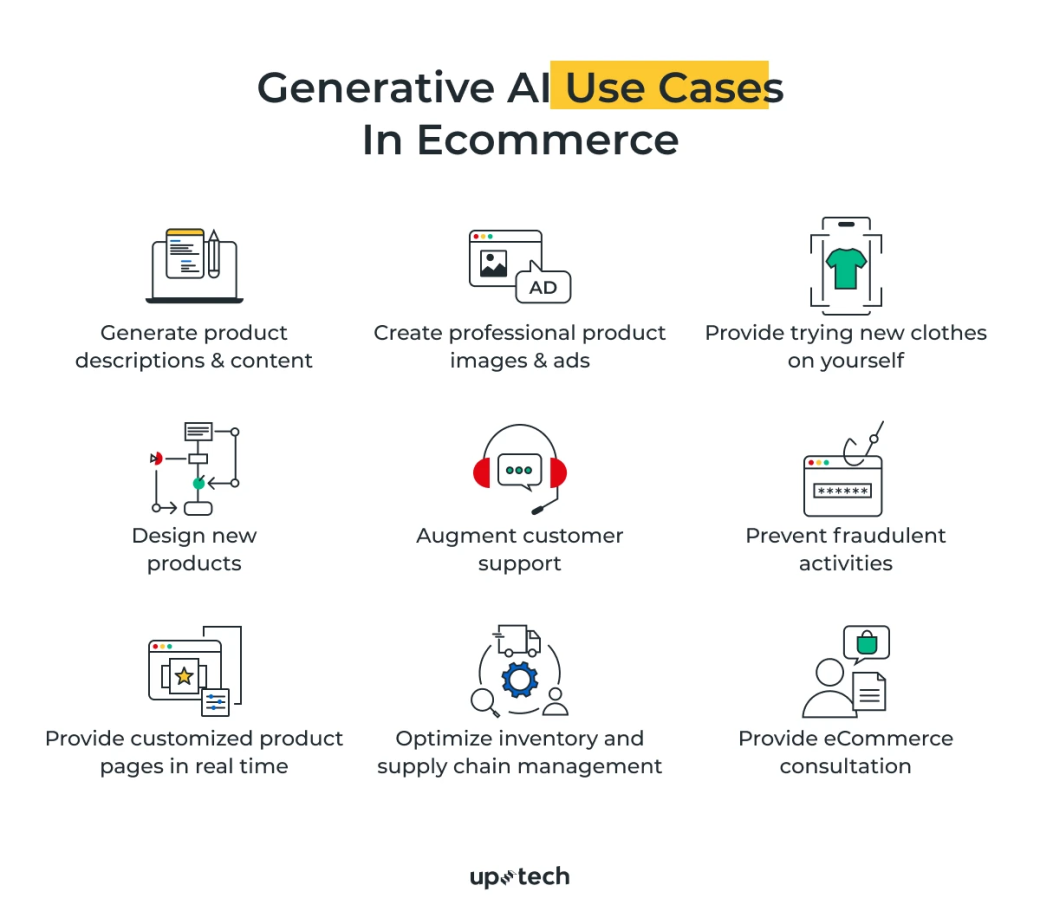
Implementing AI in backend operations has led to measurable improvements. For instance, AI integration in logistics has resulted in a 15% reduction in logistics costs, a 35% improvement in inventory management, and a 65% boost in service levels. (Gauss).
By automating and optimizing these critical functions, e-commerce businesses can achieve significant cost savings and operational efficiencies.
Here are the most common and effective applications of AI in customer experience:
These aren’t futuristic ideas. They’re already in play at top-performing e-commerce brands, helping customers feel like the experience was built around them, not a funnel.
While AI often gets attention for what customers see on the front end, some of the biggest gains are happening behind the scenes. Brands are using AI to automate support, streamline logistics, prevent fraud, and improve operational decision-making.
These backend systems are rarely flashy, but they drive real business outcomes like lower costs, faster resolution times, and better customer retention.
Here are some of the most impactful backend use cases where AI is actively solving problems and increasing profitability:
These applications create a more efficient e-commerce engine that helps brands scale without scaling headcount.
AI isn't just improving e-commerce experiences. It's driving real financial results. From better inventory decisions to automated upselling, AI influences nearly every part of the customer journey that affects revenue and margin.
Further, AI could unlock between $240 billion and $390 billion in annual value for retailers, equating to a margin increase across the industry of 1.2 to 1.9 percentage points.
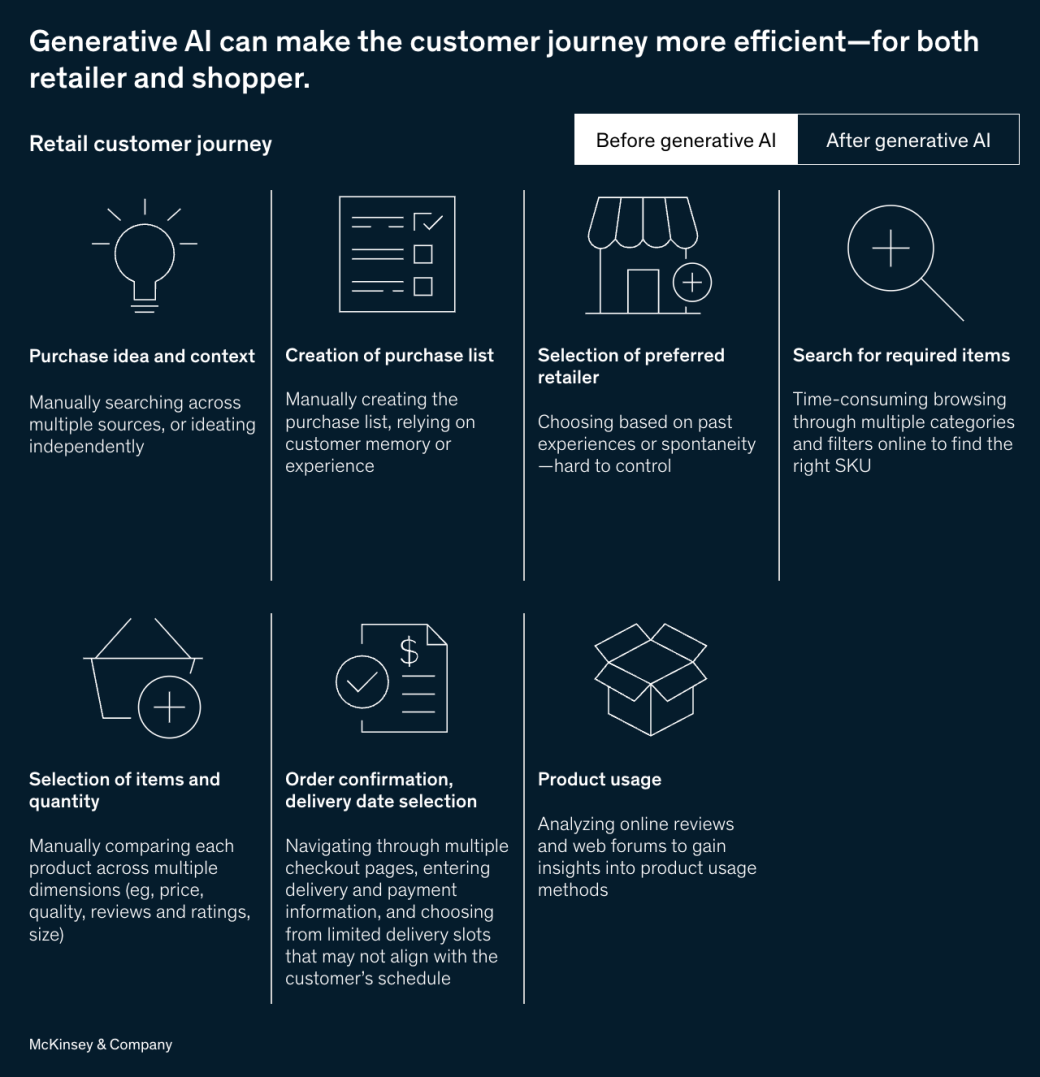
When used strategically, AI allows brands to increase revenue while reducing costs, which is a rare double win in e-commerce.
These are the areas where AI is delivering measurable improvements to the bottom line:
Brands often look to promotions or cost-cutting to improve profitability. But AI opens a different path: smarter decisions that lead to healthier margins without discounting or sacrificing experience.
If your AI strategy begins and ends with product recommendations, you're missing the bigger opportunity.
The most competitive e-commerce brands are applying AI across their entire business, not just to impress shoppers on the front end, but to build intelligent systems that scale profitably, adapt quickly, and retain customers longer.
From forecasting demand and optimizing inventory to automating customer support and personalizing site experiences, AI is proving its value far beyond marketing.
Here’s what separates brands that are scaling with AI from those just experimenting:
The goal isn’t to replace people or over-automate. It’s to build an effective, more adaptive e-commerce engine that can grow sustainably even in an evolving market.