
Website ROI: How to Measure, Calculate, and Improve Your Return
Website ROI measures the value your site generates relative to what you spend. Learn how to calculate it, track the right KPIs, and improve your return.
Updated December 18, 2025

No matter the industry, business websites, consumer-facing apps, and internal web apps are expected to deliver a distinct look, glitch-free performance, and lightning-fast load speed by default.
Even though no longer seen as something exceptional, delivering that level of experience still takes serious engineering know-how. For the majority of companies, that expertise isn’t readily available in-house, and in many cases, it doesn’t make sense to keep it in the first place.
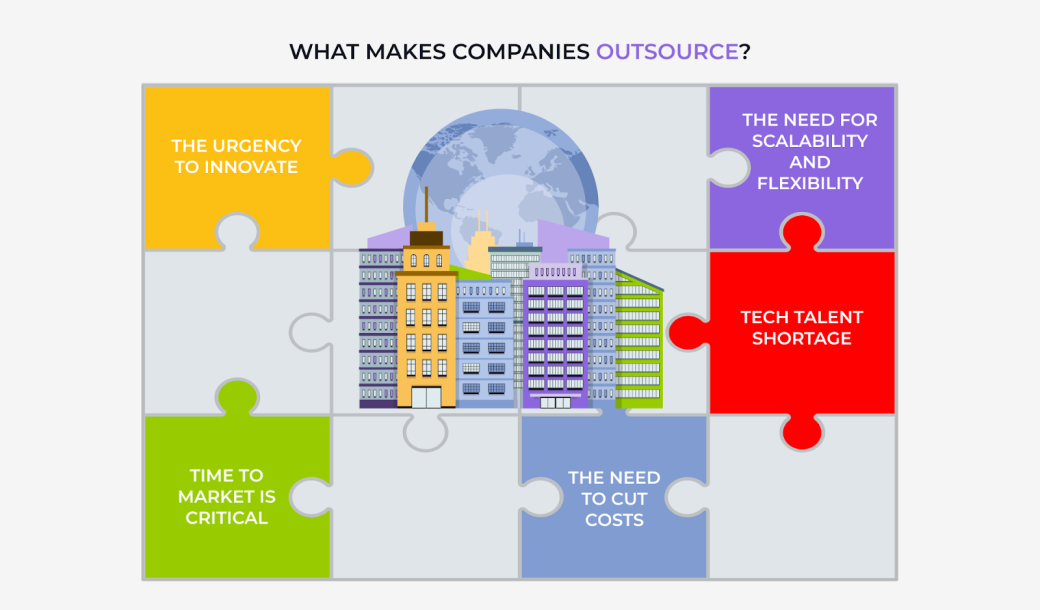
That is because outsourcing web development to external teams turns out to be a smarter choice for plenty of good reasons:
Over half of our customers say it’s all about cutting costs and having easy access to top talent. About a quarter point to their urgency to innovate. The rest just want to get their digital products live, and they want it done quickly.
By the way, our experience matches global trends — Deloitte’s Global Outsourcing Survey says web development is the top IT function outsourced, with 76% of execs going for it due to its complexity and the need for specialized skills.
Estimating the cost of development projects is never as simple as adding two and two. It’s complex due to a ton of variables you’ve got to pin down. However, for clarity, we can group them into two categories: process-related and project-related factors.
Look at the examples below, and identify what matters most to you — that’s what’ll shape the final bill.
How do you approach development?
This directly relates to the chosen approach—platform-based, low-code, or fully custom solutions—each with completely different time, resources, and complexity requirements. This decision will drive cost items throughout the entire project lifecycle.
Where is your outsourcing team based geographically?
Outsourcing to teams located in North America or Western Europe typically comes with higher rates due to the higher cost of living and salary expectations. On the other hand, teams based in Eastern Europe or Asia can offer similar expertise but at a significantly lower rate.
Do you augment your in-house team with a couple of extra hands or hire a whole cross-functional team or even set up an offshore development center?
If you opt for a cross-functional development team with specialized skills—for example, front-end developers, back-end developers, UX/UI designers, and project managers—the cost will be higher than hiring a solo developer or augmenting your in-house team. Plus, the more specialized your needs, the higher the rate.
What are the specific security benchmarks your project needs to meet?
If your web application requires robust security, it adds a layer of complexity to the development process. Meeting these demands means your outsourcing provider will need to prove its ability to build the solution that is compliant with all required standards (think HIPAA, PCI DSS, GDPR, etc.), bring in additional cybersecurity expertise, and invest in specialized infrastructure to meet even the most stringent requirements.
How complex and unique does your UI design need to be?
If you’re building a sleek, custom design with intricate animations and transitions, the design process will take more time and specialized skills of both designers and developers, translated into a higher price tag. On the flip side, using simple design elements and following standard platform guidelines can help to cut it down.
How many features are we talking about here?
The more features your web app has, the more time and effort your team will need to put in. For instance, outsourcing a simple Shopify-based app will cost less than building a custom cryptocurrency exchange platform from scratch. But it’s not just about how many features or screens your app has. If your requirements aren’t clear from the start, or if you’re working with something totally new and innovative, it’ll take more time for the team to figure things out, build, and test.
How many 3rd-party systems does your app need to connect with?
The more resource-heavy and time-consuming integrations are, the higher the costs. If your app just needs to integrate with a simple payment gateway like Stripe or PayPal, it’ll be fairly straightforward and won’t cost you much. But if you’re building a custom integration from scratch, stitching together different data formats and protocols, well, that’s another chunk of change you'll be adding to the bill.
No matter how tempting the perks of web development outsourcing may seem, the credibility and competence of your potential partner can make or break your project. Before you pick one, make sure you’ve got these essentials covered:
If the vendor is pushing back on even one of these core areas, chances are they’re not the right fit, and it’s better to look for a more reliable option.
Factors like cultural fit, cost efficiency, and mature delivery processes often outweigh the convenience of geographical proximity for on-site visits. And rightly so — there are many development hubs around the world well worth outsourcing to, namely:
To make the right geo choice faster, check out this head-to-head comparison.
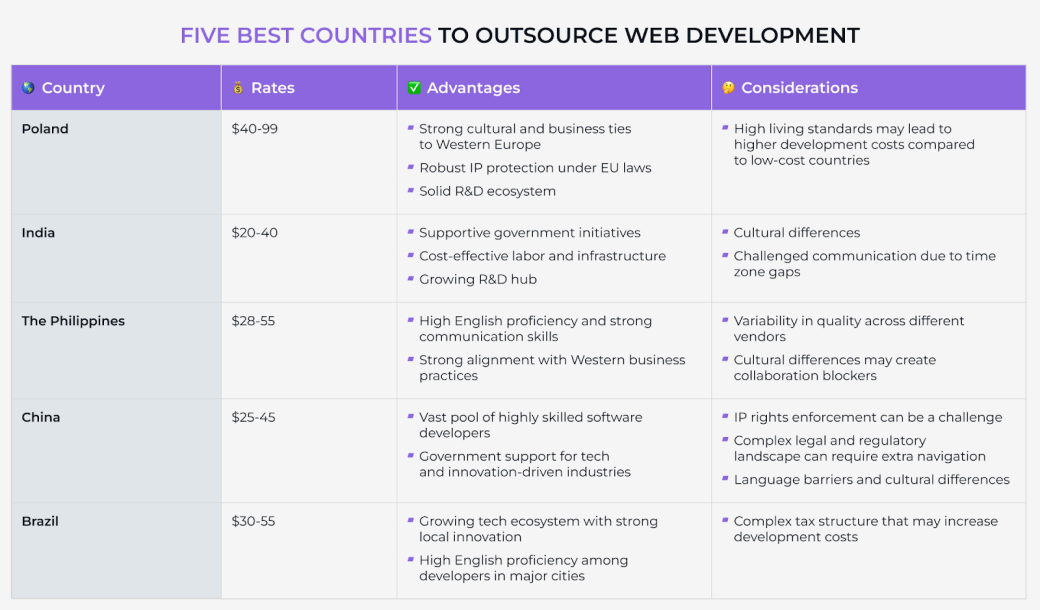
Outsourcing web development can significantly boost your project’s efficiency and cost-effectiveness. By understanding the strengths of top destinations like Poland, India, the Philippines, China, and Brazil, you can make a strategic choice that aligns with your business goals.
When done right, outsourced web development can bring significant cost savings, accelerate time to market, and facilitate innovations. With the best practices, cost considerations, and a clear view of top outsourcing regions, you’re now better equipped to make strategic, well-informed decisions.