
Why Searching for a Specialized Dev Agency Takes Longer Than It Should — And What to Do About It
Looking for a niche software development agency? Learn how to define your requirements, find specialized providers, and vet their experience.
Updated December 16, 2024

Imagine a scenario where your physical reality and digital life are seamlessly connected. This sounds straight out of a movie scene, right? Completely fictional? To be honest, that is fast becoming a reality. Welcome to the Metaverse.
What does the Metaverse mean? It is a hypothetical iteration of the internet, converging virtual and augmented realities to deliver an immersive experience. It is an interesting concept that promises to change how we interact with others through the use of AR in the Metaverse along with VR headsets.
You can create bespoke avatars that enable you to explore non-physical spaces using your imagination - without leaving the comfort of your home. For now, Metaverse is restricted to video games and social media platforms. However, that is soon expected to change.
Looking for a Software Development agency?
Compare our list of top Software Development companies near you
A potential benefit of the Metaverse is the possibility of digital identity, remote working, and decentralized governance - bringing about a positive change in society.
In this article, we will look at how the Metaverse has an impact on other fast-developing technologies such as the Internet of Things (IoT).
Interested in working with an IoT professional to better understand the metaverse's implication on your business? Find a seasoned professional today.
First introduced in 1999, IoT refers to a giant network of physical objects - such as voice-activated speakers, sensors, and thermostats - connected over the internet.
Common examples of IoT include healthcare assets like medical devices, everyday household items such as light bulbs, and smart cities. Now, the IoT is set to transform the Metaverse by seamlessly connecting the 3D world to many real-life devices.
It is predicted that IoT will minimize one of the most significant challenges faced in the Metaverse, i.e., mapping data from real life into a digital reality in real-time. IoT’s primary role would be to bring the physical world into the digital realm.
Contrary to popular belief, the real MVP in the Metaverse is Augmented Reality (AR), not Virtual Reality (VR). There will, obviously, be a need for more advanced IoT layers architectures in the Metaverse and its immersive virtual environment.
IoT in the Metaverse can help create a digital twin of people - the bespoke avatar mentioned earlier - to connect our physical and virtual worlds.
Already touted as each other’s technology twin, IoT and the Metaverse have set responsibilities. For instance, IoT will enable Metaverse to analyze and interact with the physical world. On the other hand, the Metaverse will act as a 3D user interface for IoT devices.
Together, they will deliver optimal user experiences and help companies make data-driven decisions without much hassle.
There is no doubt in our minds that IoT usage, essential to digital transformation for businesses, is growing exponentially. One of the major benefits of IoT is how it manages data, which, in turn, is fundamental to creating digital twins.
A digital twin is a virtual model that accurately reflects a physical object. For instance, if that object is a wind turbine, it is fitted with various sensors related to vital functionalities.
The sensors produce data about different aspects of the physical object’s performance, such as weather conditions, energy output, temperature, and so on. The data is transmitted to a processing system and applied to a digital copy.
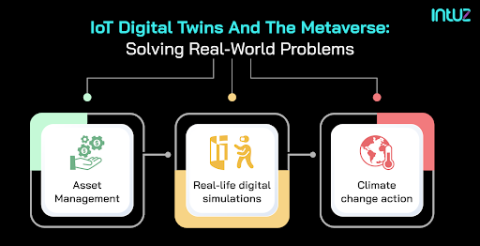
Here is what we can expect from IoT digital twins when it comes to solving problems in the real world and the effect of IoT on the Metaverse:
A digital twin simulates the product's design and showcases how the product will perform throughout its lifecycle. As such, its use is intertwined with AR and VR. However, that is about to change really fast.
IoT-powered digital twins are set to serve as an asset management environment, essentially a centralized hub for visualizing, accessing, and analyzing equipment performance data that enables non-hierarchical grouping of sensors and their data in real-time.
The Metaverse is rightly the place where IoT digital twins come together to party. No, seriously! Firstly, the idea that virtual scanned objects in the Metaverse are digital twins is a major misconception and should be totally debunked.
A scanned object may be similar to a digital twin. However, it does not become a digital twin unless it is assimilated within accurate metadata and live data feeds from sensors. The Metaverse requires us to link a physical object in a digital form with overlaid data.
The arrangement will allow for complex simulations to happen. That is how the IoT digital twin and the Metaverse technologies will work together:
IoT will soon be instrumental in monitoring and optimizing sustainable power use. As the global reliance on wind and solar power is on the rise due to increased government funding and regulation, there is a need for decentralized energy generation.
Unfortunately, most electricity grids are not designed to handle that, congesting grids sooner rather than later and blocking the growth of renewables. That is where IoT digital twins can provide grid operators the information needed to make and keep the networks stable.
The digital twins rely heavily on real-time data transmitted to IoT platforms, which are connected to solar panels, weather sensors, grid systems, and battery management systems. That is how the core technologies of the Metaverse plan to minimize the brutal impact of climate change.
The Metaverse is coming; what is it going to look like? These five Metaverse examples give you precisely what you need to know:
Omniverse™ is the AI tech company NVIDIA’s attempt to build a creative multiverse platform for 3D design professionals. Its core technology is developed by Pixar, the animation studio that also created the Universal Scene Description (USD) language, enabling 3D environments and objects to become portable across toolsets.
Omniverse™ allows the characters to be designed collaboratively, complete with clothing designers, facial animators, and other creatives. As the 3D environments become increasingly detailed and real-life-like, Omniverse™’s creative framework will come in handy.
Sandbox is a game that has garnered much attention due to its illustrious player base. Popular celebrities such as DeadMau5 and Snoop Dogg can be found within the system. What is more - brands like The Smurfs have stakes in the game.
Similar to other Metaverse games, Sandbox also has a lot to do with the community, and its core aim is to give freedom to its users. That means the players can create their games within Sandbox and monetize them.
One can build 3D items, vehicles, characters, or anything else they can think of and mint them as NFTs. Transactions are carried out in the platform’s currency called SAND. Many brands have established their presence in the game, including PwC, HSBC, and Paris Hilton.
Decentraland stays true to its name, and is a merger between a marketing channel, a game, and an experiment in designing a digital and decentralized currency. In other words, Decentraland is a trustworthy web3 platform.
Governed by the Decentralized Autonomous Organization (DAO), it is home to some of the biggest global brands, such as Coca-Cola, Samsung, Morgan Stanley, and Adidas. Its cryptocurrency, MANA, helps create an economy with artists and real estate.
Created in 2006, Roblox, the online gaming platform, only became popular in the second half of the 2010s. It follows a free-to-play model and has its virtual currency called Robux. The primary reason why Roblox stands out is that it gives leeway for user-generated content.
That means users can create their games and not just play the games offered by the Roblox company. It targets the young audience, and companies such as Nike, Gucci, Vans, and Ralph Lauren have set up custom virtual worlds where users can interact with their brands. With expanded VR support, Roblox will only become more prevalent in the coming years.
A product of Meta Quest, a Facebook-owned subsidiary that makes VR headsets, Meta Horizons, promises to change how social interactions take place in virtual reality and the Metaverse. So far, the project has led to Horizon Workrooms (virtual office), Horizon Venues (events platform), and Horizon Worlds (a virtual worlds platform).
All three platforms are interconnected and allow users to develop avatars representing them as they explore and interact with other users. Horizon Worlds is similar to Facebook as it enables socialization.
No, seriously - you can hang out with up to 20 people at a time in the Metaverse. Moreover, you can easily invite your friends or family to be a part of your virtual world.
We live in entertaining times, and watching how the Metaverse will evolve is rather interesting. Technology, after all, has the potential to shrink the world as we know it and digitize and transform it in ways we cannot even imagine! Plus, the use of IoT in the Metaverse is only going to accelerate digital adoption and transformation.
Additional Resources: