Evaluating an Marketing Agency in the AI Search Era
AI search has completely changed how people interact with online content. When an AI summary appears at the top of search results, Google users only click a...
Updated May 25, 2026

The best ways for leveraging credibility differ throughout the buyer journey. When a prospective client first notices your brand, it’s about authenticity through thought leadership, social proof, and brand voice. In the middle, trust builds through case studies, demos, and consistent communication. At the bottom, conversion hinges on guarantees, ROI proof, and human connection.
Since the online landscape is hyper-connected and tech-saturated, buyer journeys are no longer linear. Instead, they've become research-driven expeditions, bouncing from one touchpoint to another, often back and forth between different stages of the traditional sales funnel. Prospects casually explore solutions at the top of the funnel. In the middle, they narrow down contenders, and at the bottom, they prepare to engage.
While their motivations may differ at each stage, one element remains consistent: the need for brand credibility.
In sales and marketing, credibility is about more than trust. It's tangible proof that you know what you're doing and that your solution works. It may take the form of certifications, industry recognition, customer reviews, or case studies.
This article explains how to build a funnel that leverages credibility to enhance its effectiveness, layering social proof and trust from the first impression to the final pitch so prospects not only see your marketing but also believe it.
At the top of the credibility marketing funnel, your goal is to earn attention. You're opening doors rather than closing deals.
The prospects may not know you yet, or they may not fully understand their problem. They're just scanning or exploring quietly. The online space, especially marketplaces, where 30% of all online searches for a product begin, is filled with overused sales language and recycled content.
To stand out, you need to be authentic. Your goal is to signal credibility through value-driven content and relevance. You also have to make the prospects aware of your offering and how it helps them.
The prospect's current mindset is exploratory since they're in the early stages of their decision-making process. You're not yet proving that your product is the best, but letting them know that your voice is worth listening to.
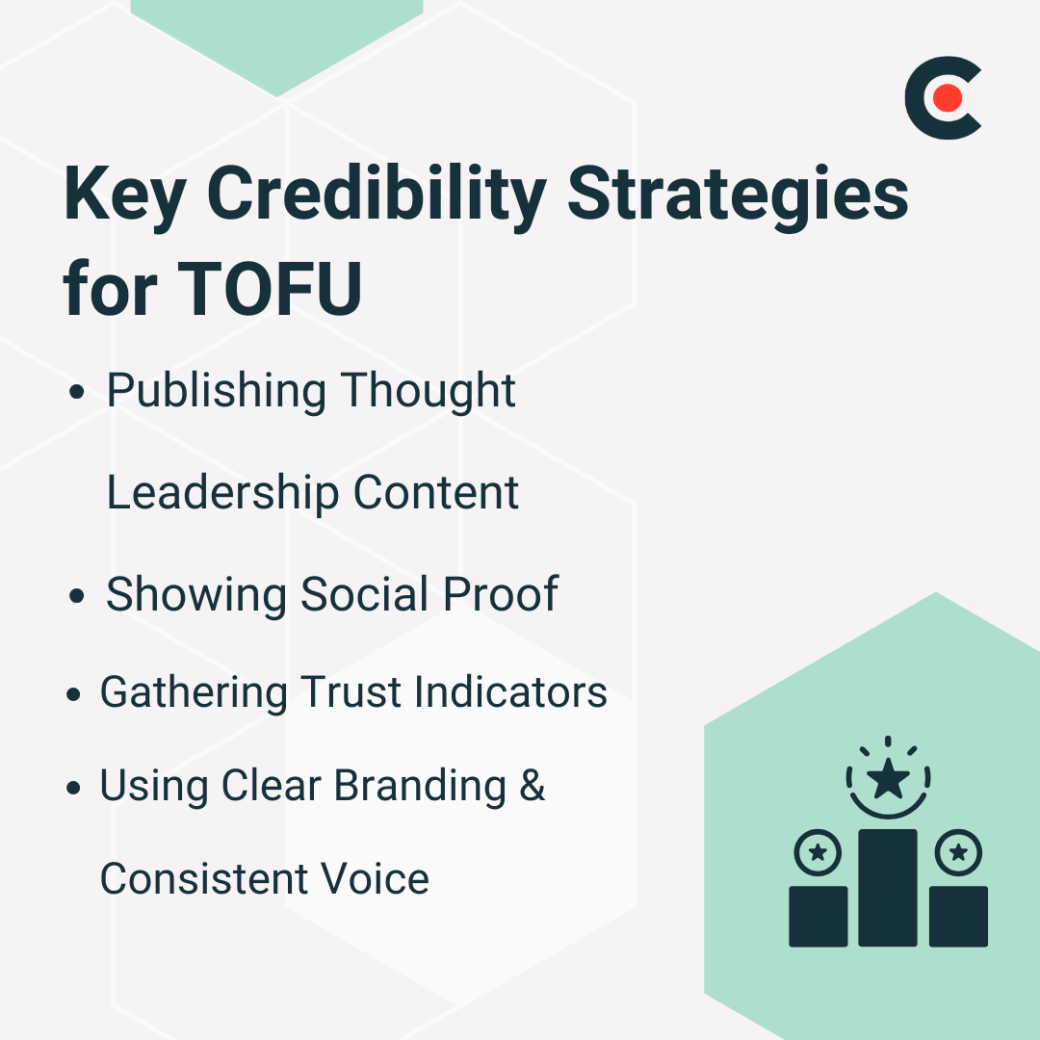
The following strategies are helpful in the awareness stage.
We discuss them in detail below.
Credibility at the TOFU usually starts with intellectual authority. Original thought leadership content, such as blogs, whitepapers, and podcasts, shows your contribution to your industry.
Don't just post content for the sake of it, though. Instead, introduce fresh insights or reframe existing narratives.
For example, a business-to-business (B2B) IT service provider might publish a blog series titled "The Hidden Costs of API Sprawl," which includes firsthand learnings from client case studies. Similarly, a VP of Marketing Services can launch a podcast featuring CMOs discussing real-world pitfalls of scaling multi-channel campaigns.
These pieces educate your prospects and position your brand as an authority that speaks with clarity and nuance.
Buyers may not trust marketers, but they do trust each other. The more likes, comments, and shares your posts receive, the higher the social proof for your brand.
A steady cadence of content that earns shares on LinkedIn, sparks conversation in industry Slack channels, or is cited by peers in newsletters tells the prospect that your brand matters in the industry.
However, credibility isn't merely about racking up likes. The quality of engagement matters more than the quantity. For example, VPs commenting on your posts or users tagging colleagues is much better than a post that receives generic "Great post!" comments. It indicates your content is effectively reaching the target audience and generating meaningful discussions.
External validation is a shortcut to trust, especially if it comes from a source well-known and trusted by the industry. When a third-party publication features your team or references your research, it serves as an impartial nod to your authority.
For example, media mentions in respected industry outlets bridge the initial trust gap. Similarly, bylines on high-traffic platforms and well-placed guest spots on respected podcasts can achieve the same goal.
Let's say you're a B2B automation platform. A brief quote from a CTO in a Wired article about the role of artificial intelligence in IT operations can carry significant weight in the early stages. You can then share this content in your content hubs (for first-time visitors) or retargeting campaigns.
Since TOFU content is your brand's first impression, it must be clear and cohesive. You should use the same voice, visuals, and values throughout the funnel, as consistency fosters credibility.
Every blog post, landing page, podcast episode, or social media clip should reinforce the same tone and positioning. For example, if your brand promises clarity in complex systems, your thought leadership should reflect that same clarity. If you're building tools for collaboration, your voice should feel inclusive and strategic.

Once a potential buyer moves into the middle of your funnel, the stakes change. Now, they're evaluating and are aware of their problem. They're exploring who can best solve it.
At this stage, credibility transforms from messaging into proof. You'll need to show your prospects that you're the best fit through transparent storytelling, hands-on engagement, and strategic content.
In MOFU, credibility deepens when prospects feel they've been given genuine insight and tangible results. Your content should not be pushy but rather genuinely helpful, and these strategies make that happen.
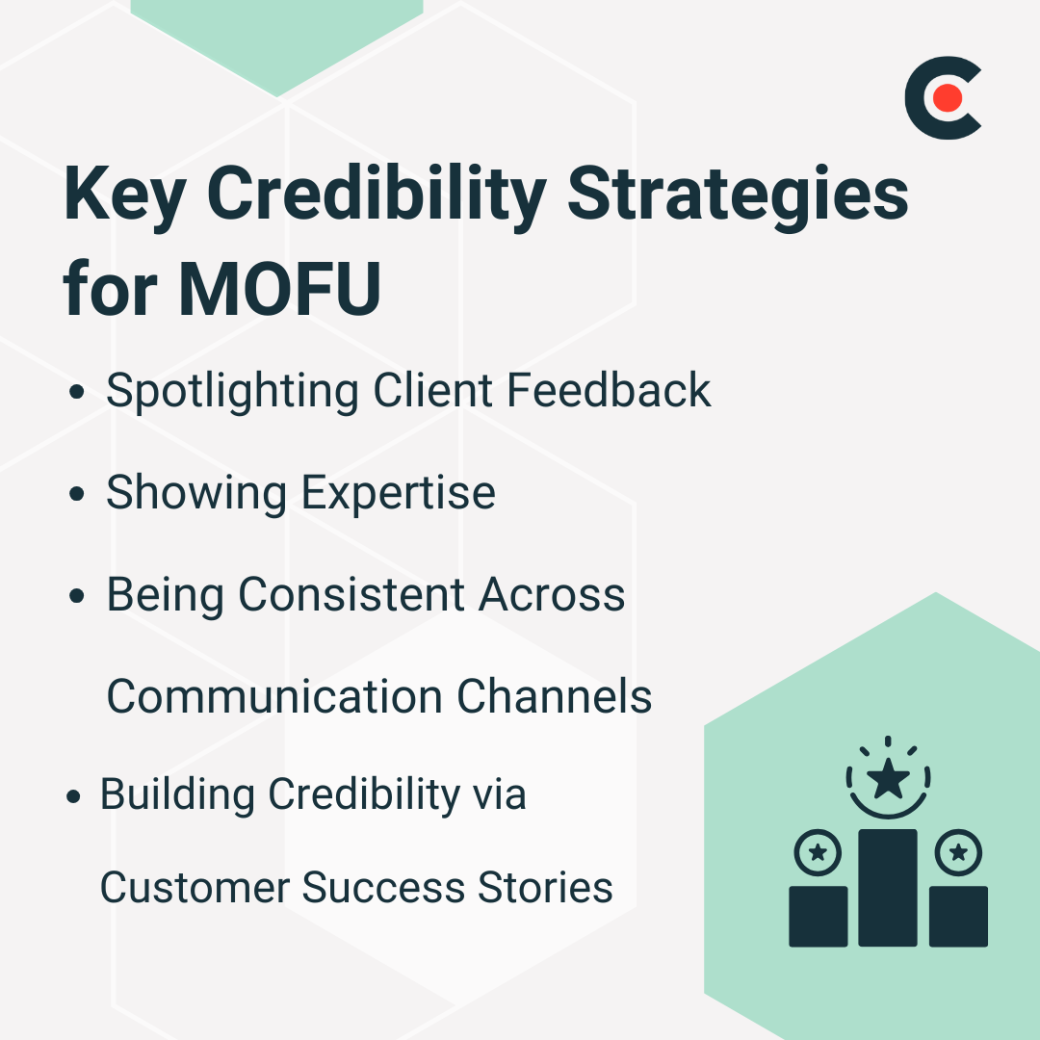
Let’s look at them individually.
Nothing earns trust like evidence.
At the MOFU stage, buyers want to know who else has solved this problem using your solution. Case studies that walk through challenges, decision points, implementation steps, and quantifiable outcomes help showcase your value.
However, a surface-level quote praising your offering doesn't really build credibility. Instead, your case studies should have steps and numbers to support the review.
Viral Nation, a digital marketing agency, excels in this area through their case studies. The agency not only shows results and walks readers through the entire process but also shares the content it has created.
In addition to case studies, user reviews on platforms like Clutch also reinforce trust. You can display any collected testimonials on your website to help boost your credibility.
Content that educates while showing your product or service in action builds confidence and satisfies prospect curiosity. Webinars that focus on use cases or live Q&As give your audience a sense of what it's like to work with your team.
Similarly, demos (live or on-demand) should focus on the why as much as the how. Buyers at this stage often compare similar offerings. What differentiates yours is not just the feature set, but how clearly you communicate the thinking behind your product decisions.
The same applies to product explainers. For example, a VP evaluating two marketing automation tools may favor the one whose explainer video includes commentary from a product manager explaining why the reporting dashboard is designed for cross-functional teams, rather than just marketers.
Prospect trust can erode when your story shifts depending on the medium in which it is presented. MOFU buyers are quick to notice red flags. Therefore, your messaging should be consistent across all channels, including blog posts, sales decks, customer calls, and so on.
Your voice should also be consistent, regardless of the communication channel, whether it's social media or nurture emails. A unified voice will also build reliability and brand recall.
When leveraging credibility, you must consider not only the logical aspects but also the emotional ones. Success stories that blend emotional transformation with measurable business results create a remarkable narrative.
Buyers want to see someone like them who faced uncertainty, took a leap, and came out ahead. They also want numbers, like growth rates and reduced costs.
For example, if you're a managed service provider, you can create a story about a mid-market tech firm struggling to scale. The narrative can follow an overwhelmed CTO who needs a reliable partner to free up internal bandwidth.
Your service was just that. Couple the story with statistics, such as a 30% drop in operational costs, and you have an emotional journey combined with a logical outcome that builds credibility.
At the BOFU, the prospect is on the edge of commitment. However, they're also cautious not to make the wrong choice.
Their goal is to make a decision that leads to a useful purchase. They are skeptical and risk-averse because they don't want to invest time and money in something that won't deliver results. Your job is to address these concerns and build trust to drive the conversion.
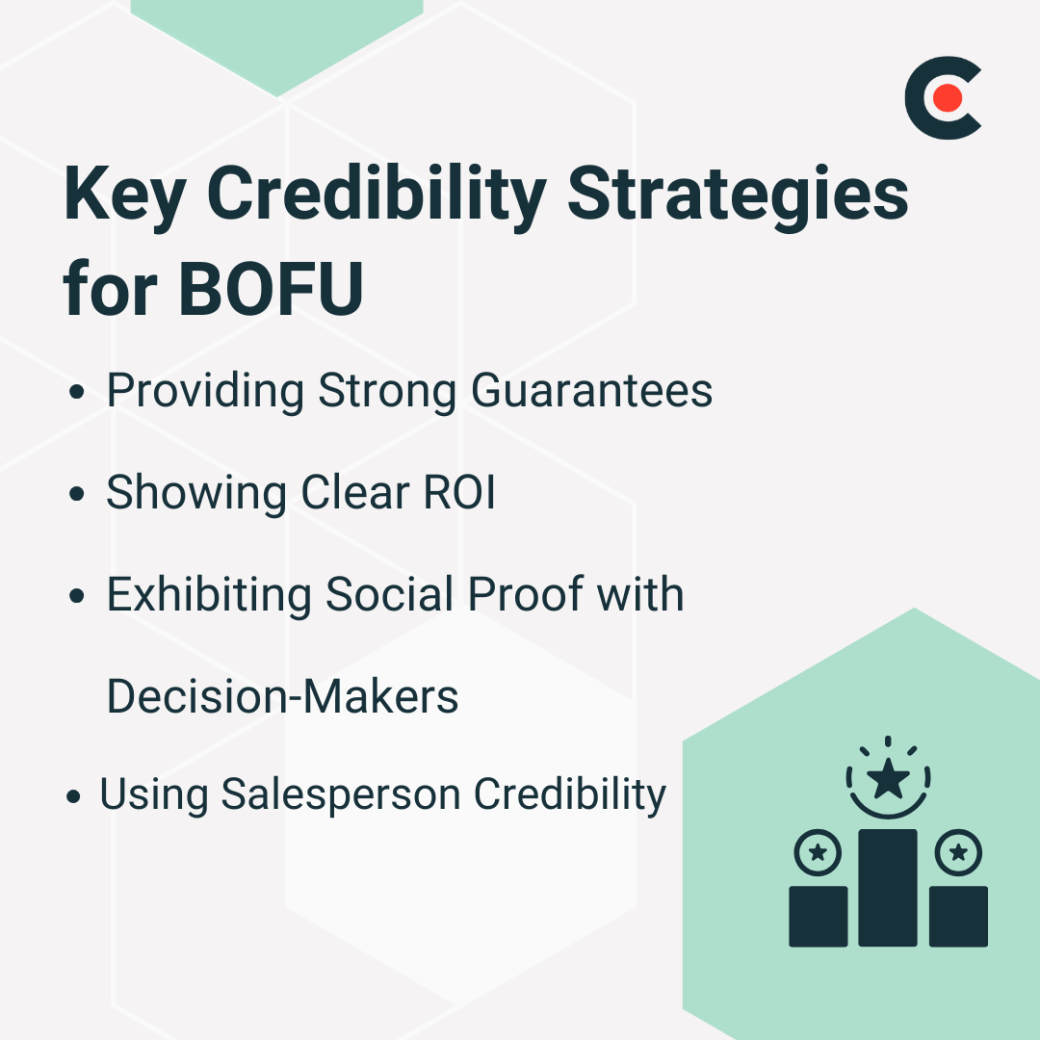
The following strategies will help take prospects to the end of the credibility marketing funnel.
Here’s how to implement these strategies.
At BOFU, even the smallest red flag can derail a deal, so you should offer confident guarantees that you stand behind your product and aren't afraid of accountability. For example, you may offer a 30-day performance-based trial, transparent service-level agreements (SLAs), a money-back guarantee, no-surprise pricing, and contracts that allow for cancellation at any time.
Quantified results are more effective than vague claims, as they show prospects what they can realistically expect to achieve by using your offering. A side-by-side comparison showing operational costs before and after implementation, or a three-month ROI snapshot from a similar client, makes the value real.
Suppose you're a logistics company. You can present a slide show that reveals how you improved delivery time for a client by 20% within just one quarter. That 20% puts an ROI figure inside the prospect's mind, which can prompt them to take action.
At BOFU, your audience wants to know who else has said yes to your product and whether those people matter. To give buyers the final nudge, you can feature the logos of respected clients, quotes from CIOs or VPs, or expert endorsements.
For example, if your company is Clutch Verified, it indicates that you have a proven track record of satisfying clients in the industry. The verification is a cumulative seal of approval from all the clients you've been endorsed by.
A big part of leveraging credibility involves using your sales staff. A salesperson who follows up with insight (not pressure), remembers details from previous conversations, and connects over mutual understanding makes a lasting impression. Their credibility then becomes your brand's credibility.
Direct interaction in the form of demos, final calls, or custom proposals builds a human connection. The human-to-human trust further seals the deal.
Credibility is a dynamic trait that evolves throughout the buyer journey. At the top, you capture attention with authenticity, followed by building trust through value in the middle, and reinforcing confidence at the bottom.
Companies that intentionally build credibility into their marketing funnel outperform those who merely depend on legacy, luck, or loud marketing. Since skepticism is high in the current market, trust can be the differentiator that sets you apart from the competition. Leveraging credibility as an asset can help you lead buyers with confidence through the marketing funnel.